

That’s Not How Transitioning Works…Let Me Explain!

“Transgendering” is not a Thing
I shouldn’t have to write this essay. Nor do I feel that I’m the most qualified to do so. However, after a number of conversations I’ve had online and in real life, I feel someone has to write this essay and it might as well be me.
I’m referring, of course, to the titular verb, the notion that otherwise normal children are being “transgendered” by some nefarious person or group. Not surprisingly, your friendly neighborhood public school is front and center in this perceived conspiracy. We see this in the discourse being spread with regard to transgender and gender queer people. Their very existence is denied by the right.1 They are passed off as boys pretending to be girls and vice versa. The issue is presented as if someone, often a teacher, somehow convinced a perfectly normal boy or girl that they are not boys and girls consistent with their anatomy.
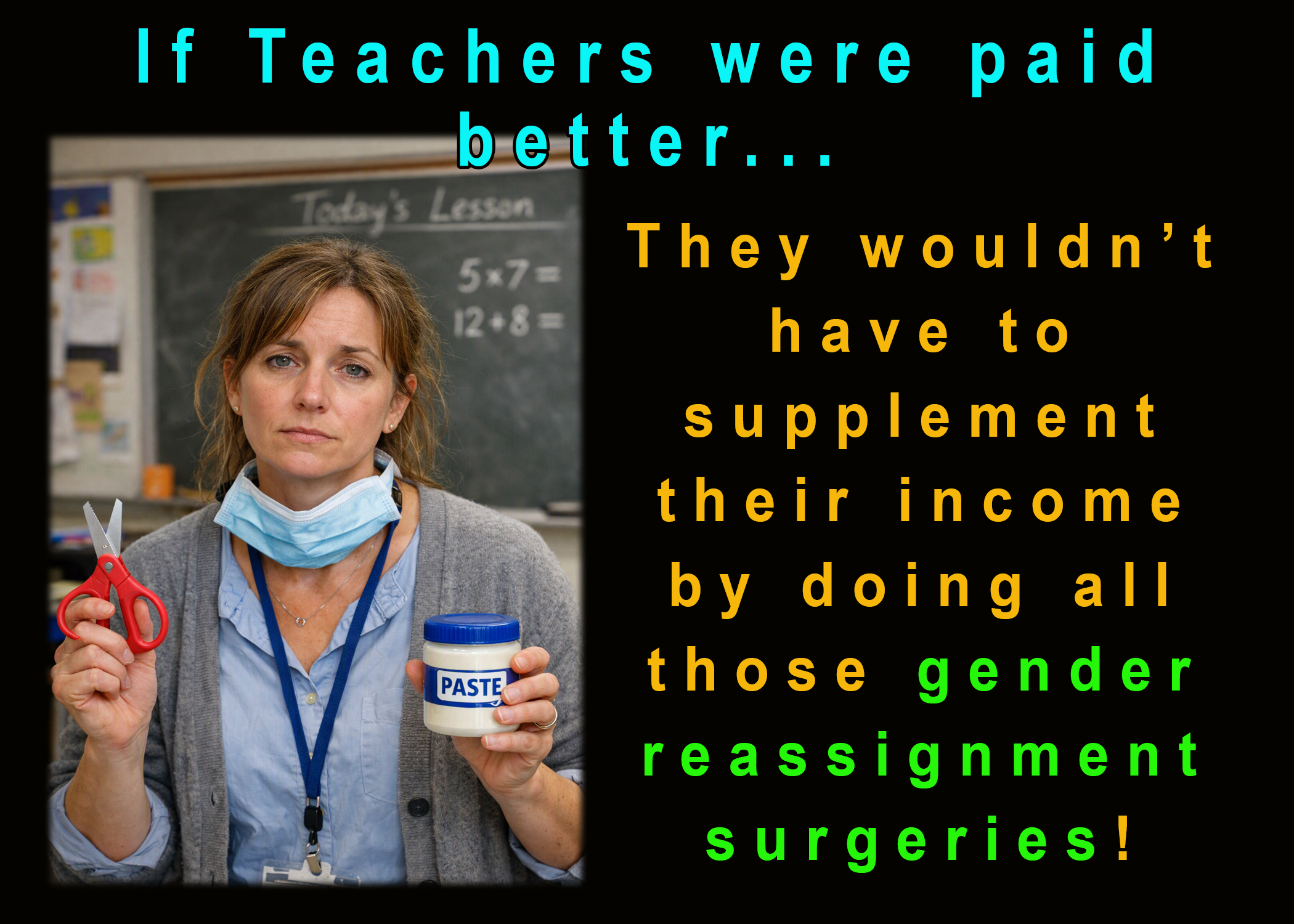
Somehow, the teacher, who has a hard enough time getting her students to put their names on their papers, is able to convince Billy to change his gender.
The term “transgendered” is a malign addition to the discourse around LGBTQ+ rights and the rights of transgender people overall. The word itself strips trans people of any agency on their part. Being transgender is not who someone is. It’s not an integral part of their identity. No. Transgendering is something that happens to a child under the influence of nefarious forces, referred to as “groomers.”
So, those good, God fearing, conservative families raising their children right are not complicit when their children turn out to be “one of those.” Rather, their child was the victim of some kind of left-wing, WOKE intervention that convinced them to change their genders. Like the proverbial “butler,” teachers are the number one suspect in this conspiracy to turn our girls into boys and…even worse…our rugged young boys into feminists girls.
Why are they doing this? Well…um…Marxism? Islam? Um…they’re just bad people!
The process of “transgendering” someone works something like this, if you listen to the right-wing:
A WOKE teacher approaches a normatively masculine Billy: Hey, Billy. You know, I don’t think this whole ‘being a boy’ thing is for you. Have you ever considered just being a girl?
Billy: You know, I never really thought of it before, but now that you mention it, that whole Drag Queen Reading Hour makes sense. Maybe I should be a girl.
WOKE teacher: No need to wait. Just step into the teacher’s lounge and we’ll get you started, [snip snip: WOKE teacher picks up a pair of safety scissors].
It should go without saying that the scenario above is absurd. It should go without saying that any scenario that remotely resembles that described above is absurd.
Unfortunately, in today’s discourse, it doesn’t go without saying.2
So, I’m saying it.
This is not the way “transgender” works. This begs the question, how exactly does one become transgender? To dispel the popular myth of how unsuspecting children are being transgendered, I thought it would be valuable to describe the process by which young people, experiencing what is often called Gender Dysphoria3, and go about the real process of transitioning.
Here I must note that I am not transgender myself. My interest in this topic centers around my experiences with transgender high school students when I was my school’s sponsor for the Gay/Straight Alliance—Pride Club for many years. I’ve written on this here. That being said, I think I can offer some insight, but I cannot give the kind of emotional depth that one can get by talking to an actual transgender person or talking to experts in the field of gender affirming care. I would like to recommend a great podcast in which Chris Hayes interviews Dr. Izzy Lowell. This is the most eye-opening exposition that I’ve seen available in the media. You can also visit Dr. Lowell’s foundation QueerMed at their website. If you are experiencing gender confusion, I recommend talking to someone who can help you get access to the resources to help you figure out the best direction for you. If you are a minor, and it is at all safe for you, please talk to your parents and involve them in the process.
Initial Awareness
If transitioning, the process by which a person identifies, presents, lives and comes to be recognized by significant others as a gender different from that assigned at birth,4 the real process is rather long, intense, and comprehensive. Nobody just goes to a doctor and says, “make me a girl!” and THWACK…girlhood! That does not happen. And there is no school in the world that will take Billy to a clinic and…well…THWACK!5
For the purposes of this essay, I’m writing from the perspective of a middle school youth coming out as experiencing Gender Dysphoria. It should be noted that, “Most patients (TM [Trans Men]: 78%; TW [Trans Women]: 73%) reported experiencing GD [Gender Dysphoria] for the first time between ages 3 and 7 years. For TM the mean age of onset was 6.17 years; for TW it was 6.71 years. A total of 81% of TW and 80% of TM described their first recollection of GD as one of their earliest memories.” (Link)
Starting with middle school is reasonable because it is at this time trans youth start feeling intense distress that defines Gender Dysphoria. This is often associated with the physical changes of puberty.
According to research, the span of time before individuals realize they are transgender and the point where they start to make a transition into their chosen gender is between fourteen and twenty years. By writing from a middle school perspective, I’m making the assumption that this young person has an accepting family. As Dr. Lowell points out, “for a lot of these children, not all of them, but many children, parents bring them in and say, oh, we’ve known that she’s a girl since she was four. The child knows that. The parents know that. Many of the cases are absolutely straightforward. Everybody knows that this person is a girl. She just needs some medical assistance to become a woman.” The hypothetical student in this description is one who has the support of their parents and is being guided by professionals through the process.
It’s important to recognize that for millions of trans youths, this scenario is not the reality. A large study conducted in Wisconsin shows that trans youth are almost three times more likely to consider suicide, make a suicide plan, and more than three times more likely to attempt suicide. This conforms to similar research.


Data on the risks for trans youth as well as the impact of family support in mitigating risks. Click images for sources.
However, support from families as well as schools is associated with significantly better health outcomes for trans youth. I have been a witness to this myself, having been a GSA sponsor in a relatively supporting school. The positive transformation in our trans youth who are supported, who have their gender self-concept validated is almost miraculous. In many cases, though admittedly not all (in fact, not enough) a withdrawn depressed boy or girl, with positive support, emerges as a confident and sociable girl, boy or neither. This fact, supported anecdotally and through quantitative study, flies in the face of the myopic, bigoted, right-wing legislation that makes offering such support to trans youth illegal.
In this best-case scenario, my hypothetical student is Billy. Since he was very young and encouraged to play with boys his age, Billy knew that his understanding of himself did not match that of the other boys. He much preferred the company of girls. He was enamored with girl affectations and presentation.
His parents tried to push him into the gender roles that they understood to be normal, but to no avail. His parents eventually realized the kind of distress Billy experienced when they pushed these gendered standards, so they backed off. They may have thought his behaviors were just a phase, or curiosity—he would grow out of it, but he never did. They did not want Billy to be transgender, but over time they girded themselves to the reality that their “son” was different and, very likely…
His parents and to a certain extent his teachers adapted to Billy’s “quirks.” Billy found peers who were more or less accepting of his differences. Regardless, there was always this sense that things did not quite line up for Billy when it came to gender. These feelings of not fitting in, of disembodiment, increased as Billy entered middle school and his body began its transformation by developing the standard secondary sexual characteristics of boyhood. Billy was repulsed by this. He did everything he could to cover up, to feminize his appearance.
He may have even found books in the school or local library telling stories of young people experiencing the same kind of distress weighing him down. Could this be? Is this me? Most everything in Billy’s social world was telling him that he was a boy and boys are like this. But Billy didn’t see himself as a boy and he wasn’t like that. He understood what it meant. Understood the expectations. But he was pretending. As his body continued to change into something that repulsed him and his interests were shifting in directions that he was not supposed to go, Billy started to realize that he really couldn’t pretend anymore.6
To a cis-gendered reader, these feelings seem strange. They’re not. These feelings are perfectly normal and experienced by everyone along the gender spectrum. If you are a cis-gendered reader, as I am a writer, try to take an honest accounting of your own experiences as you grew into and adapted to the gender expectations placed on you. I was happy to be growing into a man. I liked girls… sometimes to inconsolable distraction. But what kind of man? There are many degrees of masculine separation between John Wayne and Mr. Rogers. Who is more masculine? Or is that the right question. Perhaps John Wayne and Mr. Rogers are differently masculine. In many ways, Mr. Rogers is much more aspirational.
Of course, I didn’t want to be Mr. Rogers. But did I really want to be John Wayne? Captain Kirk was more poetic and bookish. I grew up in an Italian family, so there was an expectation. Some of which I was able to fulfill, some just didn’t “fit” right. I was better than average at hitting the outside slider, but I would much rather be drawing pictures. I loved to watch a good fight but was not inclined to actually be in one. I loved riding my bike through the trails and exploring the woods but could also spend hours perusing my encyclopedias. I wasn’t at all gregarious, but I could fake being outgoing for a little while.
What kind of man was I? What kind of man did I want to become? And just like everyone else, I had lots of examples to follow, but no singular answer that “fit” for me. Just like any other boy my age, I tried to be many variations between Captain Kirk and Fred Rogers.
I call this Trying on Gender. We all go through it. In sociological terms we adopt and experiment with certain roles and affectations as if dressing ourselves for a performance. We present this performance through social interaction and evaluate the performance through the Looking Glass Self. We gage how this expression of gender fits, but also how others respond. This is an awkward, often embarrassing process. Over time, however, we find “what fits.” In other words, we settle upon a identities that we are comfortable with and that others in our social world are willing to embrace.
The only difference for Billy is that the spectrum from which he is best suited to draw does not correspond with his sex ascribed at birth. Masculine roles and affectations do not tend to fit. In his case he is drawn to the feminine. Others may be drawn to gender neutral roles and affectations. Others embrace some combination. There are more variations than we assume. In Billy’s case, he understands himself best as a girl. But what kind of girl? What kind of woman is Billy? What kind of woman does Billy want to become? The question is essentially the same for Billy as it is for everyone developing a gender identity…just on a different axis.
Transitioning
For many months, Billy moved into peer groups that are accepting of his “quirks” and confusion. Many of them are going through the same thing. They express greater openness to gender differences, to being the outsider. He watched as many of his friends struggle against the confines of the gender binary. Eventually, the pain of pretending exceeds his fear of the truth, and he confides in someone whom he identifies as his best friend in the peer group. He confesses that he always considered himself Belle rather than Billy and wished to be referred to as a girl.7
The sense of relief Belle feels when she’s accepted and even embraced is like the peeling away of many years-worth of false skin. Her friend likely already knew or was likely not surprised by this revelation. It doesn’t take long for her peer group to accept her.
Of course, it’s not all rosy for Belle. Not everyone will be accepting of Belle as a girl. By coming out, Belle has increased the likelihood of being bullied and harassed in school. Boys’ restrooms and locker-rooms are a prime ecosystem for physical and even sexual assault for a transgender girl like Belle. Restroom and locker-room restrictions in her school more than double the likelihood that she will be sexually assaulted. For Belle, with the support of her peers, coming out was well worth the increased stigma from other students.
At this point, Belle is presenting as feminine and identifying among her peers as female. She may be experimenting with make-up but is likely not wearing dresses or clearly identifiable girl’s clothes. Though the students know Belle is a girl, it is likely her teachers are still referring to her as Billy. Belle identifies a teacher with whom she is especially comfortable. This teacher, Mr. Smith, is open to LGBTQ+ identities and makes this known with a “Safe Space” Sticker on his window.8

Belle asks to speak with Mr. Smith on his planning. It’s tough giving up planning time, but Mr. Smith will never turn a student away. It’s at that point that Belle opens up for the first time to an adult. True to his promise of being a “Safe Person,” Mr. Smith validates Belle, and yet another painful layer of false skin falls to the floor. Mr. Smith asks Belle if she’s talked to her parents yet, then advocates that she do so when he finds that she has not. Mr. Smith also recommends that Belle talk to her counselor and even the school psychologist. As Mr. Smith points out, he’s happy to refer to Belle however she likes, but the school counselor and the psychologist can help her get access to more help and more support.
There may even be a group like GSA, that can offer support and community during this uncertain time. With the help of her school’s GSA, the advice of her counselor, and the validation she received from Mr. Smith, Belle decides it’s time to come out to her parents. When her parents tell her that they have been waiting for her to open up, that they love her no matter what, and that they are there to guide and help support her decisions she cannot stop crying. That last calloused layer of false skin evaporates into dust. Nothing else matters but this.9
If one listens to the right-wing pablum (which I advocate against) it is at this point that the WOKE, leftist, feminist parents drive Belle to the nearest gender clinic to have Billy’s penis lopped off. To be clear on this, there is no place in the country that will perform genital transitional surgery on minors as part of normal gender affirming care. As for other forms of transitional surgery, like top surgery, they are rare and always done with parental approval for any non-emancipated minor. Belle is not going to be able to take a bus to the local transition clinic and get a voluntary dose of estrogen without her parents’ and clinician’s approval.
At this point, Belle and her parents are being guided through the transition process by professional counselors and/or psychologists specializing in gender transition. Belle is going to counseling regularly to discuss the process of her transition. The counselors will start her on her social transition, which she has already begun. They will talk her through her trials and tribulations and the anxieties that may be heightened for trans youth. Parents and advocates may work with the school and other social institutions with which Belle interacts to ensure her safety and acceptance.10
With Belle’s input as well as that of her parents in consultation with medical professionals, Belle may start using puberty blockers to make the social transition easier. It’s difficult to be a girl when one’s voice has dropped, or facial hair is growing, or shoulders becoming broad. Puberty blockers are minimally intrusive, but not unintrusive. There is debate about the side effects and the prospects of some permanent physiological impacts with regard to bone density, growth, maybe even fertility. On the other hand, there are also side effects to aspirin. This is why professional clinicians and counselors are involved in the decision-making process, so Belle and her parents can make decisions that are best for her…as is the case with all medical interventions.11
More extensive measures like hormone therapy do not typically happen until later in adolescence. At this point, Belle has been through years of professional counseling. She is likely established in all of her social groups as a young woman named Belle. In fact, if Belle were standing in front of you in the grocery story you likely would never know that she was born a male and had male parts. You would think, ‘what a delightful young woman.’12 She’s not a man pretending to be a woman. She certainly isn’t going through all of this just so she can get into the girl’s locker room, or to arrange some advantage on the volleyball team. She is, in every way that is socially meaningful, a young woman.
As it stands, it is socially unacceptable to go around grabbing people between the legs to determine if they are “really” the gender they claim to be (our current president notwithstanding). Therefore, under normal social terms, one’s gonads are irrelevant to the interaction. Belle looks like a young woman, acts like a young woman, presents as a young woman. She’s a young woman.
In almost all cases, gender affirming genital surgery is performed only after Belle turns eighteen. Again, this process involves counseling, consultation, and clinical intervention. Before Belle can get this surgery, she must satisfy the following criteria from the World Professional Association for Transgender Health:
- She meets the criteria for “gender incongruence”
- This gender incongruence has been sustained
- She has the capacity to give consent
- She understands the effects of surgery and all of her options
- Other causes for gender incongruence have been ruled out
- She undergoes a mental health assessment
- She has been stable on her hormone regimen
Depending on the outcome of this consultation and counseling, Belle may choose a procedure called Vaginoplasty13 to complete the process of her transition into the woman she wants to be. There are other procedures depending on Belle’s needs. In a reasonable world, Belle will make this choice in consultation with professionals and the significant others in her life. Research indicates that Belle will be satisfied with her surgery, and completing the transition according to her needs and wants will improve her quality of life. That’s not to say all of her problems will be solved and all of her identity issues will fade away. Then again, that’s true for all of us.14
The Takeaway
I wrote this essay in response to those with a simplistic model by which young people are being “transgendered” by others. Of course, that’s the nature of authoritarian discourse that seeks to limit the breadth of human agency. They deny the very existence of this agency, then make the choice for us.
In this essay, it is my hope that I elaborate the agency Belle and all transgender people exercise in their transition from their birth gender to the gender affirmed by their self-perception. Someone transitioning into a different gender is not just chasing a fad. They are not the victims of the WOKE mind virus. They are human beings who have been empowered by cultural and technological evolution to live the full and fulfilling lives to which every human being, upon birth, is entitled.
Yet, in the United States, the pervading ignorance associated with those who are different denies human agency and forbids self-fulfillment by those perceived as different, deviant, “those people,” undeserving.
My transgender students, those who trusted me with validating their most intimate selves, deserve the same full life that I have enjoy. They deserve to express themselves as they see fit. They deserve to love and be loved as the people they are. They should not be forced into the calcifying false skin that the most closed minded of us will impose on anyone who disturbs their medieval understanding of the world. By all that is right, I will speak out for anyone so concealed.
Footnotes
- I would be remiss in failing to point out that many liberals, like the well coifed Gavin Newsom, are perfectly happy with not contesting this framing and throwing trans and gender queer people under the school bus. ↩︎
- You can see an example of this absurdity here. https://youtube.com/shorts/W7Ijsp_rKgA?si=5lJTZuLxeotuaQU8 ↩︎
- I’m not a fan of this term. It infers some kind of pathology. It is my position that gender is a normal component of identity that is more complex than the binary historical and cultural boundaries we have been socialized to accept. A transgender person is no more or less pathological than a cis-gendered human being. An intersex person is no more or less pathological than a male or a female. Unfortunately, it’s the term we have, so I will continue to use it until I can find something better. ↩︎
- “Recognized” is the tricky term in this definition for obvious reasons. There are those who will never recognize a transgender person as their selected gender. That’s why I offer the “significant other” caveat. A transgender person will seek to associate with those who recognize their chosen identities as valid and avoid those who do not. Unfortunately, for many transgender people, those who were once significant others, especially family members and important peers, may lose that status by refusing to accept the transition. This is a heartbreaking reality for trans youth. ↩︎
- And yet, I still have to say it. ↩︎
- I’m hoping to reproduce a narrative flow that I have no personal experience with. Again, I suggest talking to someone who has actually had these feelings before accepting my description. ↩︎
- This was likely a process and not a spontaneous confession. ↩︎
- Throughout this essay I want you to understand the trend that I am inferring but not explicitly exploring (at least in this essay). Notably, the legislative policies that have been put into effect in so-called “Free States” like Florida are all designed around the same end-goal. Namely, right-wing anti-LGBTQ+ policy is designed to increase the pain and suffering associated with coming out as it relates to repressing one’s gender identity. The trans youth make a risk calculation when it comes to being open about their identities. The goal is to make life riskier for trans youth in the interest of silencing them and rendering them invisible. This has the circular effect of increasing the risk further as trans youth feel more isolated if other trans youth around them are coerced into silence. ↩︎
- It must be noted that in the best-case scenario the parents are at least somewhat prepared for this news and are willing to validate Belle’s identity. That is one extreme of the acceptance spectrum. The other extreme is, of course, rejection. LGBTQ+ youth are 120% more likely to experience homelessness, and as much as 40% of homeless youth are LGBTQ+. Parents may respond anywhere along this spectrum. In many cases they may try to change the child’s mind, forbid them to hang out with their peers, blame outside forces for “grooming” their child. Parents will also move along the spectrum. In many ways this is akin to grieving. A parent has an understanding and plans for Billy’s future…but Billy is gone and here’s Belle staring at them. Support for parents of trans youth is also valuable. Click Here, Here, Here. ↩︎
- Again, right-wing policies make this part of the process much more difficult…if not flat out illegal. ↩︎
- Except, of course, abortion in right-wing states. ↩︎
- Okay, time for some nuance. Whether or not one is delightful has absolutely nothing to do with their gender identity. In this case, Belle is a delightful young woman because that is the most sympathetic. Trans people, however, are no more or less likely to be delightful than any other gender. Some people are delightful. Some are assholes. That’s just the way of it. ↩︎
- For transgender males there is Phalloplasty among other procedures. ↩︎
- There is also a small chance she may regret her surgery. But that’s life. Sometimes we regret the big decisions we make. ↩︎


Leave a Reply