

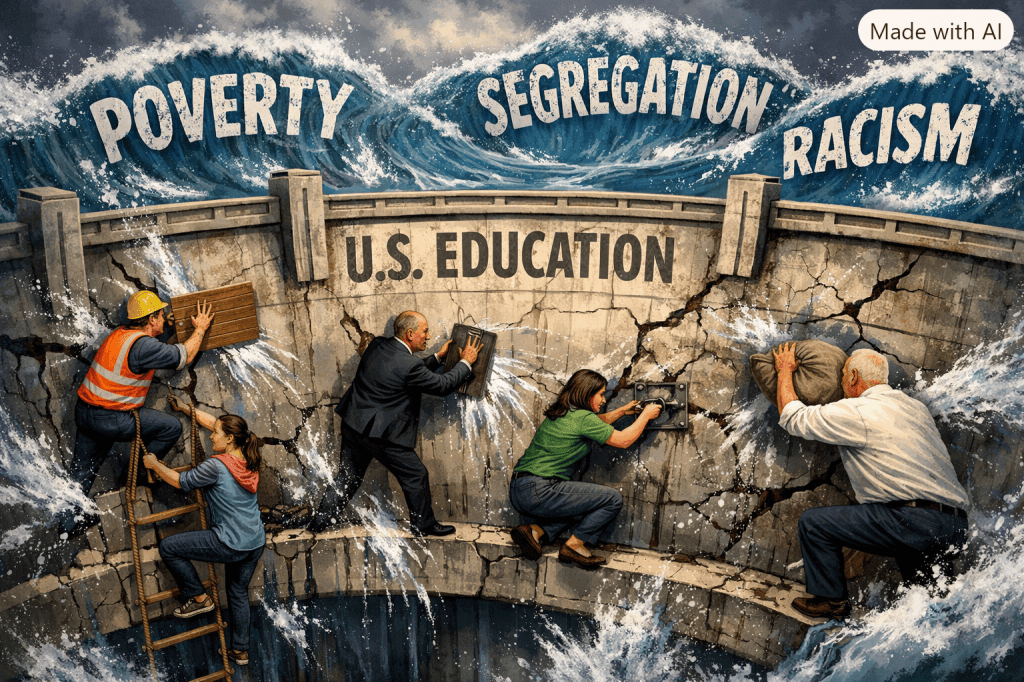
Until we are willing to put a period before the word “but,” American education is stuck
Introduction: Hannah’s Confession and Bob’s Response
It is impossible for anyone with any level of reason and empathy to be unmoved by Nikole Hannah-Jones’ recent essay in the New York Times. In her confessional Hannah-Jones recounts her regrets in giving too much weight to her personal values when choosing schools for her daughter, Najya, and not enough to her daughter’s direct educational needs. Her essay was an especial challenge to the purist values of the left that prioritizes “being the change [we] want to see in the world,” over the real implications resulting from not living in such a world.
I read quite a few very well thought out responses to her essay. I had nothing to add to the conversation myself that wasn’t already elaborated by others quite eloquently. Their responses were mostly lamentations on the burden of a leftist mindset. We have an ideal world in our minds to which we dedicate ourselves to building in reality. Yet, doing so is a generational struggle. It is unlikely that any of us will live to see the world toward which we strive, a high tech, naturally sustainable world in which everyone’s needs are met, and nobody is exploited. That’s the struggle of the ages.
In the meantime, we must make life decisions in this world—a world carved and mutilated by neoliberalism, falling into right-wing, authoritarianism motivated by racial and ethnic purity and reactionary religious dogma. Life is a constant balancing act between living our values on the one hand and navigating the heartless requirements of the real world. There is no functional formula for doing so. Unfortunately for the Hannah-Joneses and all other progressive families, there is no avenue by which to avoid regret, one way or the other.
The best we can do as progressive writers and artists, is exactly what Nikole Hannah-Jones did. She made her struggles public and challenged us to take up the debate because she offered no answers. There are none. Or rather, there are an infinite number of answers all influenced by an infinite number of impactful variables. That’s what makes this leftist life so damn hard.
It’s much easier to be on the right, where folks like Robert Pondiscio of the American Enterprise Institute have the answers and are willing to share them with all. He interpreted Hannah-Jones’ essay as an opportunity to redirect the neoliberal reform movement of which he is a part. His diagnosis is simple. Najya Hannah-Jones was the victim of incompetent teachers, under incompetent administrators in incompetent public schools. “The report cards and grades she received that concealed her elementary-level deficiencies were not caused by insufficient funding. These failures—all of them—were evidence of incompetence.” Pondiscio’s argument is the standard neoliberal education reform thesis. Yes, poverty, racism, and segregation are important, but… Then fill in the standard insults reserved for teachers in low performing schools and the unions1 that protect them.1
His prescription? This is summarized concisely at the end of his essay. “The next generation of reform should begin with two questions: Are we willing to hold schools responsible for whether children learn? And do the adults responsible for educating them know how?” In other words, let’s just keep doing the stuff that has failed for the last thirty years—just more of it. And let’s spend more time scapegoating teachers and administrators when this strategy continues to fail. What else can you do?
A Day With Poverty, Racism and Segregation in the Classroom
Robert Pondiscio, as a responsible analyst, points out, “Of course, poverty mattered. Segregation mattered. Racism mattered. Family circumstances mattered. But none of that was an excuse for giving a child a poor education.” He knows whereof he speaks. After all, he did spend some unspecified amount of time teaching fifth grade in a “struggling South Bronx public school.” The nature and context of this experience is not elaborated on his resume. All we know is that this experience began in 2002, after which he was at least on the New York DoE payroll until 2007. I’m sure he was an exceptional teacher. If that was the case, his experience was much like other exceptional teachers in schools struggling with poverty, segregation and racism. Namely, he didn’t last more than five years.
Look, nobody is using poverty, racism, and segregation as an “excuse” for low performance. We’re saying that the generational, systemic nature of these phenomena makes it all but impossible to teach and to learn effectively. They are variables that impact every element of educational experience from the cellular level to the larger society. They are negative inputs that cancel out most of the influence of any positive strategies that may be used.
The research on this is clear. You can study just about any variable influencing instruction, achievement and learning. The best you will get is mixed results. Class size. Science of Reading. Curriculum. Teacher pay. Inclusion. Retention. You name it. Much of the impact of these things on actual learning is weak. But not poverty. Research on poverty consistently shows a significant negative correlation between economic precarity and academic achievement.2
The real-life implications of what this research means, however, are often lost on lay people. After all, what does poverty have to do with how well a teacher teaches fractions? If I can learn fractions, anyone can learn fractions, and I learned fractions just fine. So, what’s the difference between my middle-class, well-funded classroom and the kinds of classrooms described by Nikole Hannah-Jones and other progressive education activists?
So, I figured I would dedicate this essay to trying to elaborate all the variables I can, based on established research, of just how nearly impossible poverty, segregation, and racism makes teaching and learning.
The Student
Take a picture of the student walking into that low income, segregated school.3 He or she has likely grown up in an impoverished community their whole life. Often, because of housing insecurity, this student has grown up in multiple such neighborhoods, and if you ask, is often not confident about where they will wake up tomorrow or the next day. His bed may have been a couch at his grandma’s house, or her mother’s best friend’s house because his family lost their rental. This child is likely sharing a room that is too small at best. That’s assuming the child has a roof over their head at all.
Even secure housing does not guarantee safe housing or a stable home life. Living in poverty increases the probability that this student will be exposed to negative neighborhood and community effects like crime, gang presence and threats, overt drug use, and anomic social conditions. He or she is of increased likelihood to be a victim of crime and domestic abuse. She may very well come home from school to find an empty house because her single parent is working multiple jobs. She may be working after school as well. When she gets home, she is likely to encounter interruptions to healthy sleep cycles, from lack of supervision, environmental discomforts like lack of heat or AC, noises outside or inside the home. This student is a walking internal conflict. She’s walking a tightrope between utter exhaustion, worry, and fear.
The impacts of poverty exist at the very cellular level. First, the child is more likely to have been exposed to neurologically toxic pollutants, like lead and heavy metal exposure. His physiological and psychological responses are more likely to be distorted through nutritional deficiencies, caused by not getting enough calories or getting too many empty calories from overprocessed, but inexpensive food. This child may be suffering from a myriad of untreated health problems, headaches, toothaches, bad digestion, muscle strains or much more serious issues. She is more likely to have an undiagnosed mental disorder. At the same time, his cortisol and other stress hormone levels are distorted. This student is primed for flight or flight, often without the neurological development necessary to mitigate such internal drives.
All these health impacts on the young are magnified in their parents and especially grandparents who may be primary care givers. Many students are leaving school only to become de facto care givers in their homes, caring for adults suffering from diabetes, chronic heart conditions, neurological, immunological, and psychological disorders. They are also more likely to be sharing space with someone suffering from untreated addiction.4
This student is not Najya Hannah-Jones. She likely did not grow up in a household in which her highly educated parents read to her every night. Poverty increases the likelihood that the household is without books or other physical reading material. Impoverished parents, even the most well-meaning, often lack the emotional resources to keep up with their children’s schoolwork. Furthermore, they also often lack the social capital by which to effectuate support even when they try. They do not have quite the social pull as a famous author and New York Times contributor. Lacking social or emotional capital, is often just the corollary to being mentally and physically exhausted.
Such a child walking into the classroom is doing so without the necessary physical, psychological, or socio-cultural tools for success. Every message this child has received before walking into the classroom has them convinced that nobody cares for them or for their future. Many have already had run-ins with police and corrections, either personally or through close family or peers. They have witnessed violence inside and outside the home. Their educational histories are marred by failure and marginalization. Poor people of color are more likely to be disciplined or defined as problematic or delinquent. Add School Resource Officers to the mix, and you have a perfect conveyor for a School to Prison Pipeline. The child is often not safe at home, not safe in their neighborhood and community, and the school is no exception. The child in a school filled with impoverished, segregated, and racially marginalized students are targets from all directions, from their peers, from the adults.
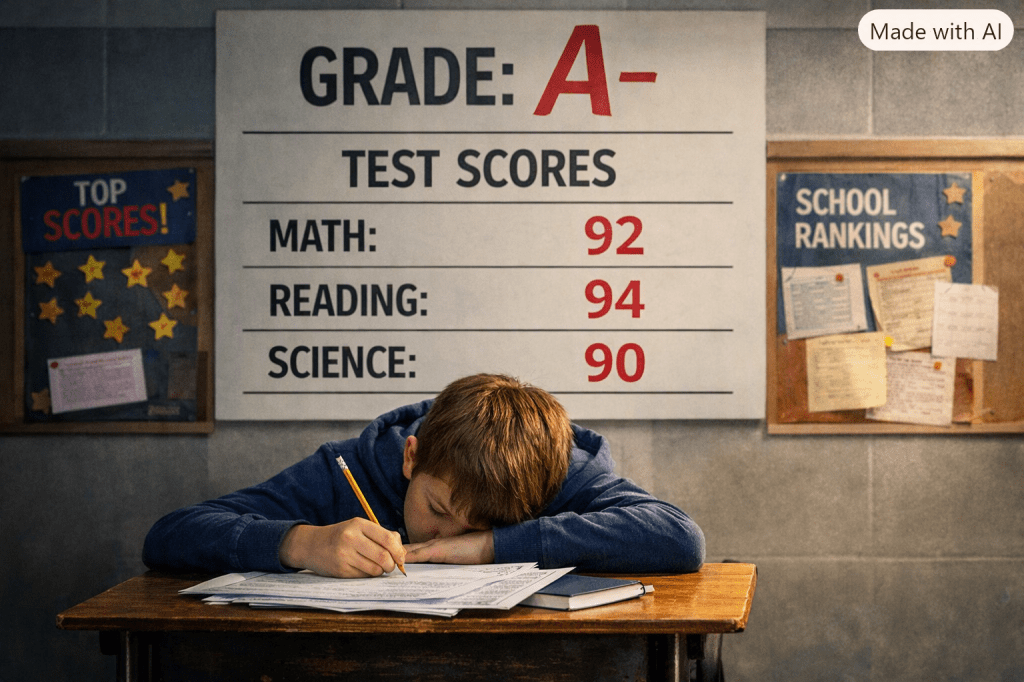
Children walking into the classroom are primed for fight or flight, and they are more likely to choose one of these adaptations over conformity to school and classroom norms and values. These responses can take many forms, all of which are detrimental to academic success. Flight includes a variety of behaviors. The easiest is to sit at his desk and put his head down, or to tune out in other ways. She may distract herself through more fulfilling interactions with friends, disrupting the class. Skipping school, or class is the most obvious form of flight. However, the student may act out, forcing the teacher to send them to the “time-out” room or even suspend them. The ultimate form of flight is dropping out. Substance use is yet another. Often, all of these strategies overlap.
Fighting is the alternative. This is especially true in social environments in which holding one’s ground, or a willingness to throw down is the only means for building social capital. I’ve worked with many young men with a history of physical conflict and fighting, who explained to me that not fighting was not an option. Backing down from a fight opened the door for everyone to take advantage of them. Overwhelmed school counselors and staff are not in a position to deal with this underlying system. So, students fight. They may, of course, fight with each other, but they are also going to fight with the adults, especially teachers. This fighting might be physical assault, throwing books and furniture, but is more likely to manifest in open disrespect, profanity, and willful disobedience, including ignoring the teacher’s directions and mandates.
Moreover, that student in flight mode can be easily nudged into fight mode by a well-intentioned but inexperienced teacher. That teacher who keeps redirecting a student whose head is chronically on his desk may be perceived by the student as ‘picking on me,’ or ‘disrespecting.’ The teacher is just asking the student to pay attention, but each redirection, to the student, seems targeted. All it takes is one bad moment. The student was humiliated at home or on the street, lacking sleep, not feeling well, and the teacher’s redirection pushes him to the breaking point. Then “fight” becomes the response.
The Teacher
This is the environment the teacher is walking into. Within minutes, the classroom is overfilled with more than thirty-five young people, most of whom are lacking the necessary social and emotional capital to succeed in any acceptable normative way. Furthermore, they are primed to resist the norms of the classroom through fleeing, or open disregard for the rules. Now, it’s unlikely that any one student is subject to all the variables above, but it is certain that most of them are motivated by at least some of the social impacts described. They are decidedly not motivated by grades, school discipline, or the intrinsic value of knowing how to factor a polynomial.
These students, with all their scar tissue, crammed into a room that is too small, given resources that are in various states of decrepitude. They are often sitting in classrooms in which the AC or heat is broken, there’s mold, old, worn-out furniture and outdated textbooks. Then here comes the teacher. If the teacher is “one of them” then there’s no reason to respect her because nobody respects one of them. If she is not one of them, there is still no reason to respect her because she either looks down on “us” or isn’t good enough to be teaching in a better school.5 The bottom line is that students do not engage in class out of respect for the teacher, or for their natural curiosity. Students engage in class because the other students in the class are engaged. When students are disengaged, the other students in the class are likely to resolve themselves to fight or flight.
Yet, it is the teacher’s job to teach every one of these students how to factor a polynomial, or read a primary source, or write a sonnet, or interpret the Periodic Table. For most kids, their past teachers were unable to impart to them the necessary foundational knowledge and skills to be successful in their current classes. Not because they didn’t try. Not because they were incompetent, or lazy. They failed because the avenue for success was so impossibly narrow that nobody could be reasonably expected to navigate.
The teacher is responsible for these children and will be held “accountable” for what they learn. Thirty-five students in a room large enough for twenty-five. Fifteen have their heads down or hoods pulled over their faces. Ten are horseplaying. Five are doodling in their notebooks. Five are absent. Five are high. Ten are hungry. At least a couple have bruises on their bodies left there by so-called loved ones. There are students coming in and out, going to the bathroom, arriving late. Some will walk out of the classroom upon a whim. It is up to the teacher to walk a particular tightrope of relation with these students, somewhere between “one of them” and “not one of them.” She must convince them that she cares when every experience these students have had confirms that nobody cares. She must be an authority to kids who have little reason to trust or respect authorities. She must pull their attention to herself without pushing the fleeing student into fight mode. She must be firm without being disrespectful. All of this must take place before the bell even rings and she starts trying to teach them how to factor a polynomial.
Every second of every class, every single day, the teacher provides instruction while finding strategies to get fifteen students to lift their heads, ten students to stop horseplaying, to stay in the room, to stay focused. She must convince them to put all the negative experiences on their minds aside for just fifty minutes and focus on math. Just try. Just try to factor that polynomial. I’m here for you. I’m here for all of you…even though it is physically impossible for that to be true. And this is on top of the scaffolding, differentiation, accommodation, and modification necessary in even the best resourced classroom.
Is it possible? Is it possible for any teacher to be successful in such an environment? Sure. There are plenty examples of teachers who find a way to engage their students and teach those polynomials. We celebrate such educators. We know that a dedicated teacher with the right balance of expertise, intuition, experience, and craft can reach even this microcosm of social problems.
But doing so is exhausting. It is impossible to describe the physical, psychological, and emotional toll teaching in such an environment takes on the teacher. I have had conversations with well-educated individuals from numerous professions who decided to go into teaching—because how hard could it be. This admittedly anecdotal evidence has been consistent. There is no other profession as comprehensively draining as teaching. I can count on one finger how many such teachers, many of whom turned out to be talented educators, lasted more than five years—Mr. Pondiscio was not one of them.
If the teacher were able to put their energy into teaching her students, that would be one thing. However, all teachers are answerable to the state and district mandates imposed upon them. They must satisfy the whims of administrators, many of whom have spent only a short time in classrooms themselves, making rules that impose more stress on the teacher. If these teachers are in Florida classrooms, their pay is tied to their “Value Added” scores as defined by test results. That talented teacher who gets a measly five hundred dollar raise at the end of the year because student test scores were low, could have received a thousand dollar raise if she taught at a “better school.” She might even get bonuses for teaching in such a school. This is not lost on the teachers struggling in poor, segregated schools.
God forbid that teacher be in a classroom in states like Florida, the lowest paying state. This teacher is often working a second job, maybe even a third, to make ends meet. Some of my peers were driving for Uber, grading essays on their steering wheels as they waited for a fair. Their stress hormones are through the roof. Their physical and mental health is suffering. Like their students, they are primed for fight or flight. Yet they come to school every day and try to teach those polynomials. They come to work knowing full well that they are not respected. They are not supported.
Instead, they are dismissed and demeaned for not doing the impossible. Nikole Hannah-Jones was appalled by “the callous disregard of the adults,” at her daughter’s school. She excused student behavior because, “[s]tudents respond to the high or low expectations of institutions…” Guess what! So do adults. And there are teachers stuck between the low expectations and dismissiveness of administrators, the disrespect of students, and the scapegoating of parents and politicians. Yet they are expected to destroy themselves for the sake of engaging a couple of students. They are on their own, and all the arrows are aimed at them.
The callous disregard of the adults is better understood as fight or flight in the face of utter exhaustion and unreasonable expectations. It’s emotional self-defense in an environment in which nobody…repeat NOBODY…is there in defense of the teacher. Not the district. Not the administration. Not the students. Not the parents. Nobody wants to hear from the teacher. Nobody wants the teacher’s honest point of view. Teachers are to be managed. And, if something goes down, the teacher will be thrown under the bus every single time.
The teacher’s aides and cafeteria workers who allowed children to “run wild, chasing, hitting and pushing each other,” in Hannah-Jones’s essay likely have a backstory that nobody, including Hannah-Jones, bothered to investigate. Very likely the teachers and teacher aids have been told that they are not allowed, under any circumstances, to put their hands on a child who is misbehaving. They may have been disciplined for taking a rambunctious kid by the arm and bringing them to their seat in the lunchroom. They were likely told that if a child needs to be physically restrained, that must be done by an administrator. Yet there are no administrators around. And this is not lost on the kids. They know. Letting the kids run around is not disregard. It’s fight or flight.
The teacher who just stops trying to get every other student in the class to pay attention, who let’s them keep their head down, is not disregard. It’s fight or flight.
The teacher who just passes the failing student because of the amount of work involved in giving that student a failing grade, only to have that grade changed by an administrator in response to an angry parent, is not disregard. It’s fight or flight. It’s conceding that in the tension between the ideal world in the teacher’s mind when she first accepted the job, and the contingencies of the real world, the real world will win out every time.
It doesn’t take long for this exhausted teacher to flee. If they are exceptionally successful teachers, they transfer to a higher performing school. Many, like Robert Pondiscio, leave the classroom for educational adjacent work, like being the Communications Director for the Core Knowledge Foundation. They may use their networks and education to become administrators or district staff. Many simply leave the profession entirely, humbled and burnt out.
They are likely to be replaced by inexperienced teachers willing to put in their time at a low performing school to get their foot in the educational door (although that strategy is becoming less necessary as fewer people are going into teaching as a profession nowadays). They may have gotten into teaching because of those wonderful summers off. Rinse. Repeat.
Could Someone Please Talk to the Teachers!
In March, the Annenberg Institute at Brown released a working paper on the impacts of transferring highly effective teachers to low performing schools. What they found was not surprising to anyone with actual classroom experience. “On average, their [the highly effective teacher’s] value-added dropped by about 0.12 student standard deviations in the first year after transferring. This drop is equivalent to moving a teacher from the 85th percentile of effectiveness down to the 66th percentile.” In other words, if you take a teacher who is successful in a standard or well-resourced school, and transfer them to a low performing, low income, segregated school, the teacher becomes less successful. They still outperformed the novice teachers, but that does nothing for their own professional vitality. Imagine knowing that you could be performing at a high level, but because of the environment in which you are working, the best you can do is a mediocre level. Compound that when states are focused on “accountability” and your ability to pay your mortgage is based on your test scores.
Fight or flight?
Relevant to this essay, however, is the fact that if you take a highly skilled, experienced, professional teacher and drop them into a low income, segregated, racially marginalized classroom, that teacher will make little headway.
This being the case, there was absolutely zero chance that dropping Najya Hannah-Jones into that mix would have any positive impact whatsoever. That the Hannah-Joneses were an upper middle-class, highly networked, family in which the mother is a renowned, respected journalist was irrelevant to this particular social problem. This is not a screed intended to criticize the Hannah-Jones’s desire to live according to their values. Caring parents make the best decisions they can for their children with the information available.
The problem is the information that is available isn’t coming from teachers. When it comes to school reform, advocates are looking for the easy (and cheap) fix. If we just had competent teachers. If we just reduce class sizes. If we just had parents who were actively involved. If we do Science of Reading. If we get rid of cell phones. If we get rid of the teachers’ unions. If we let parents choose between public and private. If. If. If. Ad nauseum.
The dam is cracking, and the reform advocates with little to no classroom experience are advocating patching the cracks. If we just get those cracks patched up, we’ll be fine. Nobody is listening to the people who actually work on the dam who are telling us that the problem is not the cracks. The problem is that the dam, as it was designed and built, is inadequate to the task of holding back that much water. We either need less water…or a better fucking dam!
But who’s going to pay for that?
About a week after Nikole Hannah-Jones’s essay ran, the New York Times Upshot feature ran a story elaborating on 30 Ideas for Fixing U.S. Schools Ranked by Experts. The Upshot gathered thirty-seven experts and had them rank thirty popular ideas for improving schools based on a continuum from least to most Effective as compared to a Cost continuum. It is unclear from the article how “effective” was defined. It’s inferred that “cost” is referring to dollar amounts.
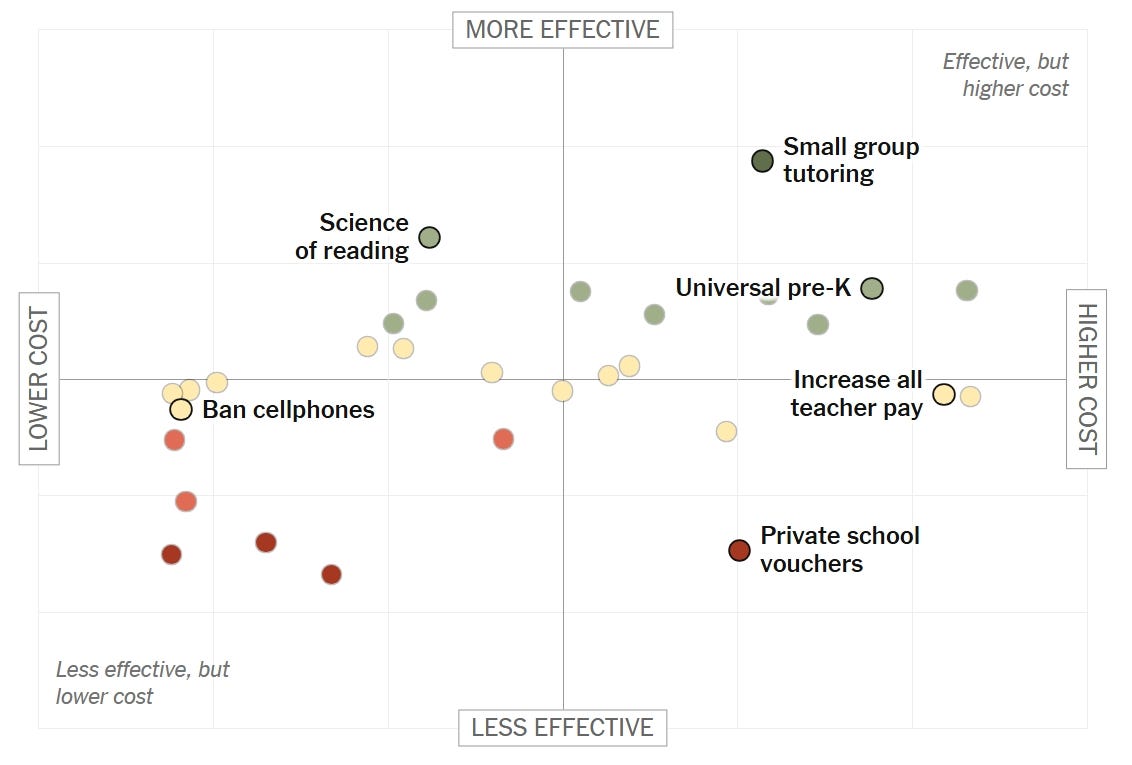
What stood out, however, was the selected thirty-seven experts. They all appeared to be fine researchers from highly respected universities, colleges, and think tanks. Not a one of them was a current, experienced classroom teacher. If an experienced teacher were asked to consult, the authors of the piece would have received…well…an education.
The first thing an experienced teacher would have asked is, “what do you mean by “effective?” Effective at what, exactly?” Are you talking about raising test scores? Because if you are that’s a very different target than improving education or “fixing” schools. For instance, the so-called experts rated “Require Full Books” as moderately less effective than a High-Quality Curriculum. What is that based on? Test scores. Yes. To improve test scores focused on excerpted short writing samples, requiring students to read full books isn’t going to be particularly effective. However, the benefits to students who must struggle through full books may not be directly testable. For instance, reading full books is a great way to build background knowledge. That background knowledge then transfers to improvements in reading, oral comprehension, even math skills.
Banning cellphones is another low cost, moderately effective tool. Recent experience, however, shows that banning cellphones has huge impacts on the social environment in which learning takes place. Banning cell phones may have a moderate impact on test scores, but preliminary observation seems to indicate significant improvements in well-being for students and teachers.
Next, what do you mean by “costs.” If we are talking about dollar amounts, that’s a very different thing than the cost to the student, the teacher, the parent, the community. The question is, the cost to whom? For instance, “Holding Back Struggling Students” lands right square in the center of the scale, a moderately effective, moderate cost intervention. Research on grade retention shows that there are serious costs that fall on the student, disproportionately on minorities. Retained students do show some short-term gains on test scores. However, the long-term consequences are dire. Retention increased the probability of dropping out of school and even participating in criminal behavior. The impact is most negative on older students.
Most immediately, however, any experienced teacher looking at this report can tell you that though many of these ideas are nice, and may even be helpful, no combination of any of these rated ideas will “fix” U.S. Schools. The bottom line is, if the goal is to improve the dam that is U.S. schooling, the first step is less water. We must relieve the pressure resulting from poverty, racism, and segregation. This will require a radical restructuring of social arrangements in which no family is without adequate housing, health care, nutrition, or access to a basic level of life resources, including access to technology.6 Schools are a reflection of the islands of marginality existing in the United States. Communities lacking resources will have schools lacking resources. One strategy is to increase the community’s access to resources. Anything less, like simply boosting the resources available to schools, is only a half-measure. When the day ends, the student returns to an anomic community and homelife.
At the same time, we must work on the quality of the dam. It’s not enough to repair the cracks. The entire structure must be reimagined. Schools must be more than just testing centers recording student data. Rather, they must be environments in which everyone who enters, students, teachers, members of the community, can access resources toward maximizing their unique human potential. Community schools are a successful model toward this end. Highly educated and qualified teachers must be recruited from the top of our academic elite and retained. Offering professional level pay is only the first step. Teachers must also have a professional, healthy environment in which to do their work, and the freedom to follow their expertise. Furthermore, teachers must have the status that comes with working in the most important profession in history. No teachers. No civilization. Period. Every teacher should enjoy the deference that comes from such an exalted position.
The physical existence of schools should reflect the ideal world that we want to see. They should not look like warehouses for the soulless, slumping bodies of children walking mindlessly to the next empty task. If we want a technologically advanced, environmentally sustainable, aesthetically beautiful world, then that should be the standard for our schools. They should be the places where everyone, especially the children and the teachers, want to be. Children are intrinsically, biologically, psychologically wired for learning. Teachers are driven to share their passions with others. This being the case, schools should be places where teachers and children can’t wait to enter. That children and teachers often groan with the thought of going to school7 is an indication that something is catastrophically wrong with American education.
Look, an elaboration of effective and meaningful school reform is beyond the scope of this already long essay. Any and every teacher can offer a wealth of solutions to American education. Students like Najya Hannah-Jones can give a listener an earful of how schools compare to their expectations, and what would improve the quality of their lives in the classroom and corridors. What Nikole Hannah-Jones and Robert Pondiscio have in common is their desire to improve American education. Each has demonstrated their desire to do exactly that in their own way. Hannah-Jones by trying to live according to her values, Pondiscio by working actively toward reform.
They both would be better served talking to teachers who actually know what it is like to live and to work in America’s schools. A teacher could have advised Hannah-Jones that the problems of America’s struggling, impoverished, racially segregated schools cannot be solved by sacrificing her child to the greater good. Until American society is dedicated to improving the conditions in which schools exist, and the environments that schools provide to the community, there will be exactly zero progress. Period.
Every teacher can report to Robert Pondiscio that neoliberal, market-based reforms have failed. There is exactly zero reason to believe that doing more of a failed strategy will result in success. The answer to his questions are as follows:
- Are we willing to hold schools responsible for whether children learn? Answer: the problem is that we are ONLY willing to hold schools and teachers responsible. We are not willing to address poverty, segregation, or racism. We are not willing to hold parents, communities, and elected officials responsible for degrading the environment in which learning takes place. We are not willing to sacrifice our tax-cuts for improving education. We are certainly not willing to hold the influential think tanks accountable for pushing and lobbying for failed reforms that do nothing but bulk the bank accounts of textbook publishers and private equity. So long as we insist on dropping the weight of all America’s social ills on the backs of teachers, there will be no progress.
- Do the adults responsible for educating them know how? Answer: Teachers know how to educate. They are not allowed. Too many people who have between zero and some minimal classroom experience are the “adults” shaping the policies under which teachers teach. When these policies fail, we hold the teachers responsible rather than the people who imposed the ridiculous mandates.
Every teacher can tell you exactly what is wrong and come up with dozens of strategies for fixing it. Until we start listening to teachers, too many of them and their students will remain in fight or flight mode every time they step into our failing, impoverished, segregated classrooms.
Footnotes:
- To be fair to Mr. Pondiscio, the essay I’m citing is not especially condemnatory of teacher’s unions. ↩︎
- A summary of the research on this is way beyond my goals in this essay. I used Claude to put together a summary of key findings with regard to the impacts of poverty on learning. You can access that information here if you are so inclined. Here is a summary of the research on poverty. https://acrobat.adobe.com/id/urn:aaid:sc:US:81b5e78c-76f3-4ece-91a8-f5d93596e8ff This document focuses on Racism and Segregation. https://acrobat.adobe.com/id/urn:aaid:sc:US:a6bd9cda-78f2-4a4e-9aa0-3caac729a2d2 Due to time constraints I did not do an in-depth evaluation, so be careful. I did evaluate, and the overall information is valid and substantial, but I can’t say you will find no mistakes. ↩︎
- My experience is in secondary education, so I picture that high school sophomore. My description will correspond to this student, but can be generalized more broadly. An elementary teacher will be able to give a better picture of young children than I. ↩︎
- And now we can add the extra stressors for the children of immigrants, both documented and undocumented, or those who look like immigrants in this reign of terror against “those people.” ↩︎
- Students know how they are esteemed. They know when they are in a “bad school.” ↩︎
- The Department of Defense School System is by far the best scoring school system in the country…as well as the world. There are many in-school variables for explaining this. Out of school factors, such as stable housing, health care and access to other life chances are also significant. When students have their needs met before coming to school, even stressors like family deployments and high mobility are mitigated. Who Runs the Best U.S. Schools? It May Be the Defense Department. – The New York Times ↩︎
- I’m hearing reports from teachers who literally sit in their cars in the school parking lot and cry before starting their day. ↩︎



Leave a comment