
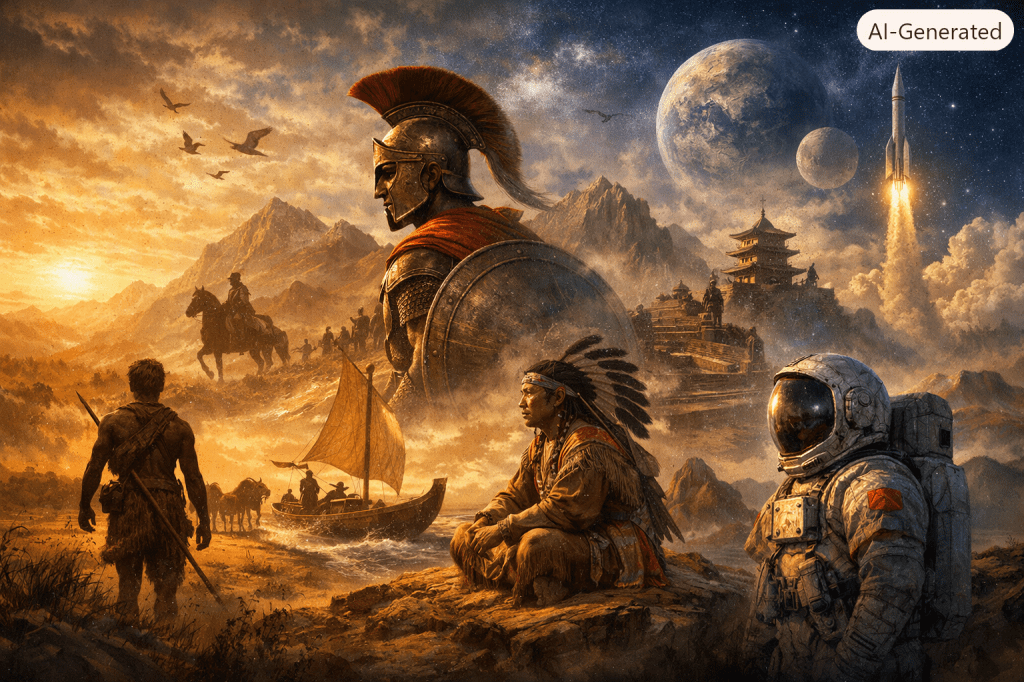
The Odyssey is not Just a Cool Story
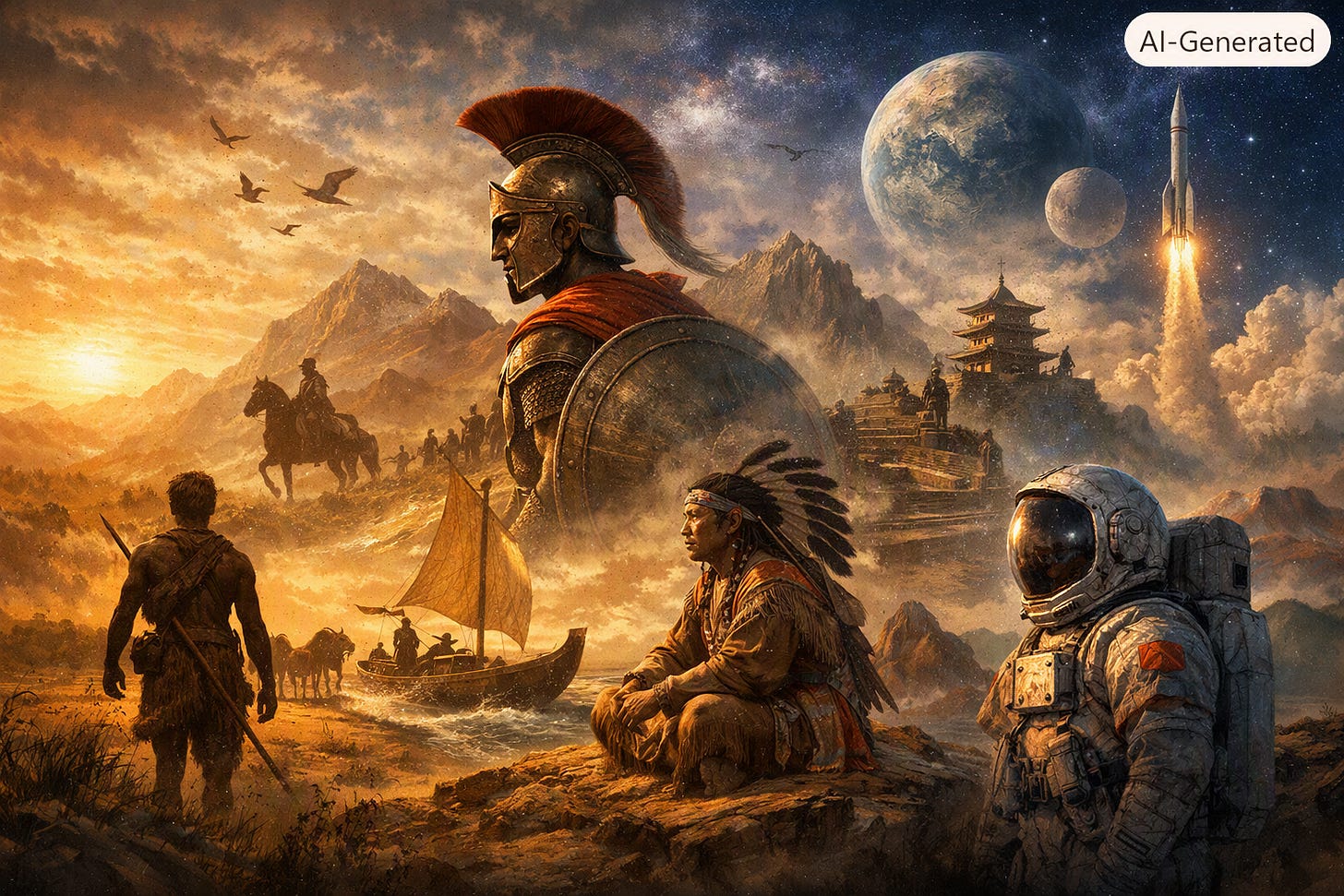
Stories of the Epic Journey are Intrinsic to the Human Condition
About twenty years ago I published my first novel, Stone is not Forever, recently republished. It’s about a young Italian man, Dominico Rossa, at the turn of the twentieth century who emigrates to the United States. His goal is to the save his economically destroyed family and to win the hand of the woman he loves. Like many Italian and Southern European immigrants at the time, he intends to return to his home village as a man of respect and means. His journey, however, takes some unpredicted turns. When he returns to the paesera where he grew up, it is not as a man of respect, but rather as an American intent on returning to his adopted home.
My second novel was The Revelation of Herman Smiley, which you can find serialized right here on Substack. This is a whimsical, philosophical novel in which the title character is taken by a coffee loving God on a journey through space and time. The goal of this journey is to discover the truth that humanity has forgotten.
Recently, I typed the final period on my third novel, which I’m tentatively calling Abode. Paid subscribers can get a “sneak peek” at this unpublished manuscript while I look for a publisher. Abode follows the adventures of a character named Sam, an average man from a society in which everyone lived in their own isolated apartments and had all their needs met by a corporation called Citadel. When Sam’s apartment is blown up during a terrorist attack, he is rescued by a clan of “Outdwellers.” Because of Sam, the clan must move from their home and travel to the distant North Country, away from the heavy hand of The Citadel.
If you are seeing a pattern in the plotlines, it should come as no surprise. I grew up watching Star Trek, both the original series and Next Generation. Star Trek translates through the decades because it’s the story of courageous explorers who travel the “final frontier” using reason, empathy, and cunning to confront the dangers they face on the outskirts of human existence.
I was also a fan of Battlestar Galactica, the original Lorne Greene, Richard Hatch, Dirk Benedict version. A tribe of humans facing possible extinction takes on a civilizational journey to find the lost tribe known as Earth.
Of course, there was Star Wars. Here was Luke Skywalker’s journey across the galaxy far far away. His quest, not one of his choosing, to become the Jedi who restores balance to the galaxy.
As I got older, I was introduced to Captains Woodrow F. Call and Augustus McCrae as they crossed from South Texas to Montana with a heard of stolen cattle. This timeless story became my favorite. I rewatch it at least once a year and have reread the book more times than I can count.
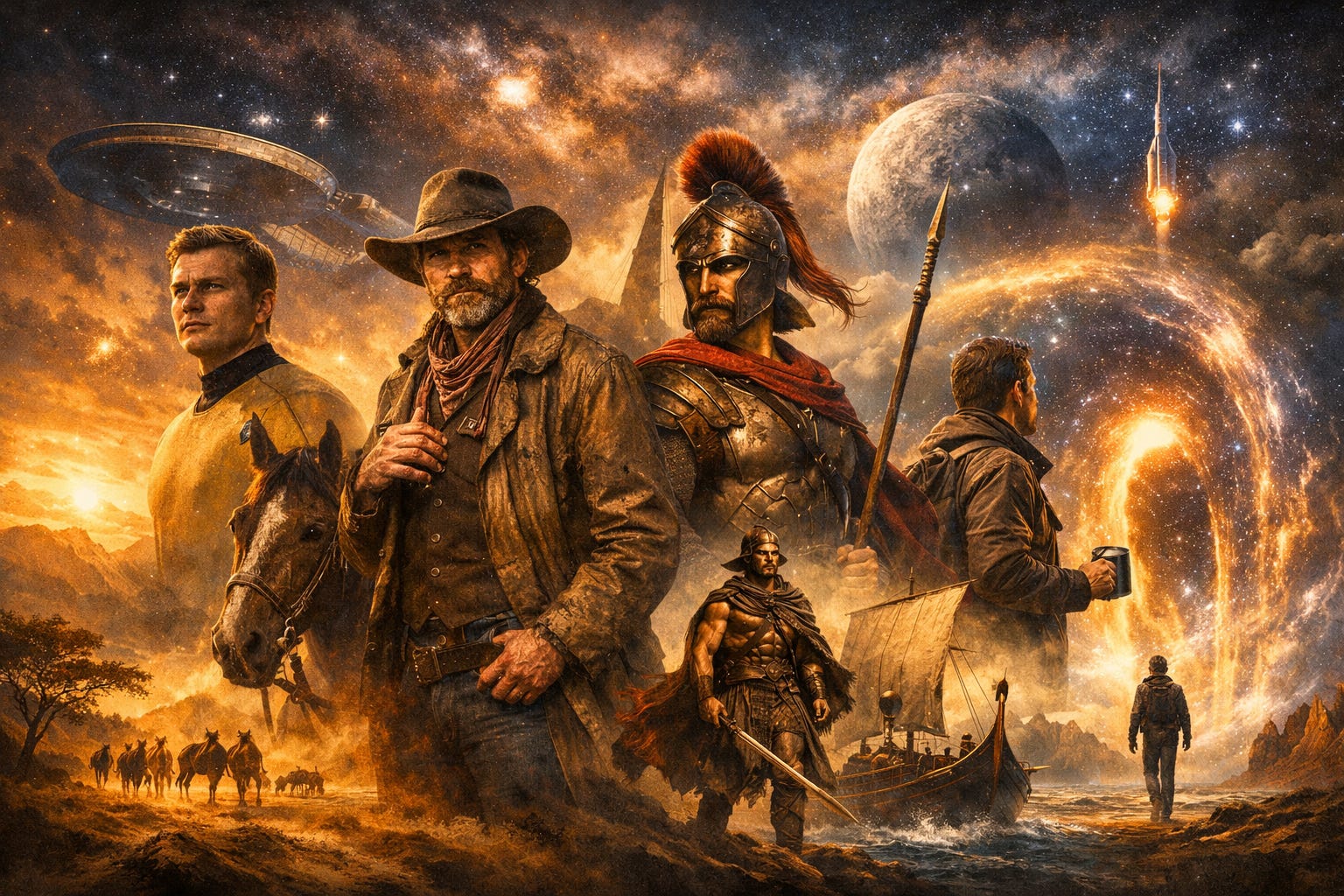
This plotline tracks with my life. When the stressors of my career became too much, or the routines of too prosaic, it was time to pack my rucksack and walk off into the wilderness.
Today, my wife and I travel all over the world looking for that perfect vista, the perfect sunset, with the perfect glass of wine or whiskey.
By now you understand that each of the stories above, from fiction or biography, is a reflection on The Odyssey. Credit for this first great story of an epic journey goes to Homer. It could be said that every such story, from The Pilgrim’s Progress to Star Wars, goes back to Homer. Today, director Christopher Nolan gets credit, and some notoriety for the latest iteration of this timeless classic.

You can see this essay and more, including video commentaries and lessons from The Underground Classroom all on the Mad Sociologist Substack Page
Nolan’s riff on Homer is, of course, not without controversy. True to form for today’s stilted, culture-war script, the debate centers around melanin and the so-called trespasses against a presumably embattled “Western Tradition.” In other words, a lot of mental energy is being expended to censure or defend Nolan’s casting decisions, completely missing the point of the story he and Homer are trying to tell.
Because the story of Odysseus’ journey is not just an epic adventure. It’s an archetype.
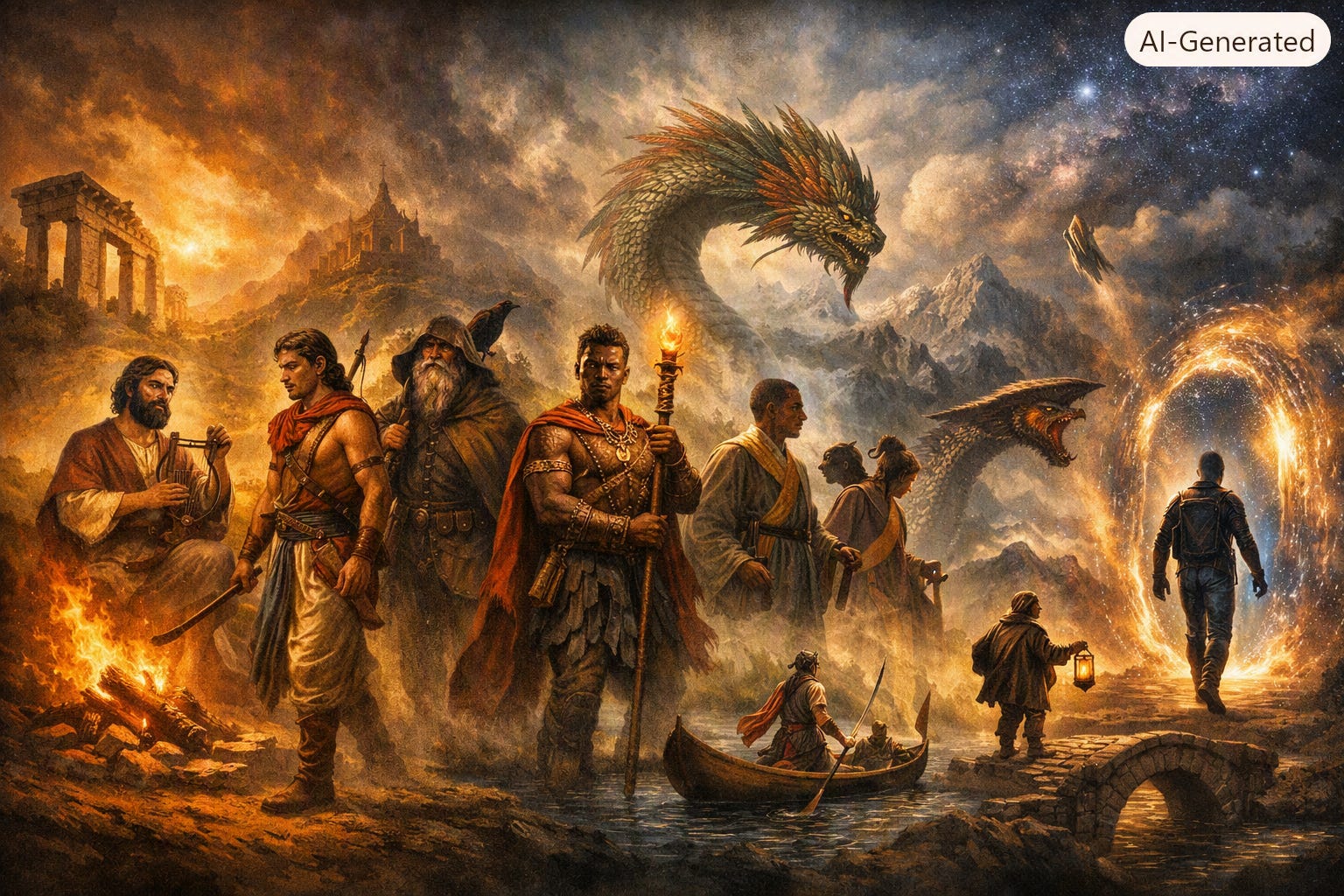
We know through scholarship that Homer inherited this story, or some version of this story, through a long oral tradition. Such stories were not exclusive to the Aegean cultures. In South Asia, the exiled Prince Rama travels the world to rescue his wife, Sita from the Demon King. In Northern Europe, Odin travels the world searching for wisdom. West Africa had the journeys of Mwindo. Across the Atlantic, the Aztec shared stories of Quetzalcoatl, and to the north the Ojibwe had Hiawatha. From the journey of Xuanzang and the Monkey King in China, to the Beowulf Sagas, to J. R. R. Tolkein’s hobbits, or Dorothy and her little dog no longer in Kansas. Even T’Challa’s journey to the spiritual realm to become the Black Panther plays into this timeless theme.
We can imagine the first epic hero emerging from his hut on the grasslands of East Africa, looking out at the horizon and saying, “what’s over there?” Or maybe she heard tales of some magical herb, or land of plenty. Maybe pushed and prodded by some supernatural whisper saying, “go and see something new and wonderful.” Some magic, be it an animal spirit, a local catastrophe, a hope for greener grass, or a strangely aligned strand of DNA, propelled this first epic hero to go.
Then this epic hero came back and told fantastic stories of the strange beasts and wonderful lands encountered. The children, wide-eyed, sat in wonder and thought, ‘If only I…’ Some later engaged their own trek across the Savanah, the deserts, the rivers and seas until only a short hundred millennia later, with dreams of exploring the stars in our heads, man left his footprints on the Moon.
The journey is embedded in our psyche. It’s incorporated into our species-being no less compelling than the migration of birds and butterflies and whales. Only for humanity, the journey is not just a linear progression across the landscape. The journey is a personal transformation. It’s the Walkabout of the Australian Aborigines, the Vision Quest of the Plains Nations, the Wayfinding of Polynesia, the Eunoto of the Maasai, and the Bushman Trance Walk. It’s pilgrimages to holy sites from Mecca the Yasgur’s Farm. Our sacred heroes, Jesus, Abraham, Moses, Buddha, Muhammad, Lao Tzu, all tested themselves along a spiritual journey.
The journey is embedded in our psyche. It’s incorporated into our species-being no less compelling than the migration of birds and butterflies and whales. Only for humanity, the journey is not just a linear progression across the landscape. The journey is a personal transformation.
Today people all over the world take on the sacred ritual of the journey, climbing mountains, crossing deserts, strapping packs on their backs and taking to the hills in our national parks. We go on safaris and river trips. Some of us make it a point to leave the comforts of the modern world behind, depriving ourselves the luxuries to which we have become accustomed, just to have a taste of the trials that define our epic heroes. Perhaps we believe that just a little bit of Odysseus’ character will emerge from within. Maybe we feel compelled by some force beyond our consciousness.
Then there are those real life Odysseuses who choose to cross deserts and dangerous seas for a chance at a better life for themselves and their families. They are engaging that very same species-being that our earliest ancestors activated when they journeyed from the plains of Africa. They are retracing the steps that humanity has laid down for a hundred millennia. Yet they face another dangerous element imbedded in the minds of much of humanity. Fear of the other, the drive to exclude those who are different. The nihilism that destroyed Troy.
The Odyssey, whether it’s Homer’s version, or Christopher Nolan’s vision, is more than just a cool story about larger-than-life heroes. It’s a classic expression of an intrinsic human drive. It’s a map into the very soul of what makes us all human. Odysseus is driven by the wonder and, yes, the glory of what lays on distant shores. There’s the journey to greatness, to transformation. This journey stands in stark contrast to an equally powerful counterforce. The latent, irresistible pull of home.
All journeys must end at home. This may involve a return to one’s starting point, like Odysseus, or Bilbo. It may culminate in the hero laying the roots for a new home, like Dominico Rossa, the personification of migrants throughout history. Either way, when the journey is done, the hero on their last steps home is never the same person who took the first steps on their journey.
And that’s the point.






Leave a comment