

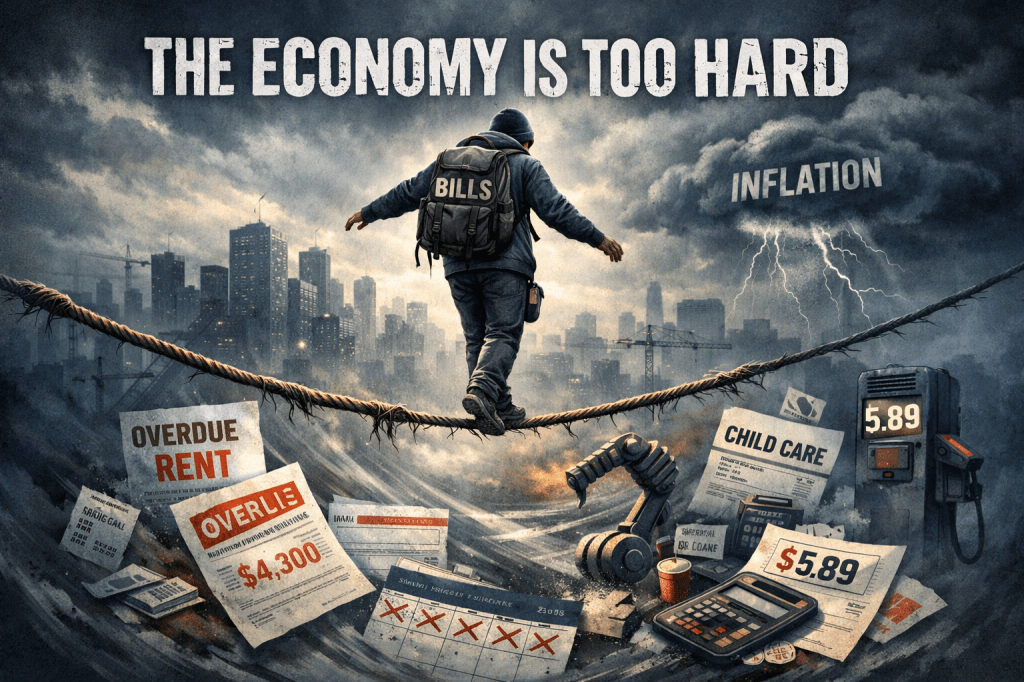
It’s not just “Bad Vibes” or Political Polarization
A Tale of Two Generations
When I was a kid, my family was exceptional in many ways. By which I mean, my family did not look like those of my peers. First, my father was significantly older than my mother. In the early seventies, my father retired from his federal job (he worked for the Navy) with a full pension. That allowed him to stay home with me while my mother went to work full time. So, on play dates, it was my father at the park gabbing with my friends’ mothers.
Shortly after I entered school, my father, who was never much of a homebody, went back to work for Texas Instruments while my mother continued to work full time. At that point I was among the millions of American “Latchkey Kids,” coming home without a parent waiting to supervise me.
It wasn’t a problem. All of my friends’ mothers were homemakers. You see, though the seventies’ stagflation complicated the economic landscape, it was still possible for a family to make ends meet with only one earner. A two-earner family, like mine, was the exception to the rule.
During that time, my mother decided to go to college, which may parents could afford without going into debt. Her resulting degrees opened doors for promotions and advancement with higher pay, and better benefits. By the time I was ready for high school, my parents’ thrift and my father’s federal pension had us living a solid middle and even upper middle-class lifestyle. They put away substantial savings and made further investments. To my everlasting chagrin, they decided that my father would retire once again and we would all move to f*cking Florida.1
Fast forward to the turn of the 21st century.2 My new wife and I were well educated professionals–teachers. I had a master’s degree, my wife a bachelor’s. Both of us had years of experience in our respective fields. However, by this point in history, it was impossible for us to sustain the same kind of middle-class lifestyle on two incomes that my friends who lived in single earner homes enjoyed less than two decades before. Fortunately, I was able to find adjunct work at Florida Southwestern State College and Florida Gulf Coast University on top of teaching secondary school full time. Three jobs. This kept us above water, but even at that, it wasn’t easy to make ends meet.
In fact, it was exhausting. For years, a typical day for me started when I woke up at five in the morning, went to my high school gig, then had a few hours which I dedicated to work, and some writing, before starting my evening classes. Four nights a week I was pulling into my driveway sometime after nine, or nine-thirty in the evening.
And there was nothing special about me. This was and remains the norm for millions of Americans. Two-earner households, often with more than two jobs between spouses.
Fortunately, this is no longer my reality, but I have never forgotten what it was like to search under the sofa cushions and in the dryer for any loose change because I wasn’t sure if I had enough gas to get to work. I remember walking into the grocery store, checking the bank app for how much I could spend on dinner. Was this going to be Hamburger Helper night?
More painfully, I remember going through the day without seeing my kids awake or spending time with my wife. Unlike many in my situation, I had the benefit of weekends off. Even at that, I was often too tired to really enjoy my family.
I’ll never get that time back. Neither will all the millions of people who were, and are currently living this kind of multiple job lifestyle. Working like this leaves a permanent temporal scar.
The consequences on my social life were only a fragment of the damage this regimen did to my physical and mental health. I gained weight, lost muscle mass, experienced fatigue and even fought feelings of inadequacy and depression.3 In many ways, though I have a much easier life now, I’m still paying the costs of those desperate years.
So, when I see economists debating the source of the “Bad Vibes” Americans seem to be having with regard to the economy, I tend to grind my teeth. I read a great deal of economists, and even the more left of center among them dances around the gap between what they refer to as “consumer sentiment” or “consumer confidence” and what the data reveals. Yeah, inflation is a little higher than it should be, but it’s not as bad as predicted. Job growth is still relatively strong. Our economy is growing. I mean, it’s not great, but it’s not that bad. Americans’ response to the economy is disproportionate to the data.
I’m not a “both sides” person, but in this case, it really is both sides.4 I remember pulling my hair out as Democrats spent 2024 saying, “yeah, inflation was bad, but the numbers are back down. Everything is fine. It’s just bad vibes.” Now the Republicans refer to any criticism of the economy as “Saggy Caesar Derangement Syndrome. “Yeah, things are tight, but we’re at war…so things could be a whole lot worse.”
The press, in the meantime, plays along, noting that this month’s numbers were better than expected. Hey! Look at the stock market. That’s going gangbusters! Yet “Consumer Confidence” remains low. One can almost see the sneer on their faces as they elaborate the latter data point. Stupid consumers and their low confidence. After all, everyone knows if your confidence is low, that’s your fault. Increase your confidence and everything will get better.
The Economy is Just Too Hard
I just want to scream at my screen, or into the pages of whatever magazine or paper I might be reading when I see that chart on “Consumer Sentiment.”
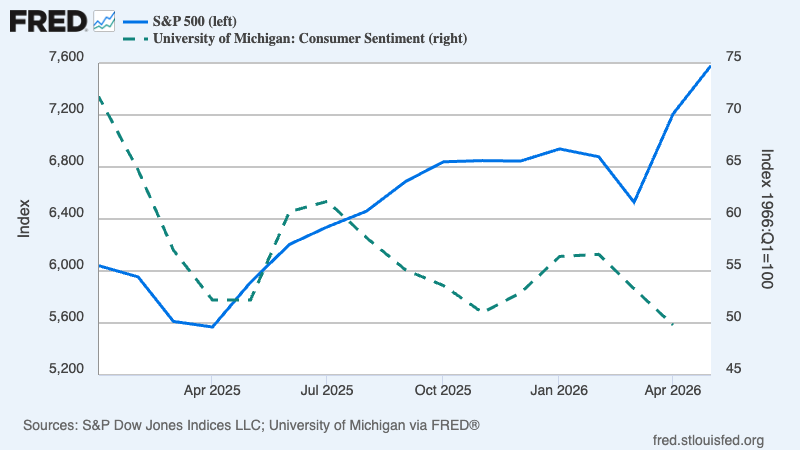
“You don’t get it! This economy is not working! It’s just too hard! Working people shouldn’t have to work this hard for just the basics!”
The problem, from a non-economic perspective is three-fold. First, it is much too difficult for the average person in the United States to achieve and then to sustain a minimal standard of living. Secondly, this is not new. Struggling just to get by is not exceptional like it was for my parents. This has been the norm for most Americans for going on three generations now. Furthermore, there is no relief in sight. There is no realistic expectation that our national leaders are able or willing to do anything to make things easier on working people. For many of our congress critters, it seems that working people are not their priority.
Finally, the unreasonable struggles most Americans face are taking place in the same context in which billionaires can literally shoot themselves into space just for the hell of it. They can rent entire cities for wedding receptions as if Venice were a Kiwanis rec room.
As for buying politicians–that’s just chump change for the uber wealthy.
In other words, the economy as it is right now does not work for most Americans. It hasn’t worked for most Americans for many years. And there’s little prospect that the economy will work anytime in the future. This is unsustainable. At some point it will not be good enough to blame the other party, or blame immigrants, or blame welfare recipients, or blame Millennials and GenZ, or blame China or, or, or… We are no longer headed for a crisis. It’s here. We need a leadership that will make navigating the economy a little easier.
Framing the Problem
There’s a graph that I believe should be plastered everywhere. It should be on posters. It should be on T-Shirts. It should pop up on split screens all over the country until someone acts on it.
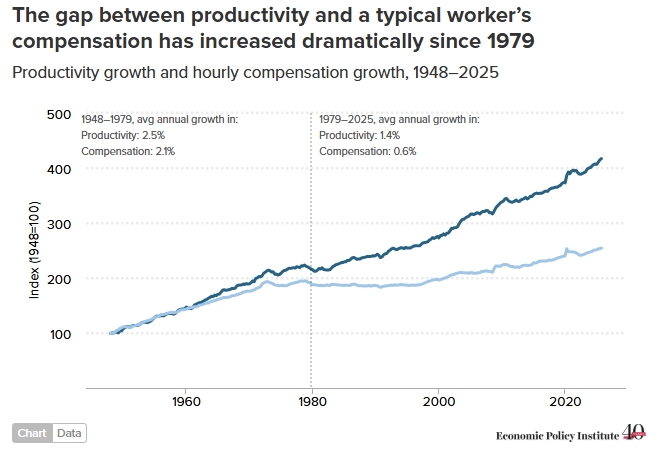
The story this graph tells is the story of the last three generations and why Americans understand that they have been betrayed by both parties. Here’s the story:
After World War II, the American economy grew. As the economy grew, as workers became more productive, they were compensated for that growth. This was my father’s generation, and my mother inherited the work-ethic that makes sense when working harder really does result in greater economic reward. It’s a picture of a fair and equitable economic contract with working people. Work harder, become more productive, make more money. As the economy grows, so does your income. It was a period many economists refer to as The Great Compression, when the gains of a growing economy lifted the working and middle class.
Sometime in the 1970’s, this contract broke down. This was the era of stagflation.5 This was the economy that my mother entered when she was ready to join the workforce. The crisis lasted for years and caused people to question the benefits of The New Deal and the Great Society programs that were instrumental in creating a more egalitarian economy. The Great Compression was over. We were entering into a period of Neoliberalism in which the laws and policies were designed to encourage investment rather than empowering labor.
Stagflation turned out to be a crisis that was too good for the economic elite to let pass.6 The ascendent conservative movement in both parties picked up on Milton Friedman’s free market critiques of the welfare state, and the warnings from Louis Powell’s secret memo to push investor friendly policies at the expense of labor. This culminated and accelerated with the Reagan Revolution in the Republican Party, and the Democratic Leadership Counsil within the Democratic Party.
New Deal liberalism was derided as “tax and spend” dedicated to funding welfare queens who live large on taxes paid by hardworking Americans. Meanwhile, taxes were cut on the highest earners. Corporations were deregulated. Public goods were defunded. Unions were busted. American industries were allowed to pack their bags and move to Mexican Maquiladoras or Asian sweat shops.7 Free trade agreements were negotiated in the best interest of the investor class, with exactly zero protections for workers.
These policies have been the status quo since the 1980s.
And the proof of their impact is in pudding.
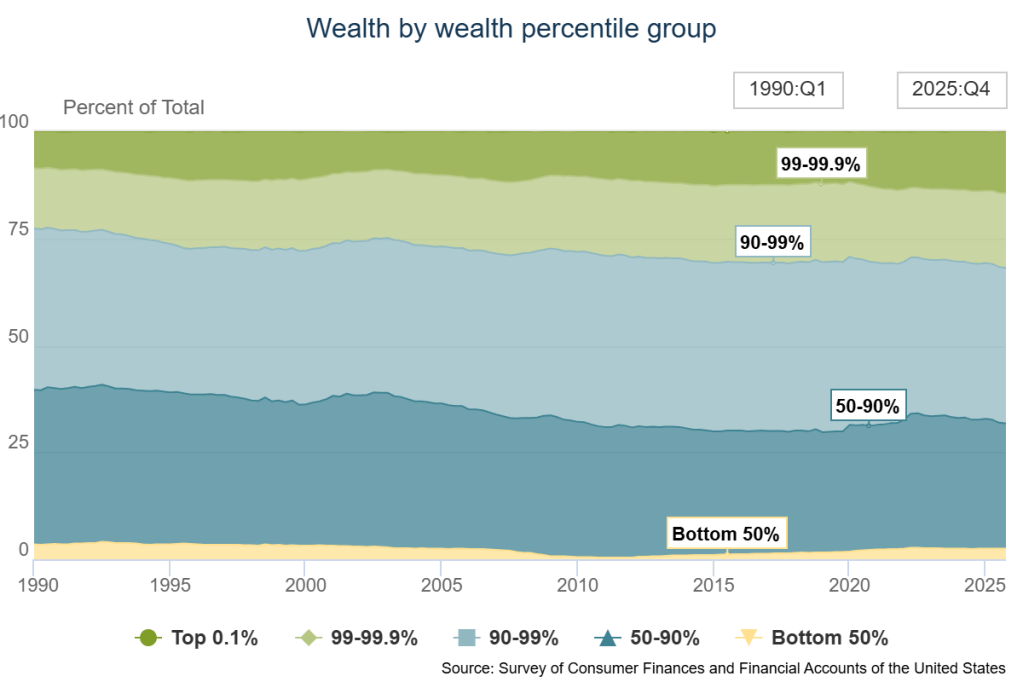
Under the status quo economy, the bottom fifty percent of wealth holders have only 2.5% of the wealth, over a thirty percent decrease from where they stood in 1990. Meanwhile, the top .1% (that’s not a typo. Point one percent) has almost doubled its share of wealth holdings, at 14.5% of all assets.
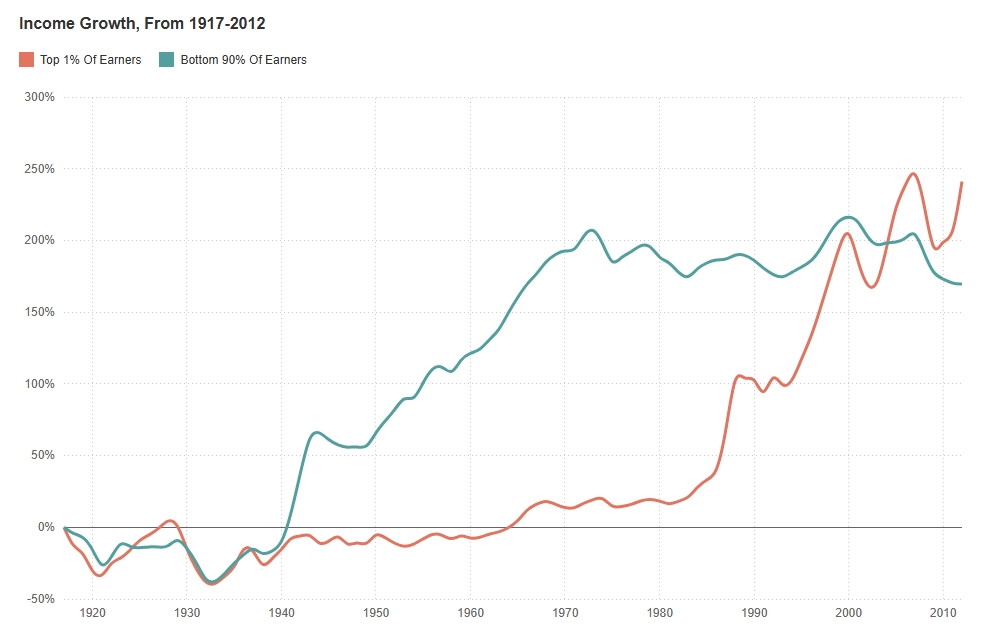
A closer look at this graph reveals that the only beneficiaries of this economic system, the Neoliberal Order, is the top one percent. Everyone in the bottom 90% of wealth holders is worse off. Even the next nine percent is no better off, though they are at least not worse off.
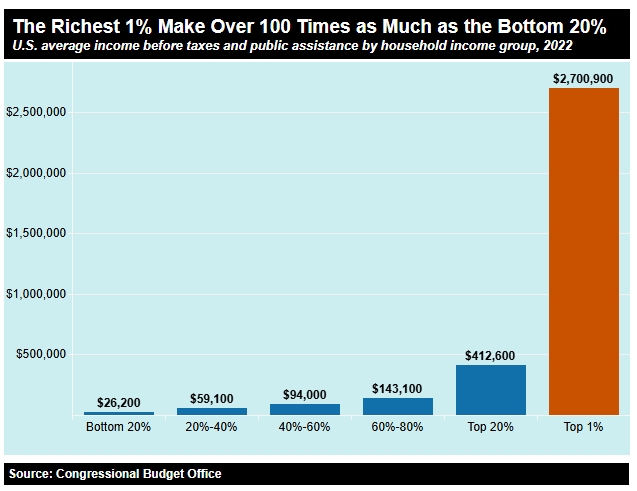
And income inequality is even more lopsided.
The Consequences
Americans were sold a bill of goods. And we all know it. There’s no hiding it anymore. We were told that if we just took the gloves off of the investor class, they would invest in great new stuff and would have to hire lots of people to do the work. Consumers would get top quality goods at reasonable prices. Workers would benefit from the growth opportunities with higher wages and better benefits. All would be good with the world. Just cut taxes. Cut spending on the deadbeats. Deregulate. These three policy priorities would loose the magic of the market and its miracles would fall on everyone.
How’s that working out?
…nobody hates capitalism quite as much as capitalists do.
I used to tell my economics students that nobody hates capitalism quite as much as capitalists do. You see, competition is the mechanism that makes capitalism work as advertised. However, capitalists hate competition. Their goal is to monopolize a given market or markets. Once upon a time, our government enforced what were called Anti-Trust Laws, breaking up monopolies, stopping market crushing mergers. No longer. Now a private equity firm can buy up a hundred houses in a given area. Sell one or two of those houses to themselves at inflated prices, thus boosting the property values for the other ninety-eight houses, impacting the property taxes, rents, and mortgages for current and prospective buyers.
It’s perfectly legal. Don’t expected the government to do anything about it because that same private equity firm makes huge campaign contributions to your elected representatives.
Now millions of working Americans are caught in a bind. Many who would like to buy a house, and qualify to buy a house, can’t afford to do so. They are stuck throwing good money after bad, renting an inadequate apartment. The same mechanism inflating housing prices, however, also inflates rent. Money that a working person might have put aside in savings so he/she could one day make that down payment on a house, is now going to the landlord–who is likely contracted with the above-mentioned private equity firm.
The solution offered is to just work harder. Take on that second or third job. It will be worth it in the end.
It’s a scam.
You see, as more people take on second and third jobs, that increases competition for labor, which reduces its value and helps keep those pesky labor costs under control. The unions are destroyed. There are no more closed shops or union shops to help level the supply of labor verses the demand. Wages and salaries have stagnated against the cost of living making it more difficult for working people to get ahead. You can drive Uber all night long and never make enough to get over this hill.
Meanwhile, the private equity CEO, with his stock options, is pointing the blame at immigrants.
Rinse and repeat for every other essential. Your food bill is up about 25% in the last five years. Your healthcare premiums and your deductibles have increased. What? You dropped your transmission. Oooh! Tough one. You won’t be able to afford a new car, but the cost of used cars has also shot up. Replace the transmission? Yeah, that’s more expensive, too! Take the bus? Good luck, funding for public transit was cut.
Want a child? Might want to wrap it up. You’ll need a bigger apartment. Your partner will have to go into debt if she takes FMLA, which she may not even qualify to get. As soon as she’s able she’ll have to go back to work, but you can’t afford daycare because that’s about the same as the rent payment you can’t afford. You can’t add another job because you’re already working three. Diapers. Baby food. Formula. All more expensive. Then when that baby comes down with the inevitable cold or infection and you need to take her to urgent care–that’s when the deductibles kick in. Also, you are going to come down with that cold, and it’s going to be a doozy! But you can’t afford to take time off.
Hope you enjoy that extra Uber shift.
The picture is clear at this point. The system is rigged against working people.
What is not clear is that this is not the natural way of things. This is the result of more than forty years of policy decisions. These decisions have, from both sides of the aisle, been made to benefit the ownership class at the expense of working people.
Oh, and they are doing great! Soon you will have the glory of living in the same country as the world’s first Trillionaire!
Doesn’t that make you feel better?
Prospects for the Future?
If there was one thing that kept me going through that time in which I was working three jobs it was knowing that I was working for the future. I was working to position my family so that my children will not have to face the same difficulties that their parents did. In the case of my wife and me, it worked out. We are now financially stable.
For my kids? Will they ever be independent? Will they ever own a home?
This economy has been the default for over forty years. Fuel the investors. Disempower the workers. Find someone to blame for the fallout. Rinse. Repeat.
There is no meaningful movement for economic change, let alone transformation. The Republican Party is dedicated to beating and incarcerating immigrants as a sick song and dance for their twisted base. Meanwhile, there is no change in the Trickle-Down con they’ve been playing since Reagan announced that government was the problem. Cut taxes for the wealthy. Cut programs for working people and the poor. Dole out the defense contracts. Let the wealthy fund the resulting debt in exchange for interest payments.
It’s a scam.
With few exceptions on the part of the Progressive Caucus, however, there is little indication that Democrats have much more to offer. True, they are less likely to cut taxes. Nor will they cut key programs like SNAP or Medicaid–maybe. The only real promise Democrats are making is that they won’t be fascists.
So…there’s that!
That’s about as radical as the so-called “left” gets in the United States at this point.
I think this is the most debilitating, depressing part of the American economy at this point. It’s the fact that there’s no prospect that it will get any better. Furthermore, there’s every reason to believe it will get worse.
My children are in their twenties now (I know, right!). Here’s what they’ve seen. Countless billions being dumped into useless wars. The worst recession since The Great Depression. A lackluster response to this recession causing depression conditions for years. Just as the economy starts to pick up, we get hit with the worst global pandemic in a hundred years. Then there’s the resulting recession.8 Then an inflationary spike. An invasion of a sovereign nation. A genocide.
And now the f*cking Fascists are back.
On top of that, they face the prospects of being replaced by AI. And if the robots don’t get us, the Earth is catching fire!
I remember at least ten years ago reading a report by top economic education researchers announcing that sixty percent of the jobs that existed at that point were not going to exist today. Furthermore, we didn’t know what jobs would replace that sixty percent. As teachers, we had no idea how to prepare our students for the future.9 I’m not sure if the specific calculations of that report were confirmed, but the larger substantive argument was apt. The future is much less predictable than it was when I was in my twenties. And it turned out, it wasn’t as predictable as I thought at that time.
If past is prologue, however, given the status quo arrangement of the last forty years, the most predictable outcome is that the wealthy will find it much easier getting wealthier, while working people will continue to find it harder and harder to get by.
And there’s no indication that anything is going to be done about it by those who are supposed to represent us. This is why uneducated people are turning to fascism and why educated people are turning against capitalism.
The only question is, how much longer can the ownership class continue to step on the faces of working people before working people decide to just burn the whole damn thing to the ground?
So, yeah! Consumers are lacking confidence!
Put that on your line graph and suck it!
What Can be Done?
Maybe Something a Bit More Immediate?
Okay. So, at this point we will have dodged a bullet if the United States does not descend into a fascist dictatorship. We are a long way off from overturning the existing mode of production. I get it.
Fortunately, we don’t need the Revolution of the Proletariat to create a more equitable system. We’ve already done it…and lost it.10 We have historical precedent to tell us how to restore economic balance and make life in the American marketplace just a little bit easier for everyone.
Bring Back and Expand Public Goods
When Reagan took the stage and declared that government isn’t the solution, government is the problem, what he was doing was declaring war against the very notion of public goods. By proxy, he was attacking the notion of the common good and the progressive belief that advancing the common good is a legitimate function of the state. He ushered in the supply-side discourse of the Chicago School, Friedrich Hayak, and Milton Friedman. Consequently, the United States has been in decline ever since.
There are certain fundamental resources, necessary for an individual’s social welfare, that should be givens in any just society. Obviously, access to food, clean water, clean air, and adequate housing11 are foundational to good health. These should be available to all, not just those who can afford to shop at Whole Foods and own a house next to or in a National Park.
Expanding SNAP as well as the minimum wage, investing in publicly owned housing, advancing and encouraging the formation of tenant associations, and the creation of a negative income tax or Basic Minimum Income (BMI) with an expanded child tax credit is just the start. Publicly provided childcare, competing directly with private childcare providers, can help provide a quality, low-cost alternative for parents struggling with daycare costs comparable to their rent.
A huge benefit to working people, as addressed in the West Wing Video shared in the beginning of this piece is publicly funded tertiary education.12 There’s a world of arguments to be made for this, but the best is that those wishing to expand their knowledge and skills should be encouraged to do so. More knowledgeable and skilled people contribute more to society. Students should not have to sell themselves into debt bondage, forced to pursue fields they have little interest and aptitude for just because that’s the only way to pay down their debts.
Yes, my Marco Rubio types. A young person with a passion and aptitude for philosophy should be able to study philosophy and practice her discipline. She should not be coerced into being a welder because the country needs welders and welders have lower debts and high income. The consequences of such a nearsighted policy is a dearth of talented philosophers,13 and a surplus of at best mediocre welders–who now have a weaker bargaining position. Who benefits from this discourse?
Of course, the big problem that everyone wants solved…except our neoliberal and fascist officeholders…is universal health care. This should be a no-brainer. Every other advanced and even some less advanced nations have figured this out, but not the United States. Citizens should not have to worry about losing their livelihoods to save their own lives.
Health care is a right, not a commodity, and should be treated as a public good. I’m on team single payer, but the easiest way to advance health care reform is to make real the public option that Barack Obama campaigned on eighteen years ago. Combine Medicare, Medicaid, the ACA, the VA, and other healthcare programs like CHIP into one big fund and offer an optional buy-in. You like your high deductibles and co-pays? Fine. Stay with your private insurance. But if you want comprehensive coverage at a sliding scale rate, here you go.
We can even offer this for free to those who serve public needs. Of course, we’ll cover our veterans for free. But there are many ways to serve one’s country, including serving as first responders, medical staff, teachers, social workers. Free healthcare is a great incentive to encourage participation in these often-underpaid professions.
Bring Back the WPA
There’s a great deal of work that needs to be done. Local, state, and federal governments should be able to hire directly to address public needs. Tightening up our environmental regulations, with an eye on sustainability, will require people to provide oversight. Creating urban greenspaces and managing public parks and conservation areas require a great deal of physical and mental labor at many levels that can be drawn from local communities. I’ve always advocated for a new WPA to build the alternative energy infrastructure and smart grid that we’ve known we need for at least twenty years. Upgrading our transportation infrastructure, including cheap and efficient public transit, will restore the U.S. reputation as the builder of roads and rail that has degraded under Neoliberalism.
Government entities should be able to directly hire and put to work the necessary labor to build these much-needed public resources, rather than contract them out to private entities. Doing so would put our democratic institutions in direct competition with the private sector for attracting labor, from scientists, to engineers, to everyday workers, helping to increase the value of labor in the market. Tightening the labor market increases the pressure on private companies to raise wages and benefits. It also empowers workers.
Empower Workers
Labor is prior to, and independent of, capital. Capital is only the fruit of labor, and could never have existed if labor had not first existed. Labor is the superior of capital, and deserves much the higher consideration.
–Abraham Lincoln (1861) Annual Message to Congress
The greatest check against corporate power is worker power. When a bunch of shareholders get together and make decisions in their own best interest, we call that a corporate board and grant it almost unlimited status. When workers get together and make decisions in their own best interest…well, that’s socialism. And to an extent, it is.
It also works.
Corporate looters and their bought and paid for political enablers in state and federal government have been working since passage of the Wagner Act to restore workers to their rightful place, namely under the bootheels of the ownership class. Unions in the United States have been relentlessly bashed by elite propaganda. The PR masters hired by the Epstein Class have created a veritable false consciousness among enough of the working class to create a debilitating rift at the expense of unions. The first great assault against union power came from the Taft-Hartley Act in 1947. The quality of life for working people has been declining ever since.
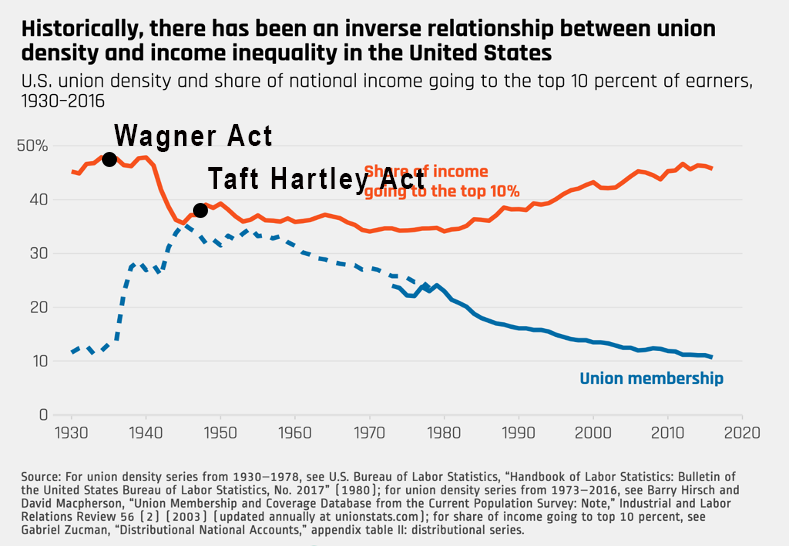
We need to restore unions to their position as a check against corporate power. If we are not going back to the days of closed or union shops, which I think we should, then at the very least it should be as easy for workers to form a union as it is for a business to form a shell corporation. Passing the long awaited ProAct should be the baseline. A true, pro-worker candidate would support overturning Taft-Hartley and anti-labor Supreme Court rulings like Janus.
Of course, such advocacy will be met with the argument, “if we give workers more power, businesses will just leave.” You can tell someone who has been brainwashed by Neoliberal orthodoxy when they just assume that corporate behavior is some natural response to stimuli. Quite the opposite. Corporations can do only what we allow them, through legislation. Corporations are government approved charters. That a corporate charter can be established about as easily as a blogsite is a characteristic of our legal structure, not some natural outcome of capitalist political economy.
At the very least, penalties can be applied to companies who outsource or offshore in order to avoid their responsibilities to their workers. At worst, such corporations can be put to death by revoking their charter. One reform that I believe can help is to create a legal structure by which a defined large business in a given community must sell their physical plant in that community if they make the choice to offshore or outsource that labor. If no private entity is willing to purchase the plant, then it should be sold to the workers at cost. The state can set up a low interest loan for such a contingency. A state or federal program can be created to help expedite the transformation of the business into a worker cooperative. This same department can also assist in the formation of independent worker cooperatives to compete directly in the market.
How do We Pay for This?
We pay for it through taxes.
Yes. I said it.
We’re going to pay more in taxes.
Yes, we can do all the popular stuff like closing corporate loopholes and taxing the rich. We should definitely do those things. A wealth tax would go a long way toward a stronger, distributive righting14 of the money system. A strong enough wealth tax will force the hoarders to liquidate assets and make them available to the market, increasing supply. It will encourage them to reinvest in the economy by rerouting resources into their own companies in the form of wage increases, benefits, or even technological upgrades. All net benefits for the economy.
That being said, we need to go further. A tax on surplus value, that is a tax on profits, rents, and other forms of unearned income can and should replace our current system of taxing earned income. That’s right. Let’s get rid of the Income tax in its current iteration. In a capitalist system, wages and salaries are already de facto taxed by the ownership class in the form of surplus value extraction, derived by paying workers less than the value of the labor they perform. It’s unfair to compound that intrinsic injustice.
Of course, not all incomes are…ahem…created equal. As it stands, the wealthy avoid income tax by claiming the lower tax rates for unearned income. There’s no reason to think they won’t switch gears if taxes focused on wealth rather than income. Special consideration should be given to the legal games available to the wealthy. A progressive tax can and should be assessed on personal income more than three times the median–about $170,000/year for an individual. Also, loans used as income, should be treated as income.
The beauty of this kind of taxation on high end earners and wealth holders is that they can be adjusted to provide carrots rather than sticks. For instance, companies that are pro-union, pay living wages and provide benefits should receive tax incentives for doing so. Companies can, through tax law, be incentivized to pay the full costs of their production rather than socializing their costs to communities. It doesn’t all have to be bad news.
We all like to jump on the “tax the rich” bandwagon. It’s low hanging fruit. The only folks who complain about it are the brainwashed and those expected to pay the taxes. The kind of public investments that I’m talking about above, however, will require everyone to pay into the system. That should not be a radical statement. After all, we are already doing so. For instance, taxes for health care and childcare can be paid through payroll in exactly the same way as we contribute to Medicare, Social Security, and employer-based insurance. The only differences are we don’t have to not die to get the benefits when it comes to Medicare and Social Security, and we won’t be paying deductibles, out-of-pockets, and co-pays for insurance.
This is not much of a stretch for working people who are already paying day care, and deductibles, or even utilities. In this case, however, instead of paying private institutions that will extract a percentage in profits, we’re paying a non-profit, public institution that can produce at scale more efficiently, with lower overhead. All over the world, public goods tend to be much less expansive than the same resources found on the private market.
So, yes. Everyone’s taxes will go up. However, we will not be paying deductibles and other fees. The things we need and the things we want will be paid on one bill to a non-profit provider.
Conclusion
There is no mystery to the gap between the nation’s economic performance, as anemic as it is, and “consumer sentiment”. Since the fall of the New Deal contract in the 1970’s and 80’s real life for working people has become more arduous and unstable. Most American are one busted transmission, or one physical ailment away from financial disaster. Add on top of that the prospect of recession, inflation, even pandemic. Then consider the fact that we are heating up our planet and networking superbrains, guaranteeing an unpredictable future. All of this at a time when our government is intentionally paralyzed from doing anything that might benefit working people.
Working people understand, without the slightest doubt, that the system is rigged not just to neglect them, but to openly harm them. In other words, they understand that it’s a scam. They are walking the tightrope without a net, and there’s always another gust of wind ready to blow them over.
There’s no current prospect for their condition to improve in any meaningful way. They have almost no representation at the federal or state level. Local politics is increasingly usurped by the state.
We know how to turn this around. The United States has history of progress on economic justice that we could have built upon fifty years ago if the economic rug had not been pulled out from under us by the sociopathic supply-siders. Other countries have also demonstrated how the state can work to improve the lives of every citizen by stewarding public goods, and empowering workers as a check against the wealthy. And they still have plenty of wealthy people!
Yes, it would be nice to finally usher in a new, democratic mode of production that met everyone’s needs. However, we do not need radical transformation to turn the curve on what economists refer to as “consumer sentiment.” Historically successful progressive changes will bring us a long way toward a more satisfying, more democratic society.
As we enter into yet another endless election cycle, we need to demand that those who aspire to be our “representatives” actually represent our needs. They must have plans to provision public goods, and empower workers, or they are nothing but place sitters. Yes, we may have to accept, “I’m not a fascist,” as good enough. But it’s not good enough. We will continue to repeat this cycle of increased hardship, vote out the incumbent, increased hardship, vote out the incumbent. Even when things seem to be turning around, the reprieve is only temporary. Then we vote out the incumbent…rinse and repeat.
It’s time to break the cycle of economic failure.
Footnotes
- To be clear, they were looking for warmer weather, not lower taxes. ↩︎
- In the 90s, my lifestyle was very different from the norm. I lived in the Everglades, working for a wilderness treatment program. I did not have the standard move out of my parents’ house and struggle to afford an apartment as I begin my career experience. ↩︎
- In true GenX fashion, I never admitted to the mental and physical strain I was experiencing. I just muscled through it. That’s nothing to brag about. ↩︎
- That’s not to say that political polarization has no effect. Of course, Democrats tend to give a Democratic president the benefit of the doubt while Republicans do the same. They do this…until they don’t. At some point economic consciousness catches up to economic reality, regardless of party. ↩︎
- I don’t want to get into the weeds on this. There was a lot going on at this time, including oil crises, the end of the gold standard, international competition, deindustrialization, urban financial crises etc. The consequences were high inflation combined with high unemployment. ↩︎
- Friedman, Milton. 1962. Capitalism and Freedom. Chicago: University of Chicago Press. ↩︎
- Deindustrialization. ↩︎
- The response to this recession revealed just exactly what a country can do if it really wanted to. Programs for dealing with the economic consequences of the pandemic improved the lives of millions of people and reduced poverty and child poverty almost overnight. This was only temporary. ↩︎
- Under such conditions it would have been wise to spend our time teaching students to be as critical, creative, and innovative as possible. We didn’t do that. We did exactly the opposite! ↩︎
- To be clear, by “we’ve already done it…” I mean we’ve already done it for white people. We lost it largely because there was a backlash against the left who suggested that maybe, just maybe, people of color should also benefit from this Great Compression. ↩︎
- Housing policy is of particular interest to me. Everyone laments the “housing crisis.” Homes are too scarce. At any given time we have over 600,000 unhoused people in the United States. We need to build, build, build! Let’s incentivize the builders to build. Cut their taxes. Deregulate. Stiff labor. Even liberals like Ezra Klein admit that there’s no other way. In the meantime, according to the Census Bureau, there are around fifteen million empty housing units in the United States. This isn’t scarcity. This is misallocation of resources. ↩︎
- The term “Tertiary Education” is intentional. By this I mean state colleges and universities, but also technical schools, vocational and trade schools. ↩︎
- Imagine if Peter Singer decided to become a welder instead! This is nuts! ↩︎
- I don’t like the term “Redistribution.” It’s deceptive. It’s only “redistribution” when it’s moving money from the wealthy to working people, as if this were some intrusion into the natural workings of the economy. When the wealthy lobby for policies to allow themselves to siphon more money into their own pockets, this is not considered “redistribution.” This is just the natural flow of the economy. Bullshit. It’s a policy choice. ↩︎
Shameless Self-Promotion Time
My novel, Stone is not Forever, offers a vivid, historically based narrative of the difficulties navigating an economy designed for the ownership class. You can purchase your copy wherever you buy books. Click the image for the link.




 The Mad Sociologist Blog
Leave a comment