
Of All the Public Goods they Hate, They Hate Public Schools the Most
My Column in the Fort Myers News-Press 5/15/2026
I attended teacher school in the late eighties and early nineties, a few years after the publication of A Nation at Risk. This publication was based on research of dubious validity but served as a rallying cry against a rising tide of mediocrity in American public education. Of course, blame was dropped onto the standard villains as defined by political conservatives, lazy teachers and the corrupt unions that protected them.
That being said, it was an exciting time to go into education. If there was a positive impact of A Nation at Risk it was in resuscitating movements for much needed educational reform. The pedagogical landscape was rich with reform ideas. I was a big fan of philosopher Mortimer Adler’s Paideia Proposal. Alas, the political consensus that emerged emphasized the rigors of “market-based” reforms. Public schools were to be reorganized around the merciless accountability of the market as opposed to the slothful mechanism of “government schooling.”
Support Local Journalism: You can read the News-Press version here. We’re disassembling public education | Opinion
Support Local Journalism: You can read the News-Press version here. We’re disassembling public education | Opinion
I was a novice teacher, but even at that time I had a visceral reaction to a market discourse on learning. The more I read on the topic, the more I lined up behind public school advocates opposed to the market approach. It was clear that such a system was bound to fail because markets are premised on a rational evaluation of inputs and outputs. Profit was the bottom-line indicator of a successful business model. Yet what constituted “profits” in a public education setting? Test scores are a poor proxy for profits.
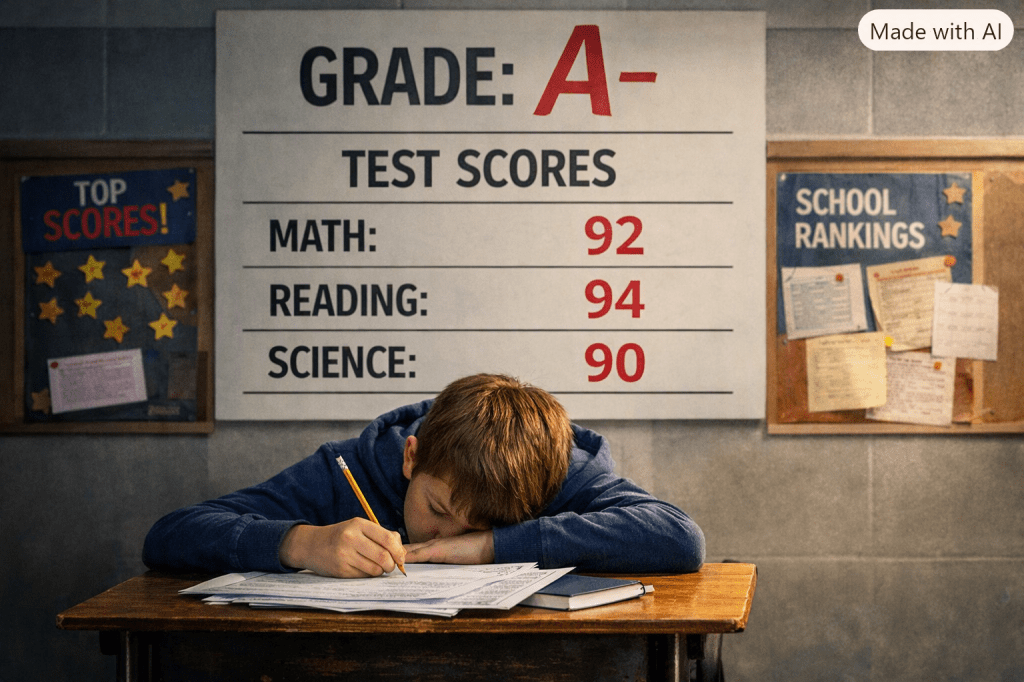
The problem was and remains that the market strips humanity from everything it touches. Uneducated students are nothing more than inputs in a productive process. Educated students are the output. Teachers are reduced to assembly line workers adding some measurable value to the inputs to maximize outputs as evaluated using otherwise meaningless test scores. Consequently, test scores rather than student needs became the over-riding interest in public schools. I have participated in PLCs (Professional Learning “Communities” for teacher collaboration) that were so focused on data points, benchmarks, and percentiles that students were never even mentioned.
When I first started working for Robert E. Lee County Schools, mania around FCAT scores was becoming entrenched in school culture. I knew we were in trouble when the principal announced, “we need to attract higher level readers to improve our scores.” She did not say, “we need to develop best pedagogical practices to improve the quality of education to improve our scores.” No. She followed market logic. Better input equates to better output. This is the major discrepancy of market-based reforms. By market logic, high scoring students are “investments.” Low scoring students are costs to be minimized or, in economic terms, externalized.
The biggest contradiction, however, had to do with the actual approach to creating a “competitive market” in education. This was labelled “school choice.” Public schools were forced to compete with private schools and charter schools to maximize the quality of their product. The ostensible advantage that private and charter schools had over sluggish public schools, was their greater flexibility and innovation. One would think that if public schools were expected to compete with privatized schools, and flexibility and innovation were keys to successful competition, that the rules governing public schools would serve to make them more flexible and innovative.
One should think that. However, one would be disappointed if one ever actually looked for evidence to confirm that assumption. Instead, public schools have been subject to increasingly stultifying mandates and inflexible policies. Some public-school teachers have been effectively handed scripts for how they are to conduct their classes to maximize test scores. It was counterintuitive. Public schools were required to compete against presumably more flexible and innovative privatized institutions but were burdened with rules making them less flexible and innovative.
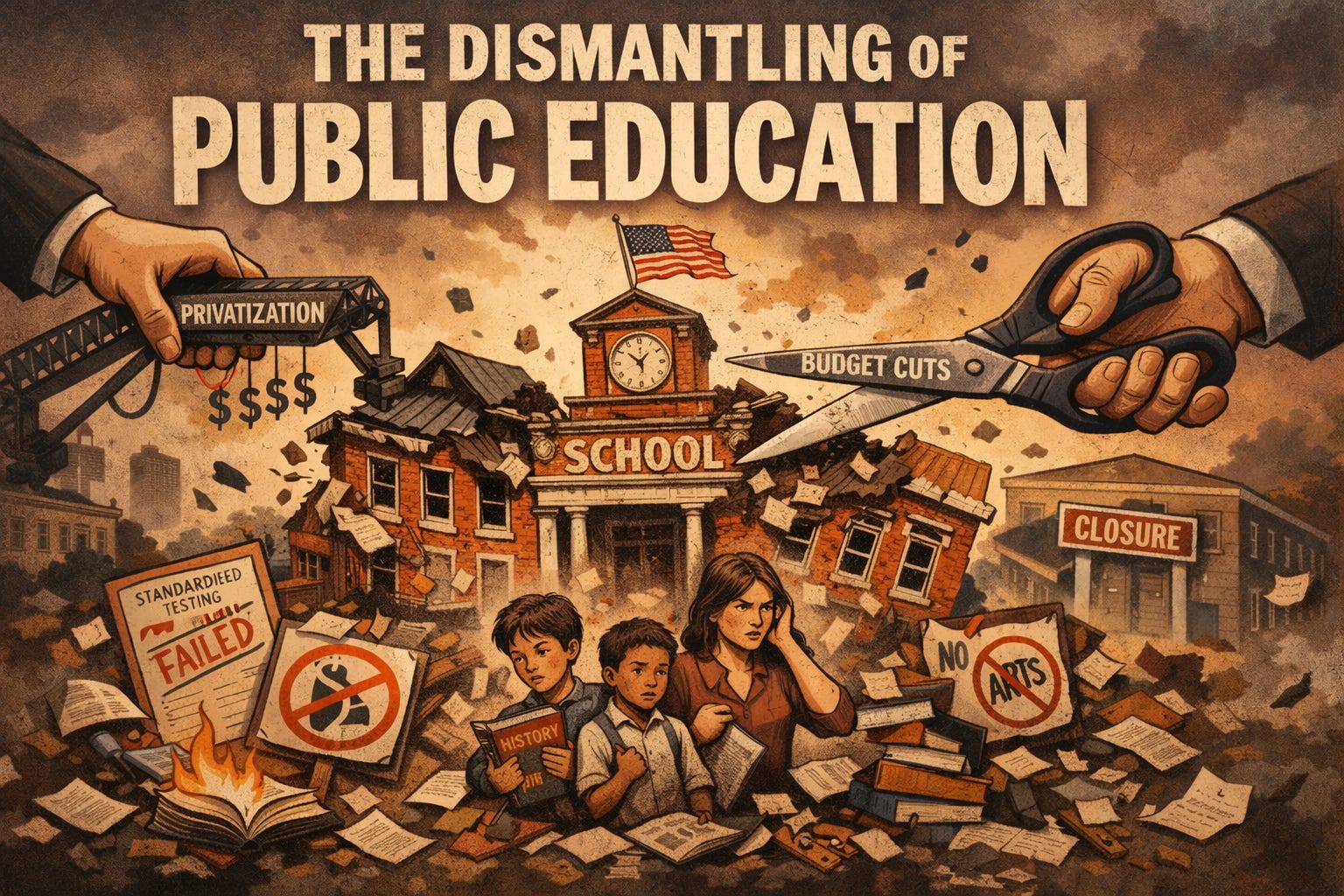
A few years into my career, in a conversation with a peer on the latest debilitating classroom mandate, I said rather tongue in cheek, “these policies make perfect sense if the goal is to destroy public schools.” It was an off-the-cuff comment…until I started thinking about it. Every significant piece of legislation at the state level for the last thirty years can be understood by assuming that the goal is to undermine public education causing it to collapse. A statement made as dark humor is now the lens through which I interpret all education policies instituted by the state.
The current public-school crisis, severe funding cuts threatening the quality of education, is a case in point. It wasn’t long ago that the dominant story was about the growing shortage of qualified teachers. Teachers were leaving the profession because it had become a personally and emotionally debilitating low pay profession. Sensible people would say to me, “surely the state will increase salaries and improve working conditions now that teachers are so hard to attract.” That is the sensible solution assuming that the goal is to improve public education. Using my model, that the goal is to collapse public education, I was skeptical. I predicted that the state would rather double down on immiserating teachers in some way.
My theory is vindicated. Instead of increasing funding, the state has done the opposite. Current legislation diverts funds for public schools into private coffers. In more than eighty percent of cases, this money is following children who were not previously enrolled in public schools. Schools are not only losing funds for the few students who have left the system but is subsidizing students with a history of attending private or home schools.
Furthermore, there’s little accountability following this money. Last year we learned that over a quarter billion dollars in voucher funds were unaccounted for, and tens of thousands of student enrollments could not be verified. The year before, an independent auditor found that Florida’s voucher system had an almost $400 million shortfall. So much for the rigors of the market.
True to market logic, these costs have been externalized. In other words, someone other than the investors are expected to pay for them. That is public school students, families, teachers, and staff who must now navigate tragic cuts to the most central institution in the community.
On the other hand, it sure resolved that whole teacher shortage problem.
My cynical theory also explains another phenomenon. For almost two generations market-based reforms have failed to improve education. The baseline response to thirty years of failure is to stop doing the failing thing and try something else. Every market-based leadership knows this. The evidence does not support the assumption that the goal is to improve public education.
Shameless Self Promotion!
You can read my philosophical novel, The Revelation of Herman Smiley only with a paid subscription to the Mad Sociologist Substack. It’s not expensive, but very much worth it. For the price of a hardback book you can read Herman Smiley as well as a sneak peak first draft of my science fiction novel, Outside. You can even comment and participate in its development as I’m working on it. A paid subscription also gets you access to my short stories and long form non-fiction that does not get on the blogs. You know, I may even throw in some poetry just for the hell of it.
Not bad! Huh?
So, help an aspiring writer out and sign up for a paid subscription.

You can order, Stone is not Forever, from most book-vender outlets. Below is the Abe Books Link.








Leave a Reply