

LIVING ON THE WRONG SIDE OF THE DIALECTIC
I got the low down, dirty exploitation of proletarian labor blues
A knowledge of the writings of Marx and Engels is virtually indispensable to an educated person in our time…Not to be well grounded in the writing of Marx and Engels is to be insufficiently attuned to modern thought, and self-excluded to a degree from the continuing debate by which most contemporary societies live insofar as their members are free and able to discuss the vital issues.
––R. C. Tucker The Marx and Engels Reader
Track 1: Capitalist Blues
Karl Marx’s Greatest Hits have one unifying theme–Capitalism. All of his work was, in some way, a critique of capitalism. Now, today, there are plenty of critiques of capitalism. On any given day we can hear people talk about the working man’s blues, how we aren’t getting paid enough, how the poor get poorer, and the rich get richer. From Johnny Paycheck to Bruce Springsteen, there are plenty of critiques of capitalism. Most of them, if you trace their history, are somehow a response to Marx.
Bemoaning the plight of the poor and deploring the excesses of the wealthy is nothing new. They certainly precede Marx. What Marx did, however, was to offer a systematic and theoretically sound critique of capitalism that became the foundation for all later critiques. Even those who are not Marxists, per se, are still responding to Marx’s work.
So, to understand Marx, we need to understand capitalism and why he was so upset about it. If you’re really into this, and you want a challenge, you can get the big picture of Marx’s critique of capitalism in his three-volume magnum opus, Capital: A Critique of Political Economy. This blog will not dig into the granular detail that Marx put in with over a million words. I’m planning on something about four thousand words. I’m just touching the surface.
Track 1: The Capitalist Shuffle
You see, before Marx, people were enamored by the kind of Jazzy tracks laid down by economic philosophers Adam Smith and David Ricardo. Smith and Ricardo both sang the songs of the rising capitalist movement that they were witnessing at the turn of the 18th century.
Adam Smith was the first theorist of capitalism with his book An Inquiry into the Nature and Causes of the Wealth of Nations, or just The Wealth of Nations because the first title is just too long to remember. Smith argued that free markets are superior to rigidly controlled “mercantilist” markets. In a free market, individuals own the means of production and use these means of production to improve their own condition.
Wait? Means of Production sounds like fancy, schmancy economisist jargon!
The Means of Production are just the technologies that are needed to produce stuff. So, if you have a hammer, nails, and some wood, the hammer and nails are the means of production. The wood is your materials. In a free market, like Smith was writing about, you naturally want to use the means of production and materials in such a way that benefits you. You may want to make chairs, because chairs have use value, you can sit on them. This is an improvement over sitting on the floor.

Ah, but let’s elevate this idea. Chairs have use value, but there are only so many chairs that you need. You only have one butt! But there are also a lot of other people out there…and they all have butts! They may also have stuff that you need. You might make a chair for a shepherd in exchange for some wool, or a lamb. In this case, the chairs you make have exchange value, they are worth a comparable amount of something else.
But what if instead of exchanging a chair for a specific item, I exchange it for money? I can then use some of that money to purchase more wood, and nails and make more chairs. Once you start doing this, the means of production, the nails, hammer, and wood, become something different. Something magical. They become CAPITAL! In other words, they can be used to make future profits. If I, as a private individual own the means of production, then I will use the capital derived from those means to better myself.

Now, it’s likely that I’m not the only person making chairs. Steve is also making chairs. I’m in competition with Steve. F#@king Steve! If I want to better myself, I need to find ways to make better chairs than Steve and sell them at a lower price. The competition between me and Steve benefits consumers because they get a better, more affordable chair.
David Ricardo elaborated on this process in his book, Principles of Political Economy and Taxation. It’s one thing if I’m a chair maker. I make a chair using my means of production. I had to buy the wood and the nails. These are my costs. There’s nothing I can do about them. Say it costs me $20 in materials. It takes me a day to build the chair, but then I sell that chair for $100. The $80 difference is how much my day’s labor was worth. That’s great! But I’m ambitious. I want a lifestyle that requires more than $80 a day. Frankly, working every day making chairs…that gets old quick. Also, there’s that stupid Steve I gotta outdo.
I know, I can hire ten people. Each person can make a chair a day. I’ll pay those people $50 a day. I’ll only make $30 per chair, but if each person makes one chair a day, that’s $300 a day!
Ooh, but wait. Now I have to teach ten people how to make chairs. That’s going to take some time and energy. I don’t know if it’s worth it.
Ah, but what if you teach each person to do one part of the chair making process. One person cuts the pieces. Another adds the legs. Another puts the back on. That’s much easier. Further, each person is interchangeable because the skill required is much lower. I can pay them less, make more chairs and increase my profits. What I have is a factory. Indeed, I no longer have to make chairs. I’m now making money because I own the means of production, the chair factory, and therefore own the rights to the profits1. This is called a rent, or the profits made from ownership.
This system by which individuals own the means of production and use what they own to benefit themselves in competition with others is called capitalism. Capitalism is the most successful economic system in the history of man. If you think about economics in broad strokes of human history, you can see the power of capitalism. When human beings moved from hunter/gatherer tribes to sedentary communities with a surplus of food, human productivity increased. Over the span of a few centuries, we found ourselves with cities and roads and temples conducting trade over long distances. This lasted for thousands of years. The economic growth that resulted from these transitions, however, was eaten up by increased population.
Then, in the 18th century, the Industrial Revolution spurred by capitalism developed and human wealth and technological development expanded exponentially. This is the world that many of you reading this post enjoy, and it is really an outlier when compared to the rest of history. A person taken from 500 bce and dropped in 1000 ce would soon fit in quite well. There wasn’t much difference. A person taken from 1800 and dropped in 1900 would have to adapt to an entirely different world in just that short hundred-year span. A person taken from 1900 and dropped into 2000 would find it almost impossible to adapt.

Even Marx was impressed by the transformative power of capitalism.
The bourgeoisie, during its rule of scarce one hundred years, has created more massive and more colossal productive forces than have all preceding generations together. Subjection of Nature’s forces to man, machinery, application of chemistry to industry and agriculture, steam-navigation, railways, electric telegraphs, clearing of whole continents for cultivation, canalisation of rivers, whole populations conjured out of the ground — what earlier century had even a presentiment that such productive forces slumbered in the lap of social labour?
Karl Marx and Friedrich Engels, The Communist Manifesto
Track 2: Working Man’s Blues
That sounds great!
What was Marx’s problem with that?
Well, let’s think about your chair factory for moment. Let’s say that you have been an exceptionally gifted capitalist. You have expanded your factory. You now employ a thousand people to make chairs and tables and all kinds of furniture. You purchase lots of wood and nails and tools, but because you are buying so much of these things, you can negotiate a better price, allowing you to make the furniture even cheaper than Steve. You have the process of furniture making broken down to very simple tasks so that your factory now produces two thousand chairs a day.
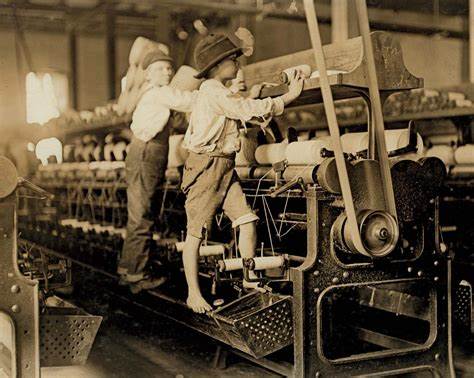
Each of your workers is now performing very simple tasks that anyone, even children, can do. In fact, lately, you have found machines that can do much of the repetitive tasks even cheaper and more efficiently than can people. Instead of paying your workers $50 a day, you are paying them $5. This is barely enough for them to survive. But hey, that’s their problem. It’s a free market. If they want to do better, they can start their own chair factory.
But can they? To start a chair company, they need capital. They don’t have capital. All they have is their bodies, and all of their time is spent keeping those bodies alive.
This was the world that Marx was looking at. He looked around and noticed that, despite the massive expansion of wealth created by capitalism, few people really benefited. There were a handful of very wealthy people who did nothing but own stuff. Then there was the rest of humanity. Millions lived in urban squalor, destitute despite working long hours in the factories. They owned nothing except their own bodies. All the stuff they needed to survive, housing, food, clothing, was owned by the capitalists. The capitalists weren’t going to give this stuff away, they weren’t going to share, but they were willing to sell it for a profit in the form of money. To survive, you needed money. To get money, you had to exchange your body and your energy to build the chairs that the owner then sells for a profit.
The problem was what Ricardo identified as the Iron Law of Wages. If you found a job that paid really well, other people would try to compete for that job and undercut you, offering to work cheaper than you. It wouldn’t be long before your wages fell. If they fell too much, to the point where nobody could survive on that wage, then people would find work elsewhere. Consequently, the natural level of wages was only ever going to be enough to subsist. This was good news for you, the factory owner, because lower wages meant more profit for you.
So, we have a system that works really well if you happen to own the means of production. If you don’t, however, the system exploits your poverty.
Track 3: Hegel’s Blues
To understand what Marx meant, we have to understand the perspective he was bringing to his analysis. When Marx was a young college student, he was like all such students in Germany at the time, very influenced by a fellow named Georg Wilhelm Friedrich Hegel. Hegel was an idealist in the truest sense of the word. He believed that history evolved as a result of competing ideas. Let’s say you had a great idea, like men look best when they are clean shaven. Your idea takes off and men start shaving their beards. Then someone comes along and says, “hey! I like my beard! I’m not shaving.” Now there’s a conflict between these two ideas and we start slinging it out with the Babyfacers debating the Werewolves. Eventually, we get to a place where we are okay with beards, but they have to be trimmed.
The Babyfacers had what Hegel called a thesis. The Werewolves countered with an anti-thesis, but this anti-thesis is inherent in the thesis…men can have beards, otherwise there would be no need to shave. The conflict between two ideas, Hegel referred to as a “Dialectic“. The idea of trimmed beards is the synthesis between the two conflicting ideas. But now, this synthesis becomes its own thesis–men look best with well-trimmed beards. This is ripe for someone to come along and say, “hey! I like my scraggly beard!” and a new dialectic is born!
Hegel saw this process of competing dialectics as the driving force of history. From this process we get the emergence of Enlightenment thought. Man should be free. Man should be constrained. Man should be mostly free, but somewhat constrained. And the dialectic continues. We can see this in contemporary debates. The acceptance of same-sex marriage is a great example. This was an idea that was not even discussed when I was a kid. It was silly to think that a man could marry another man. But someone came along and said, “why not?” Now same sex-marriage is legal and not uncommon–but still contested.
Track 4: Materialist Blues
Marx, a German philosophy student, was well steeped in Hegelian theory. He fully embraced the notion of conflict and the dialectic as a driving force of history. However, he rejected the notion that the conflict was one of ideas. When he looked around, he realized that relatively few people were intimately involved with ideas at all. Instead, they were just trying to survive. The ideas that they had were more often than not influenced by their material realities.
I’m a working man with a working wife, raising children in a world where they have to work to survive. I’m going to teach my kids to develop a “work ethic.” I’m going to teach them how to find and hold a job. I may hate my job, but I don’t have the luxury of playing around with hippy ideas of a life unburdened by material wants. I have to survive, and I have to teach my kids how to survive in the real, material world.
Furthermore, if you look back at history, this was always the case. I’m a factory worker in nineteenth century Europe struggling to survive. The world I would like to see, the ideal world, is one where I don’t have to struggle, but the real world is the one I have to deal with. That’s no different from a feudal serf, or an ancient slave, or Centurian on the march in Caesar’s armies. Our response to the world is predicated on our material realities. The more material resources we have at our disposal, the more flexibility we have in playing with ideas. Through all of history, however, few human beings had that luxury.
Instead of looking at history in the Hegelian sense of idealism, Marx flipped the script. Idealism was a bit player. The true driving force of history is the material reality in each age. This becomes Marx’s foundational contribution to history and philosophy. The song is called Historical Materialism. It’s the idea that history should be analyzed by looking at the material realities of those living it.
Marx did, however, like Hegels concept of the Dialectic. He simply disagreed that the dialectic had anything to do with ideas. Instead, the inherent conflict, the dialectic, is based on the inherent competition for material resources. In any given society, there are those who have control over the material resources necessary for survival, and there are those who do not. These two groups are not going to get along. Those who control the material resources are not just going to share with those who don’t out of the goodness of their hearts. They are going to live in an inherent state of conflict. This is called Dialectical Materialism…and it’s Marx’s first number one hit!
Marx saw this dialectic as a law of history. Humanity, according to Marx, would have to pass through a series of Dialectics before shedding itself of conflict and settling into a peaceful and productive communist utopia. This idea is going to create some philosophical problems. It will also create some very real material problems. This will be covered in a later post.
Track 5: The Dialectical Blues
Once upon a time, according to Marx, the material reality for human beings was one of pure survival. The inherent conflict was one of humanity vs. the natural world. To effect survival, people worked together in tribes. Everyone was dedicated to the means of survival rather than the means of production. There was no private property2. There may have been chiefs and shamans and people with higher status, but overall, everyone did the same jobs, mostly procuring food. There were no social classes. The tribe shared everything, and everyone benefited from participation in the tribe. It was a state of Primitive Communism.
Then, someone discovered that you could catch baby animals and raise them to make more baby animals. This was much easier than hunting. You could clear out the plants that you didn’t need and make more room for the plants you did need. And you could take the hard things in the plants and put them into the ground and make more plants. This was much easier than gathering. Humanity had discovered technologies, horticulture and agriculture, that allowed for the production of surplus food, and the means of production were born, and with it the dialectic.
Having a surplus freed some people from the food production process. They could do other things. Some of those people helped keep track of the food. Others participated in protecting the food from those who might want to steal it. Then there were those who took charge of the food itself. And, if this person had a group of big, burly guys to protect the food, and they were big enough and burly enough, they could use them to go take other groups’ food. Militarism was born.
Control of this surplus fell into the hands of a small knot of people who made the decisions about how this surplus was gathered, protected, and distributed. Tribal leaders became kings (and in some few instances, queens…but not many) The vast majority of the people, however, were tasked with actually doing the physical labor necessary to produce the surplus. In ancient times, this was slaves who were owned by masters3. This was the first dialectic, and the beginning of human history.
Since then, humanity has always been divided between those who have the stuff, the upper class, and those who do not have the stuff but need it to survive, the lower class. In Marx’s words, “The history of all hitherto existing society is the history of class struggles.”4 This is the intrinsic dialectic. It’s also a dangerous way to organize human societies. Those who control or own the stuff are always dependent on those who make the stuff. Furthermore, those who make the stuff always outnumber those who control the stuff. Under the right conditions, this dialectic can implode, toppling those who have the stuff. When this happens, however, the only real change is in those who control the stuff. When a new group seizes control of the means of production, they use this control to exploit others to do the work.
Track 6: The Proletarian Blues
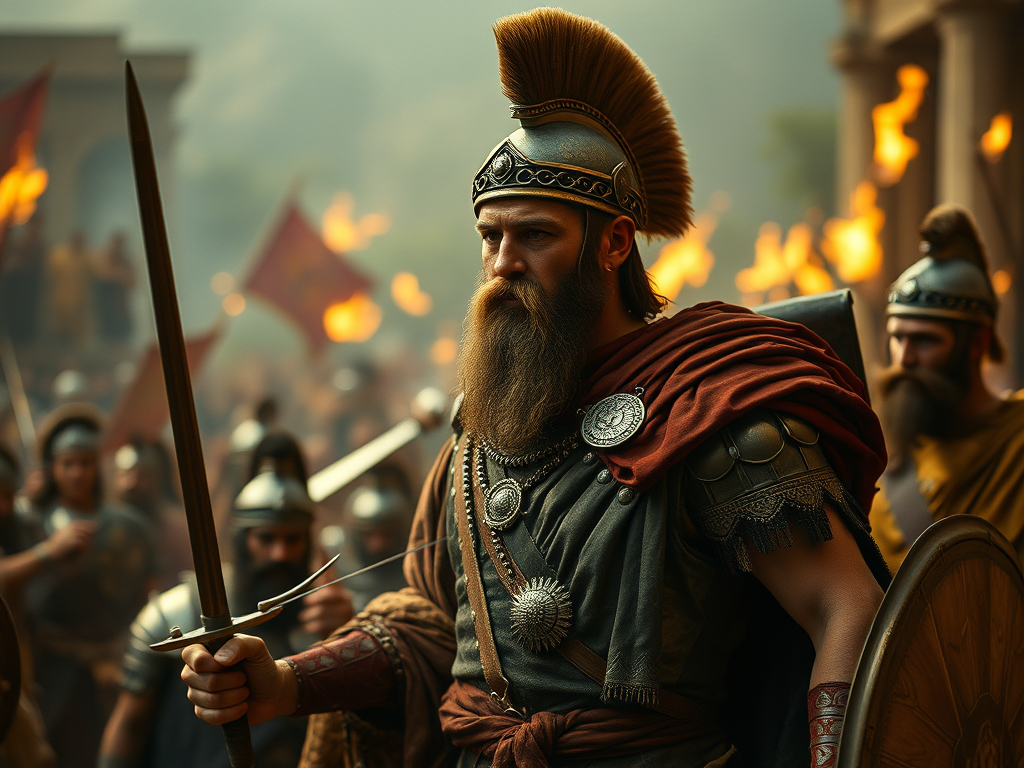
The first dialectic, according to Marx, was one of masters and slaves. In this case, the masters controlled vast armies used to capture slaves and land to produce more stuff. This system collapsed with the fall of the Roman Empire in the fifth century. The next great dialectic was called Feudalism, a system in which the labor of serfs was exploited by a militaristic landed nobility bound together through a material system called vassalage.
This system lasted about a thousand years but was replaced with the rise of a merchant class after the opening of Asia as well as North and South America to European traders. This merchant class, called the Bourgeoisie in France, became very wealthy through a system for keeping, maintaining and expanding investments–a system we now call capitalism. As the Bourgeoisie became more wealthy and powerful, they eventually challenged the status of the old Feudal nobility and overturned Feudalism in the revolutions of the eighteenth and early nineteenth centuries.
The system the Bourgeoisie created was one in which the important stuff was no longer land, per se, but capital that could be defined in terms of money. This is called wealth. The Bourgeoisie owned the wealth and thus controlled the money and invested that money on manufacturing and trade. A growing population became dependent upon getting access to that money. They provided the labor in the factories in exchange for some of that money. Marx referred to this group of desperate urban laborers as the Proletariat.
The modern dialectic then became an inherent conflict between the Bourgeoisie and the Proletariat, or in contemporary parlance, the capitalists and the working class. It was and remains, according to Marx and Marxist theorists, an inherently exploitative system by which the proletariat must sell their bodies to survive, while the Bourgeoisie profits from their labor.
Track 7: Labor Blues
The conflict starts from David Ricardo’s Labor Theory of Value. You see, Ricardo recognized that if you have a hammer, nails, and wood and you just stare at it, given enough time you will have an old hammer, rusty nails, and rotten wood. You have nothing. Chairs, on the other hand, are things of value. As mentioned above, they have use value, and they have exchange value. Chairs, however, do not magically appear. To get the chair, you have to put your physical energy into using the hammer, nails, and wood. Consequently, the labor (the time and energy) is what adds value to the chair. Without the labor, you just have pile of wood and nails.
That seems sensible enough. So, what’s the problem?
Let’s map it out.
I’m a furniture maker during Feudalism. I buy or acquire the materials, and I make a beautiful chair. The materials cost me $20. I sell the chair for $100. The value I added to the wood and nails to make the chair through my labor was $80. I get to put the full value of my labor in my pocket.
Now let’s say I’m a chair capitalist. I don’t make chairs myself. I may not even know how to make chairs. I hire people to make the chairs for me. I pay $20 for the materials. I can sell the chair for $100. That’s the exchange value of the chair. If I pay the workers who made the chair the full $80 of the value that they added to the wood and nails, I can’t make a profit. I get nothing.
As a capitalist, I’m not willing to do that. I’m trying to make a profit. There is only one way for me to make a profit in a capitalist system. I have to pay my workers less than the value that they added in doing the work. I will pay $20 for the materials because that’s the materials cost. I can’t control that. When it comes to my workers, however, I’m only going to pay them $60. The extra $20 is then called surplus value. From my point of view, the owner, the surplus value represents my profits. However, this same surplus value from the worker’s point of view, can be looked at as a theft of the worker’s labor. It represents how much I’m underpaying my workers.5
Marx saw a couple of problems with that.
First, as the owner, I had nothing to do with making the chair. I put in no productive labor. I profit because I own the means of production. In Ricardian terms, I extract rents from my ownership.
Secondly, the more surplus value I can extract, the more profits I make. In other words, I have an incentive to pay my workers the least I can get away with. According to Ricardo’s Iron Law of Wages, that is just enough for mere subsistence. I have a vested interest in exploiting my workers.

Now, here’s the important thing that a lot of people fail to understand about this analysis. This is not a matter of me being a greedy capitalist. The exploitation of the workers is not the result of my personal greed or lack of character. The problem, according to Marx, is capitalism itself. Exploitation is inherent in capitalism as an economic system.
I might be the best guy in the world. But in a capitalist system, if I don’t make a profit, I go out of business. The only way to make a profit is to pay my workers less than the value of the work they do. There’s no other way to do it in a capitalist system. I must exploit my workers.
Because of this, Marx believed that there was no way to make capitalism work for everyone. Capitalism could not be reformed and democratized. It could only be overthrown. Furthermore, capitalists understand this and work very hard to keep that from happening. That’s the topic for next post.
Stay tuned for
The Superstructure: Keeping the Dance Going
Notes
All images in this post were AI generated except for Figures 1 and 2.
- It’s important to note that I own the rights to the profits because the state agrees to this arrangement. Fans of capitalism really don’t like thinking about the role of the state in protecting my “right” of ownership and my “right” to profit from that ownership. But it is important. Ownership is only possible with a strong state recognizing and backing that ownership. These are called Property Rights. ↩︎
- Private property is a really important, and often misunderstood concept in Marxist philosophy. For Marxists, private property equates to the formal ownership of the means of production by individuals and companies. It’s this private property, protected by the state, that makes capitalist exploitation possible. Marxists distinguish between private property and personal property. Personal property is those things that you own for their use value. Marxists, like all communists, endeavor to eliminate private property, but not personal property. ↩︎
- It’s important to note that this improvement in the amount of food did not translate to better health for most people. Often, increasing the amount of food led to decreasing the diversity and the quality of food, often leading to poor nutrition. Graeber, David, and David Wengrow. 2021. The Dawn of Everything: A New History of Humanity. ↩︎
- Marx, Karl and Friedrich Engels. 1848. The Communist Manifesto. ↩︎
- The examples used by Ricardo and again by Marx take a different form. Marx goes into great detail about the time it takes to make the chairs as opposed to the time necessary for the workers to add enough value to sustain themselves. As a worker, it may take me only four hours of labor to contribute enough value to the chair making process to sustain my survival. The capitalist, however, requires me to work for ten hours. In essence, the six hours extra that I’m working I’m doing so for free while the capitalist pockets the value that I added during that time. I find this explanation a bit confusing for students to grasp, so I’ve simplified it by looking at the surplus value in dollar terms rather than in time/labor terms. ↩︎




 The Mad Sociologist Blog
Leave a reply to Mad Sociologist Cancel reply