

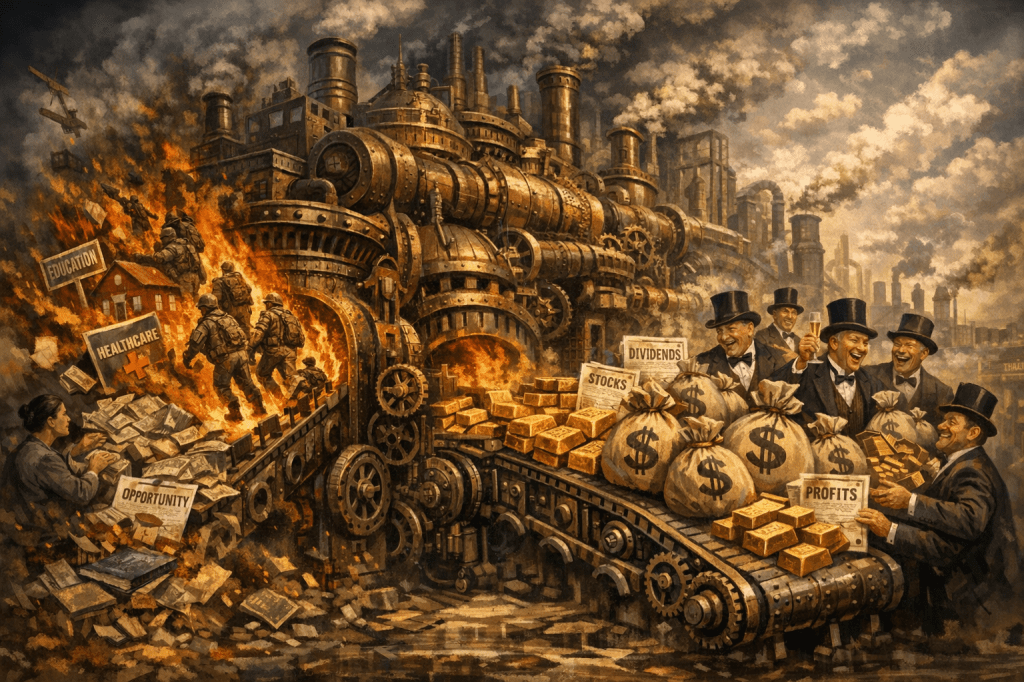
More evidence that a Free Market is inherently corruptive.
If you’re like me, then you see the term “corporate corruption” as an unnecessary redundancy. The widespread nature of this noxious corporate culture became glaringly obvious in 2001 when companies like ENRON and Worldcom, etc, were exposed as institutionalized scams. Trading in image rather than substance the corporate managers bilked billions of dollars from millions of unsuspecting investors and consumers while at the same time lining their pockets based on information that only they had access to.
Of course, this was nothing new. From the Keating Five to BCCI and the S&L scandals of the eighties the United States should have been prepared for the likes of Ken Lay and his ilk. But we weren’t. When corporate malfeasance and short-sightedness plunged the nation into recession in 2001 the political response from conservative politicians invested in free market policies culminated in an even greater collapse in 2008one that brought down the entire world in what is being called the Great Recession.
Since then, working Americans have been living on a frayed tightrope, watching their workplaces shut down, their savings evaporate and their unemployment compensation run out. Millions have lost their homes. Meanwhile, the dispossessed get to watch a parade of largesse from the corporate boardrooms as those who actually created this catastrophe are rewarded with six figure compensation packages on the tail of a major bailout.
We know that the cards are stacked against us, that a system which rewards the culprits at the expense of the victims is inherently unjust. It’s rare, however, that academics actually conduct the necessary research to highlight this corruption. Corporate corruption is usually the subject of journalism, not academic sociology.
So it was heartening to me when I noticed an article in the American Sociological Review that did just that. Harland Prechel and Theresa Morris analyzed the historical data on Fortune 500 companies to highlight a causal explanation for corporate malfeasance, lack of regulation and oversight on the part of the government and small investors. “The historical analysis shows that neoliberal policies enacted between 1986 and 2000 resulted in organizational and political structures that permitted managers to engage in financial malfeasance.” (331)
According to Prechel and Morris, the free market policies advocated by conservatives in both parties, including neo-liberal Democrats, lead to capital dependence on major investors at the expense of small investors, incentives for managers to mislead and misrepresent corporate accounts, “information asymmetries” that kept small investors in the dark and opportunity structures conducive to managerial malfeasance. This began with the massive increase in corporate influence over the political process. Skies-the-limit campaign coffers of Fortune 500 companies ensured that corporate friendly politicians filled the seats of Congress while round-the-clock lobbying guaranteed policy alignment between legislators and the corporate elite.
In 1986 Congress passed the Tax Reform Act. Key to the corporate elite was the provision that eliminated New Deal taxes on cash transfers within a single corporate entity. The Multi-Layer Subsidiary structure of modern corporations was born. By expanding its divisions into subsidiary corporations, a parent corporation could better manipulate its majority investment in the company. It was also in a better position to hide its losses and create the impression of false growth through complex capital transfers and off the books accounting.
In 1992 the SEC relaxed rules that regulated interaction between management and investors. Since corporations had become dependent on their major shareholders for capital, corporate managers and large investors could align their goals. These goals were often at the expense of small investors who were not privy to high level communications. This is what Prechel and Morris refer to as “information asymmetries.” It was these asymmetries, for instance, that lead to the ENRON scandal.
In 1995 Congress overrode President Clinton’s veto of the Private Securities Litigation Reform Act. This piece of legislation was justified by conservatives and neo-liberals as a means for deflecting “frivolous lawsuits.” As is always the case with tort reform style changes, the effect was to limit the capacity for those who were violated to seek legal recourse. In this case, investors were no longer allowed to use SEC laws to bring suit against managers who used “speculative statements” about corporate finance. Since just about every statement made by corporate managers could be considered “speculative,” small investors lost the last element of holding corporate managers accountable. This came on the heels of two Supreme Court rulings that limited investors to a short timetable for bringing suit against corrupt managers, and restricted their ability to hold corporate attorneys responsible for acting as corporate consiglieri.
Then, in 1999, came the crown jewel of the neo-liberal movement. It was called the Gramm-Leach-Bliley Financial Services Modernization Act. This law overturned the crucial Depression Era Glass-Steagal Act which kept commercial banks separate from financial investment firms. After 1999 commercial banks could provide financial advice and services that reinforced their own commercial investments. A clear conflict of interest.
Then, in 2000, the Commodity Futures Modernization Act became law. This law deregulated, of all things, the derivatives market. Remember derivatives? It was speculation in derivatives, often comprised of bundled mortgages and other risky investments and futures speculation propped up by a tenuous housing bubble that caused banks in 2008 to go belly up when the bubble burst.
So by 2008 large investors, in cahoots with corporate managers, could invest in high risk derivatives designed by commercial banks acting as investment firms without disseminating this information to the majority of their shareholders. They could freely transfer their funds between subsidiaries, hiding their gains from regulators, but also hiding their losses from their current and future investors. With lax regulation, both due to legal constraints as well as the prevailing political ideology of those in office as well as those at the FED (a point not made by Prechel and Morris) there was no one watching the store. If someone did catch on, there was very limited legal recourse. Managers now had an open door to pursue any strategy they wanted to maximize their outcomes.
And here’s the kicker. Manager’s were often compensated with stock options. It became an incentive for corporate managers to steer capital toward risky, unregulated investments with the potential for high returns. When such gambles didn’t pay off it was incumbent upon the manager to exaggerate, manipulate and outright lie about the financial health of the company lest the stock lose value. One method mentioned in the study was the use of Off-Balance Sheet Financing. With multiple subsidiaries dividing and bundling good investments with bad investments then swapping cash transfers through ever more elaborate and creative book-keeping what could possibly go wrong?
This research demonstrates that the worst thing that can happen to capitalism is de-regulation. According to the study, “the power of the managerial class is at a historic high point because a power imbalance exists between corporations and the state.” (350) As is always the case, when the power of one particular group grows unchecked you can expect exploitation, or using the phraseology of this study, malfeasance.
The authors suggest some solutions with regard to restructuring policy. Their analysis, however, pinpoints certain institutional and historical forces in play that must also be addressed. Most immediately is the disproportionate influence of the corporate class over our government institutions. The American political-economy is such that we cannot expect our “representative” institutions to clamor for policy change. So long as our politicians are as capital dependent as are corporations, and this capital is derived from large investors, those large investors in both the market and the halls of government, will continue to assert undue influence over policy decisions.
The problem is that a free market is inherently corruptive. Not only does the neo-liberal philosophy corrupt economic institutions, but it also promotes malfeasance in any institution in touches.
________________________________
Prechel, H. Morris, T. “The Effects of Organizational and Political Embeddedness on Financial Malfeasance in the Largest U.S. Corporations: Dependence, Incentives, and Opportunities.” American Sociological Review. 75(3). 2010




 The Mad Sociologist Blog
Leave a reply to Irrigation Drip System Cancel reply