

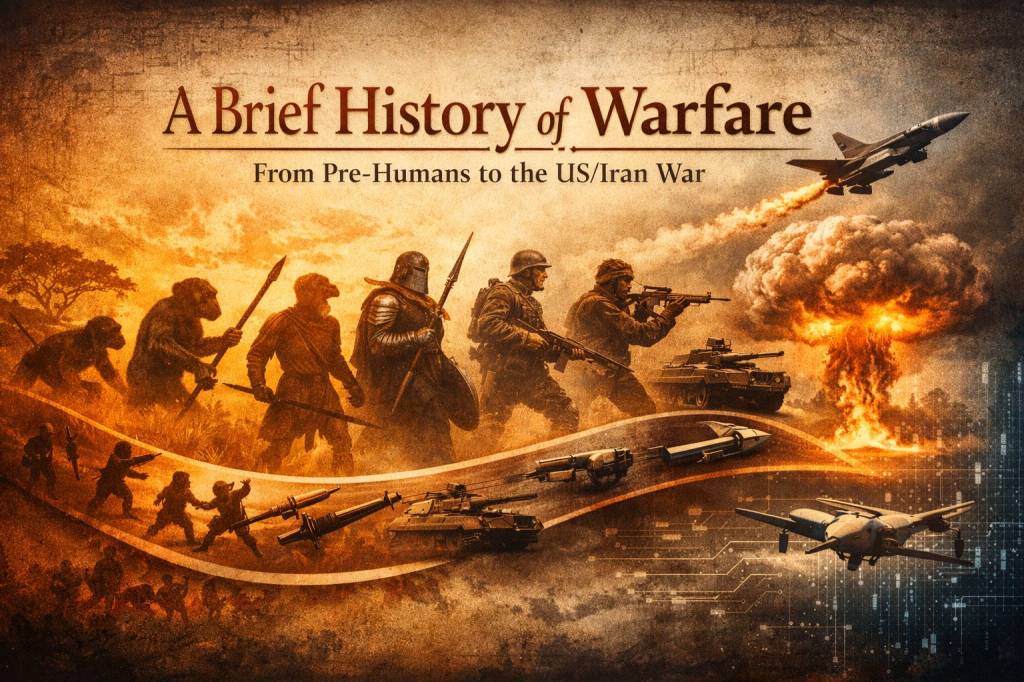
On Why Wars are Unwinnable
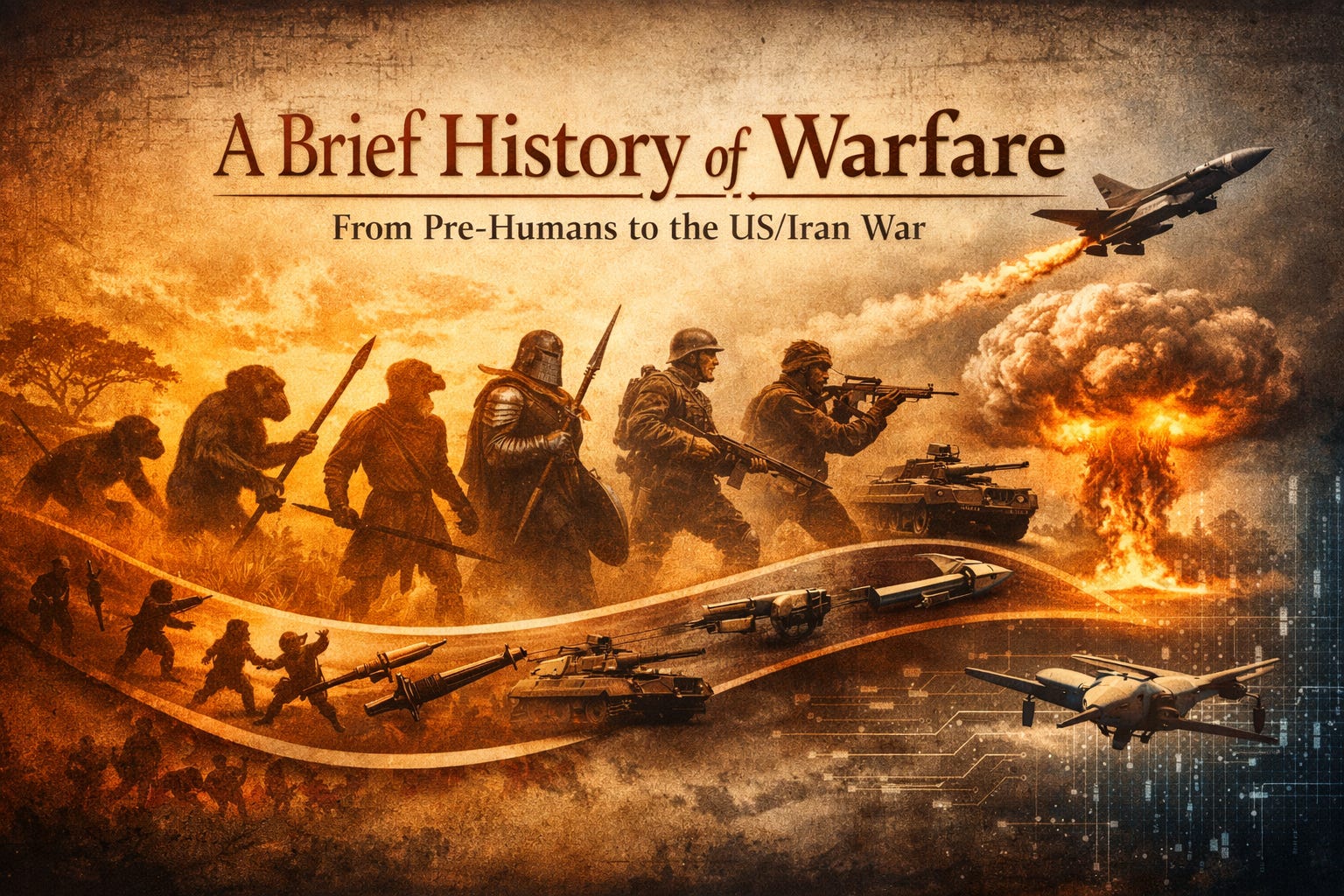
Introduction:
There’s a brutal civil war taking place in Uganda. It’s a historically violent conflict, the likes of which only happens once or twice in a millennium. That is, if you happen to be a chimpanzee. Primate researchers have now been collecting data on the deadly civil war taking place between the Western and Central branches of the Ngogo Chimpanzee group. So far, this war has included two dozen battles and has led to two dozen deaths, including those of seventeen infants.
Around ten thousand years ago at least twenty-seven human beings were massacred in what is now Nataruk, west of Lake Turkana in Kenya. Six of the victims were children, one was a visibly pregnant woman who appears to have been bound at the wrists when she was killed. The mummified remains of the victims reveal, “extreme blunt-force trauma to crania and cheekbones, broken hands, knees and ribs, arrow lesions to the neck, and stone projectile tips lodged in the skull and thorax of two men.” The cause of this human atrocity is lost to history. What is clear, however, is that planned warfare and premeditated inhumanity against one’s fellow man precedes human civilization.
Meanwhile, ten thousand years after this butchery by an ancient African lake, we have an administration openly reimagining global military dominance, eschewing established limitations on war that emerged with the modern age, and disregarding even the rhetorical pretensions of defense in reconstituting an imperial Department of War. In charge of this War Department is the human analogue of the stereotypical primate alpha male, pounding his toned and tattooed chest, emphasizing masculine virtues of lethality. We have a national leader openly declaring that we cannot pay for childcare, or healthcare. Instead, we need massive spending on an overwhelming military machine with which to re-establish our dominance over the world.
Yet, this administration’s latest foray into alpha-male nationalism, a senseless bombing campaign against a nation that has never attacked us despite almost half a century of conflict and antagonism, turned out to be a disaster. In fact, since the ascension of the United States as the dominant military power after World War II, and despite the unprecedented amount of money and resources dumped into the military over which Pete Hegseth now presides, the history of contemporary warfare has been dismal. “Since 1950, strong actors in asymmetric conflicts (not limited to, but certainly including the United States) have lost a majority of fights with nominally much weaker adversaries (up until 1950 strong actors had won a majority of such fights).” The U.S./Iran War is just the latest in a line military failure.
The implication of the Ngogo Chimp Empire research and the disheartening history of human warfare since The Massacre of Nataruk is more than alarming. Does this bloody spectacle among humanity’s closest biological cousins reveal some innate drive in human nature to inflict violence? Has three million years of human evolution culminated in the tatted torso of our Secretary of War?
Or is the late historian Howard Zinn correct in his hypothesis, “Are there not persistent facts about human society that can explain the constant eruption of war without recourse to those mysterious instincts that science, however hard it tries, cannot find in our genes?”1 After all, if humanity is intrinsically warlike, why do our leaders have to lie to convince us to take up arms?
We better figure it out. Understanding that overlap between our genetic and our cultural evolution needs to be foremost in our collective imagination. Our chimp cousins go to war with sticks and rocks. Our human predecessors used spears and arrows. A survey of social history suggests that any biological or cultural propensity to mass violence is now colliding with human technological evolution.2 If we are the slaves of biology, then humanity exists on borrowed time, an apocalyptic clock. However, if warfare is a cultural construct, even if tangentially influenced by our genes, we may yet stand a chance in building norms and values that prod us toward peace.
Warfare has always been a fragile hook upon which to hang one’s future. Conflict deplores power asymmetry. Technological innovation often resolves any power asymmetry between social groups. Innovations in killing technology may incentivize conquest. They also encourage further innovation to compensate for the gap in power. This is an immutable engine of technological evolution that has reached its plateau.
Today, technological innovations in warfare have all but eliminated long-term power asymmetries between even the strongest powers in conflict with the weakest. We have reached a point in which the best even a superpower can hope for is a short-term victory in a limited conflict. Anything more is bound to failure.
Then, of course, there’s the worst-case scenario. Civilizational annihilation.
I’m an independent writer trying to compete with the big guys. My goal is to provide quality, accessible and readable analysis of the world around us. If you think this essay is doing exactly that, please subscribe.
When Wars Could Be “Won”
The Ngogo Chimp Civil War and the Massacre of Nataruk challenge our assumptions about human warfare as an artifact of civilization. The standard paradigm assumes that warfare evolved as humanity developed agricultural surplus. This surplus required protection of markets in which this surplus was stored, as well as the fertile lands from which this surplus was derived. Freed from food acquisition, the most intimidating males could be assigned the job of defending the resources of the newly emergent kingdoms. And if those males are effective enough defenders, why not use them offensively as a means to take other kingdoms’ stuff?
As satisfying as this explanation is to our materialist preconceptions, it falls short as an explanatory model. The Ngogo Chimps do not have a grain surplus. Nor was it likely that the Massacre of Nataruk was so inspired. After all, a community with a massive surplus of grain or food would be better served to just share it, or to exchange it for other goods. In fact, in most cases, they did exactly that.
Sargon the Great (~2300 bce), humanity’s first recorded conqueror, did not train, arm and inspire his warriors by virtue of some innate violence on their part. Nor did he tell them that they were being put in harm’s way to secure some barley that they could easily acquire through trade. Existing evidence suggests that Sargon may have had materialist aims, but he used transcendent and exclusionary rhetoric to inspire others to fight his wars. He had the best technologies for killing, he had the most innovative tactics. He was in a position to take the stuff of other cultures and control their valuable lands and waterways. His soldiers, however, fought for different reasons. Many saw fighting as a way to get access to resources or status. Others were convinced that they were doing so to protect their loved ones from dangerous others. Some fought because they believed in the divine destiny of their king and wanted to be a part of it.
These are not so different from why folks sign up for the military today. Economic opportunity. Social status. Fear. Transcendent values.
Regardless, King Sargon’s forces went forth armed with the best weapons, trained with the best skills, using the best tactics. Once victorious, a king, like Sargon, with a strong enough force, could win by taking and controlling the land and resources of other kings. Such a king could then become something else, an emperor. So long as that emperor had the strongest army, or the best military tactics, he could rule. Doing so may, in the eyes of his soldiers and subjects, seem to confirm his divine calling. It also created the reality that our people must be protected from thosepeople, because thosepeople are plenty mad that we took their lands, their waterways and their stuff and might just strive to get them back.
The conflict inherent in this system was always obvious. Controlling so much of what others valued incentivized other kings in other kingdoms to raise their own armies, advance their own killing technologies, and innovate new tactics to challenge the dominant Emperors. To do so they also appealed to their gods and swore to protect their people from the threat of thosepeople. Empires founded on principles of mass violence tended to vanish once their tactical advantage was matched. They fell to external forces that figured out how to neutralize the Empire’s strengths, or they fell to internal coalitions intent on taking the mantel of power for themselves. Thus, fell empires from the Akkadians to the Macedonians. Power hates an asymmetry, no matter how great.
Empires that endured, however, did so because their leaders realized that victory in battle was not an end in itself. Winning a piece of real estate at the point of a spear was, at best, a temporary benefit if that real estate couldn’t be held. The desire to balance the asymmetry had to be mitigated. It’s no coincidence that diverse empires with little contact came to the same conclusion about the next steps in military conquest. The Han in China and the Romans of the Mediterranean, around the same time, realized that their armies were nothing more than the tip of the spear. Once land was secured, and the requisite number of slaves taken, the emperor needed to consolidate his legitimate claims, his divine right. He had to do something to disincentivize thosepeople from balancing the asymmetry. They did so by coopting existing political, economic, and religious elites. Later, they sent their engineers to build roads and other infrastructure, improving the material lives of those living in their conquered territories. They found ways by which diverse people could identify with being citizens of the Empire.3 In other words, they endured by convincing thosepeople that they were now a part of uspeople.
Of course, Rome and the Han could not incorporate everyone. First, they needed slaves to do the work of building and maintaining the empire. Secondly, there was a natural limit to their ability to conquer. Where those boundaries formed, asymmetries became obvious. The great agrarian empires emerging from conflict cannot help but generate power asymmetry. Wherever that asymmetry can be exercised, within the boundaries of empire, its power becomes a shield against weaker structures. Where that asymmetry breaks down, like the Xiongnu lands and the Scottish Highlands for the Han and Roman Empires respectively, they built walls. Where one powerful empire bumps against another, as with the Romans and the Parthians, warfare is often extensive and costly to the point where both cultures come to terms and build garrisons that face each other as an ever-present reminder of the costs of war.
Such empires tend to accumulate a lot of wealth, including control of strategic geographies which it uses to sustain itself. This wealth becomes the incentive for external and internal forces to intrigue against the power of the Empire. These forces lay like predators waiting for their opportunity to pounce, scanning the great power for any sign of weakness. And weakness is sure to come in the form of natural calamity, weak or complacent leadership, over-extending the Empire’s military commitments, unexpected military defeat, economic turmoil. There is one avenue for imperial success, but multiple routes of failure. Each is taken as an indicator of divine will.
Calamities happen, even among the great Ngogo Chimp Empire of the 1990s. Researchers hypothesize that a key source of the violent conflict was the death of key leaders among the chimps who served as social bridges between different clusters within the larger group. When those chimps died, the clusters became increasingly isolated and polarized against presumed threats from the other clusters. The different Chimp Clusters developed a sense of thosepeople vs. uspeople, or rather thosechimps vs. uschimps. The leaders that emerged in the context of that isolation, polarization, and dare I suggest paranoia, acted on the impulses characteristic of fear.
Empires collapse when the social ties that bind diverse groups are severed. This does not seem to be a specifically human characteristic. Fragmented feudal fiefdoms result, all weary of the other. In ancient times, the great walls were breached, but thousands of smaller, fortified walls were built around castles that controlled the regional countrysides. Winning meant breaching the castle walls, deposing the established Lord and exacting tribute from his vassals. The rise of a meticulously trained warrior caste around the personality of a central baron assured a long period of military strife between Baronies and Dutchies and Earldoms until one could consolidate enough power to declare themselves king, protector of the realm from thosepeople…in the name of God.
Often missing from the historical analysis of warfare is the lives of ordinary people, the serfs who worked the fields, the craftsmen who made the goods, or the slaves who performed the labor nobody else wanted to do. At first, they found themselves in the path of great, heavily armed, well-trained armies building empires. Or they were at the mercy of a military caste serving the whims of one wealthy patron or another. They had few means to resist these intrusions into their lives, possessing neither functional tools of war, nor training with which to defend, let alone design their own interests in the face of power. They were the victims of military asymmetry, and thus subject to the whims of those with the weapons.
Help me compete with the big names. Share far and wide!
Arming the Commoners: The Precarity of Military Asymmetry
History may be written by the victors, but the forces of history continue to work against power asymmetry. In 1199 ce, Bertrand de Gurdon, a boy guarding the ramparts of the Châlus-Chabrol in the Limousin region of France, saw an opportunity to avenge the death of his parents against their murderer. He raised his crossbow, took aim, and fired a bolt through the armor of the world’s most storied warrior, King Richard I The Lionhearted, hero of the Holy Crusades. Richard died ten days later of gangrene.
The French boy’s act was significant in many ways. The crossbow, an ancient Chinese weapon, was becoming common in the eleventh century Europe. It had many benefits. First, it was cheap and easy to make. Secondly, it required very little training for one to become proficient enough to take down even the best trained mounted and heavily armored knight. Richard I famously embraced the crossbow as a great equalizer as he led often poorly trained conscripts off to battle the mighty Saracens during the Crusades. This weapon was so efficient that Pope Innocent II, seeing the writing on the wall, banned it during the Second Lateran Council in 1139, declaring it to be “hateful to God and unfit for Christians,” at least when it came to killing other Christians. For killing Muslims, it was fine.
As kings rose to prominence throughout Europe, their ability to put effective weapons in the hands of commoners and mobilize them against their enemies became invaluable. Even an army of the best trained knights had better have a regiment or two of commoners with crossbows when marching into battle. When it comes to war, lethality beats out holy condemnation any day of the week. This was the beginning of the end of the military caste known as Knighthood.
By the fifteenth century, commoners with simple but effective weapons were filling military ranks all over the world. In China, the Mongols using light cavalry and composite bows made hash of every well trained, heavily armored military they encountered, creating the largest empire in world history. In Japan the mighty Samurai were humiliated in the Battle of Hemi by foot soldiers armed with bows. At the Battle of Agincourt, commoner archers with long-bows defeated a numerically superior French army of mounted Knights.
The incentive for mass armies of commoners, raised at a moment’s noticed, trained in weeks or months, then sent to the field to defeat seasoned warriors with years of fighting experience was brought to a head with yet another Chinese innovation. Gunpowder was first used in canons and ushered the end of the wall as an effective defensive technology. As metallurgy improved, smaller canons were built until they could fit in a person’s hands. The musket, and the rifle replaced the sword or the pike as an army’s defining feature. The military was no longer a “divine” calling for an elite or semi-elite class. It had become a job, perhaps a career, for commoners. The soldier replaced the warrior.
These late feudal developments marked the birth of the modern age, but also the end of the kind of asymmetry that made wars “winnable” in any meaningful way. Great armies marching into battle against other great armies turned wars into macabre campaigns of attrition resulting in appalling violence, instability, and destruction. As weapons of war became less expensive, more prolific, and easier to use, they also destroyed the asymmetry between the conqueror and the conquered, making it far more difficult for a ruler to impose military authority over any region.
By the middle of the seventeenth century, Europeans found themselves exhausted militarily, culturally, and economically as they stood in the rubble left after thirty years of the most brutal warfare known up to that time. It was, of course, a war fought ostensibly for the glory of God. Eight million people were dead, not just from combat, but from the resulting disruptions to resources and trade causing famine and disease throughout the region. Cities were smoldering. A third of the German speaking population was wiped out. Central Europe never recovered. Even the victors could hardly claim that their gains were worth the immeasurable sacrifice. Europeans realized that the costs of war were far too heavy. On the other side of the world, the Tokugawa in Japan had come to similar conclusions at the end of their Sengoku Period. Rules had to be put in place to ensure that such bloodshed never happened again.
The Long 19th Century and the Myth of the Winnable War
According to tradition, almost certainly apocryphal, Marshal Michel Ney was the last French soldier of Napoleon’s Grande Armée to cross the Niemen River from Russia into Prussian territory. Ney fired his last shot and then threw his pistol in the path of the oncoming Cossack army he had been outmaneuvering during the entire ignominious retreat.
What is not apocryphal was the fact that the greatest military force in European history up to that time, an army of over six-hundred thousand men, was destroyed. Marshal Ney led the rear guard defending the slogging remnants of Napoleon’s Russian Campaign as they retreated. By most accounts, there was almost nothing left of this brave force. The indefatigable Marshal is reported to have fought next to his men, firing canon, braving attack, freezing in the Russian ice. Upon reaching safety he sent word to the French Emperor, “The army is no more.”
It was a parable for the historical forces to come.
After the Treaty of Westphalia ended the catastrophic Thirty Years War, Europeans continued to engage in wars with symmetrical powers. These wars followed the tendency of historical evolution to that point. Rules were written by the Dutch jurist Hugo Grotius in his work, De Jure Belli ac Pacis in a vain attempt to regulate the primate impulses of mass violence. These rules included strictures against attacking civilians, abusing prisoners, unnecessary and cruel destruction of property and infrastructure, and rules for what constitutes a just war. It would be an exaggeration to suggest that Grotius’ rules of warfare were universally respected. They were mostly good suggestions that gave warfare a patina of respectability…except when it didn’t.
Wars against symmetrical powers were not uncommon but did not descend into the kind of relentless butchery experienced during the Thirty Years war. Armies would engage. Victories would be won. Boundaries would be drawn. Bounties would be paid. Then another war, new victories, different boundaries, repayment of bounties. There were larger, even global conflicts, like the Seven Years War, but the glories of war in the tradition of Alexander, or Caesar, or Charlemagne were relegated to the past.
At least this was true until the rise of a Corsican citizen of France through the ranks of a French officer core decimated by the Reign of Terror. Napoleon Bonapart was a master tactician who excelled at moving armies faster and more efficiently than anyone else, using artillery and cavalry in ways nobody else did, and inspiring his troops in ways never before seen. When General Bonapart first took the field, all of Europe was arrayed against his country. Within a few short years, Bonapart defeated them all, often against superior odds. Many of his soldiers were draftees, but Napoleon inspired them into battle for greatness, for history, for liberté, egalité, fraternité, for the glory of France. He manipulated this military glory into political power, becoming an Emperor in the old Roman tradition presiding over a sizable chunk of Europe. He was unstoppable.
Until he wasn’t.
Again, history evolves against asymmetries. The problem with scoring victories by doing things nobody else has ever seen is that this necessitates people seeing what you are doing. In military terms it would require an endlessly innovative strategist to continue inventing tactics nobody had ever seen. Napoleon was innovative, but not endlessly so. When Napoleon invaded Russia, the Czar’s military understood that they did not have the military means by which to stop him. So, they took the great general’s strengths and found ways to counter them, to turn them into weaknesses, to create symmetry out of asymmetry.
Bonapart’s Grand Armée was huge. It was futile to try to engage it directly. A “Grande” army, however, requires equally grand amounts of food. Russian Cossacks attacked the supply lines. An army without supply lines would need to live off the land, a contingency Napoleon had long since mastered. So, the Russians destroyed their own lands, leaving nothing to satisfy the army’s needs. They did this even to the point of burning their own capital city of Moscow before French troops could use it to shelter from the harsh Russian winter. A grand army could defeat a less grand army engaged in battle, but a petite army could continuously inflict injury on such a force if it were dedicated only to hurting it, aggravating it, exhausting it, not defeating it. Russian armies didn’t have to “win” in the traditional sense. They only had to not lose long enough for mother nature in the form of ice and snow to do the rest. Napoleon won every battle of the Russian Campaign yet was forced to retreat. This pattern has repeated throughout modern history.
Napoleon’s victories were stunning. They were also costly. The Empire over which Napoleon presided lasted only ten years before he was forced to abdicate, returning briefly in 1815 before his final defeat at Waterloo. The social, cultural, and political implications of his reign continued and remain influential. Militarily, however, by the early 19th century everyone was well versed in Napoleonic tactics. There was nothing special about them anymore. Symmetry had been restored.
This shouldn’t have come as a surprise. In the Americas, colonial militants were defeating better trained and resourced European armies. In Haiti, a slave revolt overthrew the French military at the height of Napoleon’s power. European empires, with their rifles and cannons and versatile navies had extended their power all over the world, rivaled only by Imperial Japan as the 19th century progressed. However, they found themselves falling short where locals were able to achieve symmetry to their military power.
The problem was a Frenchman named Honoré Blanc, and Eli Whitney. Unique among individuals, Eli Whitney can claim to have changed the course of history twice. He is best known for inventing the Cotton Gin, an invention that brought great wealth to the American South and reinvigorated the dying institution of chattel slavery. His second invention, interchangeable parts, likely inspired by Blanc, was perhaps even more significant. He marketed his innovation to the United States government in terms of weapons of war. Because of Eli Whitney, relatively cheap, efficient, easy to repair rifles proliferated against the more expensive hand-crafted muskets. With easy access to rifles, those inclined to resist occupying forces were better equipped to do so.
Interchangeable parts were, of course, incorporated into every component of the industrial economy and largely responsible for the second industrial revolution. Wars could be fought with industrial level efficiencies. The results were devastating. As many as seven million people died because of Napoleon’s adventures, but this was just the beginning. The U.S. Civil War, the Crimean War, the Franco-Prussian War killed hundreds of thousands. The War of the Triple Alliance wiped out as much as seventy percent of Paraguay’s male population. The Sepoy Mutiny in India was suppressed by the mighty British Empire only after 800,000 deaths. The worst of them all, The Taiping Rebellion devastated China, causing the deaths of as many as twenty million people. All these wars were fought in the name of abstractions like Nationalism, an excited form of Thosepeople vs. Uspeople, racism, patriotism, and of course, the divine interests of the Lord.
Most of these conflicts were frozen in time by another invention. The photograph. Modern wars were not just grotesque in their consequences, but equally so in the images they produced of putrefying bodies lying scattered over the battlefield. Historically, the costs of war could be reframed in heroic terms with great paintings depicting the glories of battle. With the photograph, however, the heroic battle scenes were gone of secondary influence. Instead, civilians could see the bodies in the grass, the blood soaked into the soil. Thosepeople, Uspeople, the glories of God, seemed less convincing, requiring more and more dehumanizing propaganda for its perpetuation.
Fighting wars with symmetrical powers may have been too costly. Asymmetrical wars, however, were still available for the sake of the Greater Glory. In the American Indian Wars and the Scramble for Africa the Gatling Gun and the Maxim Gun mowed down any resistance. This new technological innovation, as well as quinine and flat-bottomed steamboats, made it possible for the United States to bring a century long conquest of indigenous people to an end, while Europeans penetrated the heart of the Dark Continent, mechanically scything indigenous Africans like wheat. As Hilaire Belloc bitingly penned in The Modern Traveler, “Whatever happens, we have got/The Maxim Gun, and they have not.”
Until they got the Maxim Gun, because power hates asymmetry. Combine motivating abstractions like Nationalism, Patriotism, and theology, with militant imperialism. Sprinkle in a touch of profit motive. Soon, everyone who wants an efficient tool for killing massive numbers of people in a short amount of time will have exactly that. By the end of this Long 19th Century, the great powers had run out of room. They were bumping into each other, working to undermine the other and preparing for a war nobody wanted to fight.
Until it came.
In August of 1914, forces with precise, industrial killing efficiency, faced off with others possessed of the same macabre technologies. The best resourced and trained soldiers could do nothing more than dig into the muck of the battlefields and hope to survive in the face of Taylorized Death Instruments. Slaughter had become so efficient, so morally nauseating that an entire global generation was lost to the prospect of fighting one last war to end all wars, a noble abstraction akin to Sargon’s Devine quest. Over twenty million people died before a “winner” could be declared. It turned out, the war was not won. What was considered a victory was nothing more than a temporary balm over an underlying infection festering below the surface. A generation later when the scab of resentment broke under the strain of fascism, another seventy-five million would be sacrificed to “win” the next war.
The Postwar World and the End of Asymmetry
World War II was the last war between major, relatively symmetrical powers that can be said to have ended in a definable victory. The costs of this victory were staggering in devastation and atrocity. By the end of the war the science and technology of efficient killing had reached a point where the victors were incinerating over a hundred thousand people in any given day, creating firestorms in major cities like Dresden or Tokyo. Total War, the targeting of every structure necessary for a nation’s existence, rejected since Grotius, was resurrected in the brutality of the the 19th century. It became the status quo in the war against fascism. Great cities like Tokyo, Stalingrad, Warsaw, and Hamburg were reduced to rubble.
The war culminated in the ghastliest crime against humanity, the creation and use of atomic weapons. The necessity of using these monstrous, genocidal weapons on civilian populations is a matter of contentious debate. That the United States used these genocidal weapons in part to establish its asymmetrical power, is beyond question. Consequently, what became the Cold War is the most illustrative case of history’s relentless balancing of power asymmetries. By the end of the decade, after the use of these doomsday weapons, the Soviet Union had its own genocidal bomb, because power hates an asymmetry. Today, nine nations are known to have weapons that make those dropped on Hiroshima and Nagasaki look like fireworks. Many others have the capacity to build their own. The next war between major symmetrical powers could mean the end of human existence.
Despite this apocalyptic reality, the last major war between symmetrical powers was not the end of warfare. Minor symmetrical powers continue to engage in battle. Sometimes this means war between developing nations. More often than not, however, these symmetrical powers are coalitions within nations willing to tear the country apart to achieve power asymmetry. Such wars often last for generations.
Warfare also continues for developed nations, even and especially the most powerful of them all, the United States. The U.S. has been described as the most asymmetrically powerful hegemon in history.4 If true, such a position has not been a source of comfort for American citizens. Since its ascent to superpower status, American leadership has had no shortage of abstractions to justify continuous exercise of its vaunted Military Industrial Complex. Gore Vidal, one of our nation’s greatest critics of American hegemony referred to it as an “enemy of the month club,” noting, “each month we are confronted by a new horrendous enemy at whom we must strike before he destroys us.” The ubiquity of such threatening phantasms has kept the American war machine engaged and profitable every day since MacArthur signed the peace on the USS Missouri.5
That’s over eighty years of continuous, presumably asymmetrical warfare. That asymmetry may look overwhelming on paper. Indeed, this paper asymmetry may even incentivize military intervention over other strategies. After all, if a nation has a hammer the size of the American Military, all problems must look like nails to be pounded.
Based on the outcomes of the United States’ military adventures, however, the asymmetry is hard to see. Yes, the United States scored a quick victory over Grenada, but overall, U.S. military performance has been less than awe inspiring. Monica Duffy Toft, writing for The National Interest notes, “U.S. military interventions since WWII have only rarely achieved their intended political objectives. That is, the United States has lost more than won; and when it has “won,” it has generally won at a cost far in excess of what would have been considered reasonable prior to the intervention.”6 The stalemated Korean War and Vietnam were the preambles of the War in Afghanistan and the Iraq War.
This trend is not exclusive to the United States. Before the United States was humiliated in Vietnam, France was humiliated in Vietnam and then in Algeria. Before the United States was humiliated in Afghanistan, the Soviet Union was humiliated in Afghanistan. Russia is currently being humiliated in Ukraine. Wherever we look we see that the results of warfare between seemingly asymmetrical powers look very much like the outcomes of wars between symmetrical powers. Todd confirms this observation, “Since 1950, strong actors in asymmetric conflicts (not limited to, but certainly including the United States) have lost a majority of fights with nominally much weaker adversaries.” In other words, asymmetrical military power has largely become extinct.
The End of Military Asymmetry
We should have learned this lesson after Vietnam, but we didn’t. We didn’t learn in the face of the dismal record of around two-hundred military interventions since the fall of the Soviet Union. Iraq did not teach us. With all this pre-learning, the lessons from watching the Taliban retake Kabul after our disastrous exit from Afghanistan should have been enough for the United States to recognize a failed strategy when it is obvious.
Maybe a visual is in order. Take nine hundred thousand people. Bury them under $8 trillion dollars and set fire to the mountain of money. That’s the cost of the Iraq and Afghanistan wars.7
It is clear to everyone, except for the shareholders of the Military Industrial Complex and the politicians they purchase, that war is no longer an effective tool of the state. National leaders today, especially those of the advanced industrial powers, are not just governing their respective nations. They are presiding over a world that is more globally interconnected than ever before. It is only recently that our understanding of biology and ecology has led us to think of these systems as global in scale. Consequently, the damage done by two hundred years of industrial extraction and pollution have taken a global toll requiring global thinking.
Since the laying of the first Transatlantic Cable, and the first intercontinental flight, global infrastructure has developed at an exponential rate. We’ve come a long way from the days of the Silk Roads, the Trans-Sahara Routes, and all roads leading to Rome. The human species has been engaged in a vast, millennia spanning infrastructure project binding the world together. The first Roman laying the first cobblestone on the Via Appia had no idea that he was engaged in this species-wide project that spanned millennia. Today, communications satellites, fiber-optic cables, emails, social media, jetliners and cruise ships the size of cities are the culmination of his work.
Where people travel, they bring their microbes. Diseases that were once specific to bats hanging in lofts far away can in a matter of weeks become a contagion threatening every human being on the planet. We worry about open borders when it comes to thosepeople. The real threat is the fact that microbes do not care about passports or green cards.
The last pandemic gave us a first-hand lesson on just how integrated our economy has become. If you are walking around with a cell phone in your pocket, that little device on which you watch cat videos and learn to feel shame about your body is the culmination of global production networks coming together to put a little box in your hands by which global corporations can sell you more cheap plastic junk produced in sweatshops from Bangladesh to Tijuana. When those networks bog down, the consequences hit everyone.
Among the goods that can be manufactured, advertised, transported, and sold in this globally interconnected world is cheap, efficient killing machines. A single peasant with an AK-47 or an AR-15 in his hand is a warrior capable of more destruction than a hundred skilled and armored knights in the army of Richard the Lionhearted. Then ship him a Stinger Missile, a weaponized drone. Send him a link by which he can learn how to make an IED out of a length of pipe and easily available household chemicals. Combine these technologies with guerrilla tactics going back to the French and Indian War or the Spanish Resistance against Napoleon, refined by the Vietcong. This is what the modern soldier finds himself facing whenever his political leaders decide to put his or her boots on the ground in a foreign land.
So long as that peasant is willing to fight for the abstraction he or she understands as home, and country, and sacred beliefs, any army not so inspired is hard pressed to win in any conventional military sense. Even the most noble of wars is an inhuman bloodbath. Now put soldiers in a hostile environment in which every step they take poses a level of terror comparable to pitched battle. That such interventions do not become even more appalling than they do is a testament to intrinsic human capacity for empathy. Regardless, this combination of terror and violent capacity will result in massacre. It will result in atrocity. Massacres and atrocities that will be captured on video and transmitted around the world at the speed of light so everyone can see the human toll of war in real time. The glory of battle is no longer an abstraction.
The end of U.S. support for the Vietnam War is often blamed or credited to intrepid journalists like Dan Rather who brought the horrors of war into everyone’s living room. Today’s battlefields are filled with hundreds of Dan Rathers transmitting the horrors of war into everyone’s pockets. We all witness Israeli snipers shooting unarmed Palestinians doing nothing more than trying to secure food rations for their children. The lies that have always been the prelude to war are almost instantly exposed.
This is not the world in which ancient Sumer prospered. Yet almost without exception our national leaders still hold the same militaristic views as Sargon the Great. However, the stakes are so much higher. We live in a globally integrated world facing imminent ecological collapse. Every year the abstractions we know as national borders are challenged by desperate populations trying to escape environmental degradation, human depredation, and economic desperation. Oceans are rising. Agricultural fields are drying out. Potable water is polluted. Billions of people face social and cultural disruptions ranging from violence to pandemics to artificial intelligence. All this is taking place under the specter of the mushroom cloud and nuclear holocaust.
Yet our leaders are still trying to conquer Persia—and failing.
There’s not much room left for the historical cycle of military asymmetry, expansion, challenge and symmetry until a new asymmetry emerges. We have the capacity to blow up the world. The smallest bands can, with enough guile, keep the most advanced armies distracted to the point of exhaustion. Any target nation willing to suffer enough for an abstraction can through attrition humiliate the greatest powers not so motivated. Human destructive efficiencies have reached a plateau beyond which we dare not aspire.
This is potentially good news. If we can rule out war as a tool of the state this will require our leaders to be more visionary and less brutal. If humanity is to prosper…in fact, if humanity is to survive, those who would walk it into the future will need to be the most tenacious, fearless, creative, innovative, and empathetic individuals in human history. We need to expect as much from any leaders we may select. The options are narrow. A future Sargon may very well lead us into oblivion. The great men and women of the future will, of necessity, be those with a globalized vision of greatness that is the human potential, the human inheritance of every individual with whom we share this planet.
Today’s military symmetry is exemplified when a $20 billion naval vessel must use million-dollar missiles to protect a $120 million tanker holding a quarter of a billion dollars-worth of oil from a $30,000 drone. One of the most important waterways with the potential to disrupt productive networks all over the world can be effectively blocked with a device not much more complex than a child’s toy.
This is the new symmetry.
Footnotes
Zinn, Howard. 1990. Declarations of Independence: Cross‑Examining American Ideology. New York: HarperCollins.
Lenski, Gerhard. 2005. Ecological-Evolutionary Theory: Principles and Applications. Boulder, CO: Paradigm Publishers.
ROBINSON, R. (2018). Spectacular Power in the Early Han and Roman Empires. Journal of World History, 29(3), 343–368. https://www.jstor.org/stable/26607626
Posen, Barry R. 2003. “Command of the Commons: The Military Foundation of U.S. Hegemony.” International Security 28(1):5-46.
Vidal, Gore. 2002. Perpetual War for Perpetual Peace: How We Got to Be So Hated. New York: Thunder’s Mouth Press/Nation Books.
Toft, Monica Duffy. 2017. “Why Is America Addicted to Foreign Interventions?” The National Interest, December 11. Retrieved April 16, 2026 (https://nationalinterest.org/feature/why-america-addicted-foreign-interventions-23582).
Costs of War Project. 2026. Costs of War. Watson Institute for International and Public Affairs, Brown University. Retrieved April 16, 2026 (https://costsofwar.watson.brown.edu).


 The Mad Sociologist Blog
Leave a comment