

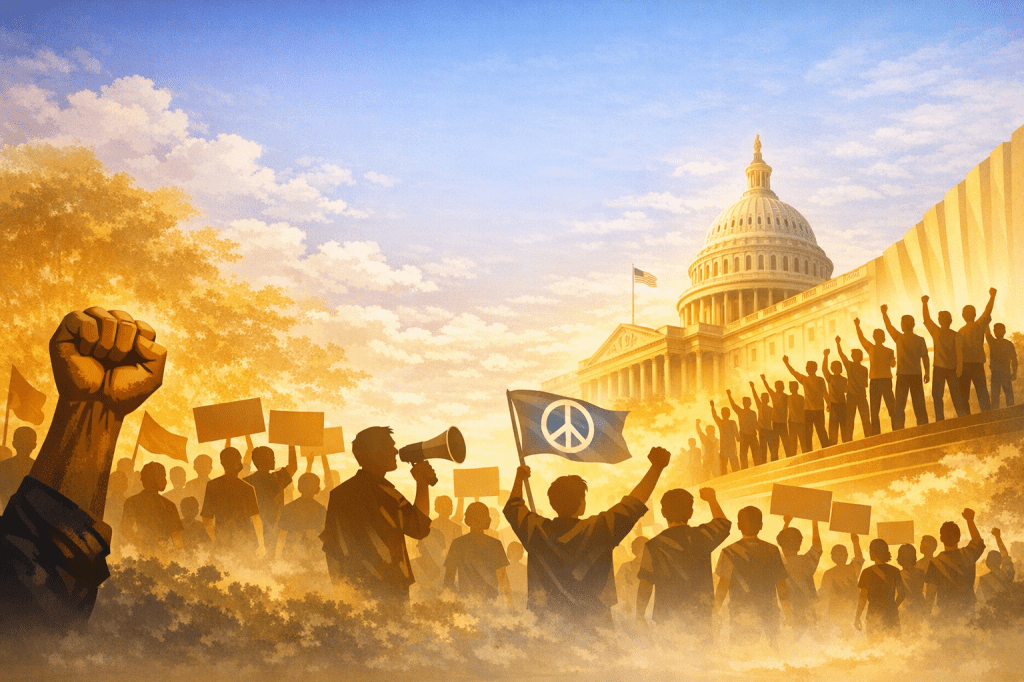
THE SOCIAL FUNCTION OF PROTEST
Note: For personal reasons I was not able to attend the No Kings Protests in person, but my heart was there! This essay is just a little way for me to participate.
Back in 2011 I took my father, who was ninety-four at the time, down to Centennial Park in Fort Myers Florida to attend the area’s first Occupy General Assembly. It was pouring when we set out. By the time we got to the park we were experiencing a blinding downpour. Over a hundred people gathered under the park’s central pavilion to plan a possible encampment.
This was my first experience with the human microphone. When I spoke, those in who could hear me over the driving rain, loudly repeated what I said for those who could not. It took a little getting used to but was otherwise amazing.
My father and I spent the rest of that evening floating between the different groups that gathered in tight clusters under the dry pavilion. There were the hippies, the anarchists, the liberals. In the corner I had a fruitful conversation with Ron Paul enthusiasts about the nature of government.
When the rain let up enough to make walking back to the car not too cumbersome for my father, I expressed how uplifting it felt to be in such a diverse group all focused on economic justice. My father agreed with the overall experience, but was more cynical about the movement’s potential.
“I’ve seen this all before. There’s all this Rah Rah Rah and fists in the air. In the end it makes no difference at all.” He said.
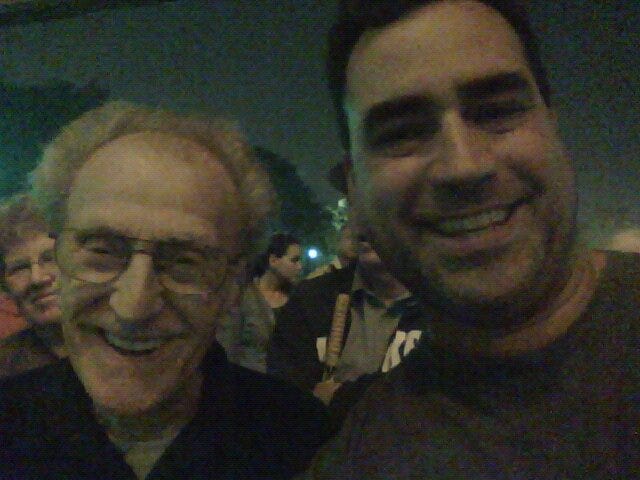
I understood his moral fatigue. My father came of age during the Great Depression, a witness to the many protests and bread riots that were hallmarks of that era. He was a witness to Pearl Harbor and his experiences during World War II instilled in him a searing rejection of war. He was a union organizer and president of the local National Association of Government Employees (NAGE) chapter, during which he was positively influenced by the civil rights movement. He was sympathetic to the anti-war protests of the sixties, and the anti-nuclear protests in the seventies and eighties. He saw all of these movements come of age, peak, plateau, and often wane. Gay Rights. The Environment. Free Speech. AIDs.
Yet here we were, picking ourselves through the ruins and wreckage of an economy destroyed by the very wealthy who in turn manipulated their own bailouts, bonuses, and windfall while millions lost everything in paying their costs. We were engaged in two senseless wars. Any attempt to improve the real lives of working people was met with an onslaught of corporate funded propaganda labeling even the most milquetoast reform an “atheist, socialist” plot to enslave real freedom loving Americans. And millions of people believed this pablum enough to take to the streets in tricorn hats demanding that Obama keep his government hands off their Medicare, pontificating about black helicopters and FEMA camps for white Christians.
From my father’s perspective, this was the culmination of eighty years of protests for one damn thing or the other.
It was easy to fall into cynicism and despair. The General Assembly decided to begin the encampment the following week. I was unable to participate directly in the encampment but stayed close to the protestors and tried to contribute as much as I could while working three jobs. The encampment received a great deal of attention in this otherwise conservative Republican stronghold in Southwest Florida. Much of it was positive. In fact, initially local police took a hands-off approach with regard to the Occupation of Centennial Park.1
That was true for about a month. Then, in mid-November
Local police evicted the encampment. It turns out that this was one small part of a coordinated federal effort to shut down the larger Occupy Wall Street movement. And it worked. Occupy was no more. All was for naught.
Or was it?
Shortly after the Centennial Park encampment was broken up, I found myself talking to activists, many of them brand new to direct action, inspired by their experiences with Occupy. Often invited by my college students, I sat in living rooms and kitchens brainstorming the next steps that could be taken in the interest of social justice. Many of these conversations led to the formation of local movements and organizations. Others chose to access the resources from larger, national organizations by opening subsidiary chapters.
The Centennial Park encampment is long gone, but many of the wonderful people I met and interacted with are now helping to organize the No Kings Rallies today. The mark of Occupy continues on.2
You see, my father’s jadedness was a response to a mistaken notion that We the People would take to the streets and the power elite would respond by changing their wicked ways. That’s not how this works. Anyone who is taking to the streets in protest with the belief that their actions will bring about the changes that they want will certainly be disappointed.
In my college sociology classes I spent time talking about collective action and social movements. As an activist myself, I hoped to inspire my students to actively participate in the social world around them.3 I implored my students to find something that they cared about and make it their cause. This was always followed with a warning.
“Activists don’t act for themselves. Activists work for the ages. Most of the people involved in ending slavery never saw a single chain broken in their lifetime. But chains did break. And it required the efforts of generations of people who had no reason to believe that they themselves would ever benefit from their activism. Being an activist is mostly heartbreak…especially for those who want to see a radically different world. You’re not acting for yourself, or your children, or your grandchildren. With tremendous dedication, and a lot of luck, maybe your great-grandchildren will reap the rewards of your sacrifice.”
In this long, fatiguing process, the street protest is not the culmination of activism. It’s just the first step. The street protest is what sociologists refer to as “Collective Action.” It’s a person on the corner shouting, “This is fucked up!” and another person hearing him and shouting back, “This IS fucked up!” and lending their own voice to the first until a hundred, a thousand, ten thousand people are in the streets shouting, “This is REALLY fucked up!”
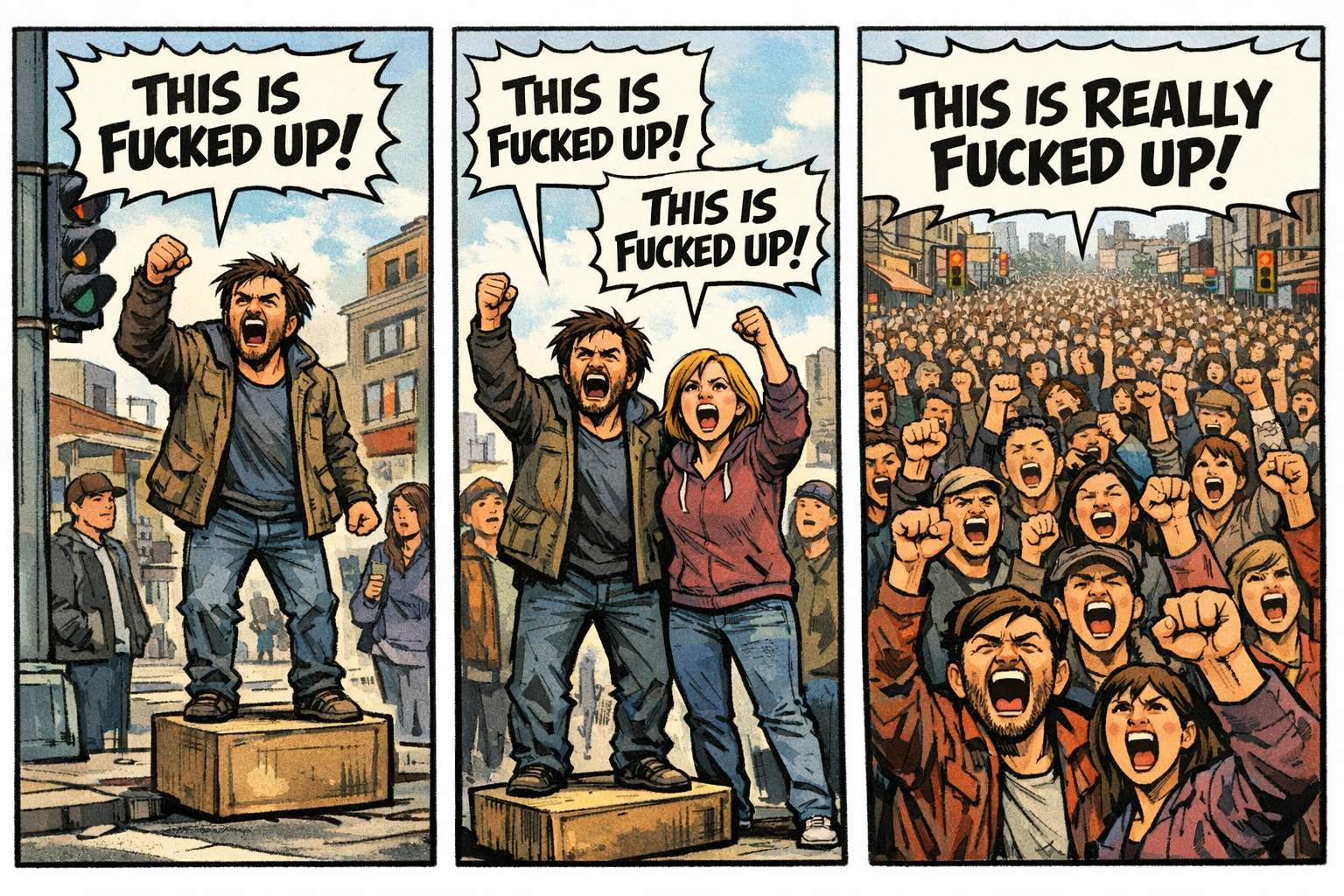
Collective action in the form of public protest rarely inspires the power elite to change or even to implement a single policy. It does, however, announce that the notion that “this is fucked up!” is there and has some level of popular support. It’s not just scattered singular individuals who believe “this is fucked up.” The street protest is an announcement to those in power that we see what’s going on, and it matters. More importantly, it’s an announcement to the world that if you believe “this is fucked up!” you are not alone. There are others like you out there ready to reach out. They are ready to take to the streets. Come and join us! The power elite ignores this, and to be honest they almost always ignore this, at their own peril.
In collectively shouting “this is fucked up!” the protest also defines the values and creates the language of resistance. By the time Occupy Wall Street was just an idea in the back of a trendy magazine I was more than fifteen years into my field of sociology. Economic inequality and injustice was central to everything that I was learning and teaching. For at least ten years I had been railing against growing income and wealth inequality, labor exploitation, declining wages, anemic benefits. I might as well have been shouting into a pot.
Then Occupy Wall Street. Suddenly, millions of people were shouting, “We are the ninety-nine percent!” We are the ninety-nine percent? It was perfect!4 We now had a language that encapsulated the values of economic justice in just five words. It was everything sociologists were trying to communicate in our stilted, jargon inflected muckity muck that is the language of our field.
The street protest is also the locus of bringing people together. Nowhere else did I ever see the bow-tied Ron Paul Libertarians, black-clad anarchists, and sandaled hippies breaking bread together but in an Occupy Encampment. At No Kings we see young and old, seasoned Boomers reflecting on their Vietnam War days standing with their grand-children, holding signs deploring authoritarianism and police state tactics. Though I missed this last round, in previous protests I talked to conservatives lamenting their exile from what used to be their party as well as leftists disgruntled that they still had to protest this shit. College professors and truck drivers. Business owners and their employees. All of them combining their voices in a single song for freedom.
From these interactions we gain more than a recognition of each other’s humanity. We also see individuals networking. Organizations are there with their tables, sharing their information looking to gain members. We see local groups consolidate their goals into feasible strategy. People who never met before are making plans to meet in a living room or kitchen somewhere to plan the next step. The collective action of the protest is the incubator of social movements. In sociology speak, the social movement is the more organized systematic approach to activism. This is where people join or even more crucially start formal organizations to effectuate their goals. They divide up the work. They build a consensus on the rules they’ll follow and the values they’ll serve. They start collecting money and gathering resources for a sustained effort toward meeting agreed upon goals.5
This is the point in the process where activists move from the “this is fucked up!” part to, “here’s what we need to do about it.” This is also where we start to see fractures in the original collective action crowd. It’s unlikely that the bow-tied libertarians, the black-clad anarchists, and the sandaled hippies have the same solutions. That’s not necessarily a bad thing as society benefits from a diversity of ideas. It does, however complicate the overall movement.
Regardless, in the end successful organizing results in organizations ranging from the local to the international level, situated to take direct action toward the interests of larger movement. These organizations have the resources to implement strategies such as lawsuits, media exposure, political lobbying, supported direct action, and even electoral politics to pursue the interests of the larger movement.
Take strikes, for instance. A spontaneous walk-out of disgruntled employees will likely end in failure. An organized and prepared strike in which employees have resources available to help sustain them and their action is much more likely to succeed. The first is collective action. The latter is as social movement. If change is going to materialize, it is through these mechanisms, not the initial protest. However, the street protest is a necessary locus for galvanizing the social interactions that ultimately lead to the larger structures necessary to effect change.
My father was wrong. Though protests are not sufficient by themselves to effectuate larger social change, they are indispensable toward that end. In my father’s lifetime the many street protests of the thirties were a necessary catalyst for the New Deal. The willingness of thousands of people to sacrifice their bodies in the streets, on the Edmund Pettus Bridge, in the interests of racial justice transformed the nation’s values and brought about the end of Jim Crow even if it didn’t end racism—yet. The peace protests didn’t end war, but it did establish that those who would wage war no longer had a blank check to do so. The environmental movement really did matter in creating a healthier world even if we continue to struggle with those who profit from poison. Occupy created the language and solidified the values signaling the end of the Neoliberal Era, and the idea that the “job creators” deserved their largess at the expense of those who do the work.
Protest matters. Participating in protests in the interest of humanity and justice is a source of personal pride. Someday, I will talk to my grandchildren about what I did for free speech, the environment, peace, academic freedom. I will tell them about Occupy, about No Kings. It will be a source of personal pride and identity6 that I will pass on to them to take the next necessary steps in creating the democratic humanist world I may never get the chance to live in myself.
Footnotes:
- Indeed, my experiences with local law enforcement policy toward protest here in Robert E. Lee County has been mostly positive. Local police, both municipal and county, are careful to have a conspicuous, but non-threatening presence during protests. I’ve spoken to many police officers and deputies about this. It is intentional. They each expressed a sincere interest in public safety and the guarantee of rights. In other words, doing their jobs as law enforcement professionals. November 17, 2011 being, of course, a notable exception. ↩︎
- I don’t intend to candy-coat the Occupy experience. Millions of people were involved in occupations throughout the country that lasted for weeks. Not everybody involved was a dedicated activist and idealist. Some small number of people were there to cause chaos. Some were there to commit crimes and to abuse and exploit others. Those who took responsibility for the encampments did a yeoman’s job policing and protecting their own, but it wasn’t and would never be perfect. If you research this moment in history, you will see some amazing human innovations, People’s Libraries, Clinics, Food Kitchens, inspiring stories of humanity. You will also see the opposite. These interactions are complex. It was my experience, however, that the good and humane far exceeded the few examples of inhumanity. ↩︎
- Yes, that includes my conservative students. I made it a point to offer some focus on movements that were in opposition to my own goals. ↩︎
- Even if not technically, statistically valid. ↩︎
- This was a significant criticism of the original Occupy Collective Action. Outside of “We are the 99%” there was little elaboration of specific goals of the larger movement. What exactly did the Ron Paul acolyte, the black-clad anarchist, and the sandaled hippy all want? It wasn’t clear that they agreed upon a solution. ↩︎
- Those taking to the streets to support autocracy, and bigotry are subject to the same social processes. I shudder to think about what they will be handing off to their grandchildren when the time comes. I’d like to think they will be shamed by their rejection. Maybe some will. Unfortunately, many will not. ↩︎
Shameless Self Promotion!
If you enjoy the Mad Sociologist Blog, you will love @MadSociologist on Substack. A free subscription gets you access to all Mad Sociologist and Underground Classroom features, as well as video commentary. An inexpensive paid subscription, about the price of a hardcover, gets you access to my novel, The Revelation of Herman Smiley. Substack is, at this point, the only place you can read it. Also, be the first to read and contribute ideas to my novel Outside as it is being developed. You also get access to my short fiction like Walter’s House, and my long form research projects coming shortly, including Teaching Heresies, and Democracy is of the Streets.
Not bad! Huh?
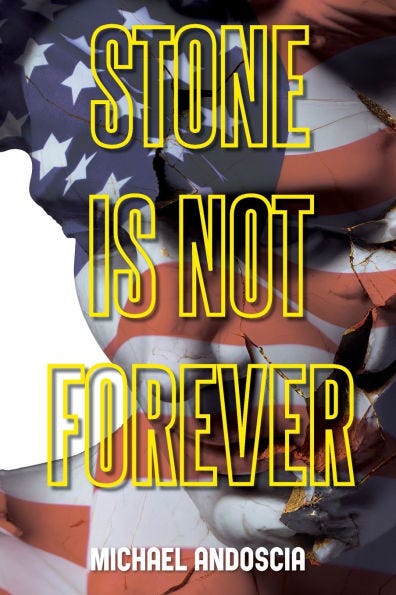
Collective Action and Social Movements play a huge role in my novel, Stone is not Forever.

 The Mad Sociologist Blog
Leave a comment