

THE FREE STATE’S REACTIONARY PEDAGOGY IS COMING TO YOUR STATE
I loved teaching. I hated teaching in Florida. It turns out, my thirty-year career overlapped with Florida’s experiments in education reform beginning with Governor Jeb Bush’s market-based strategy. It culminated with Governor Ron DeSantis and his more authoritarian approach of stripping public schools of all vestiges of “WOKE”.
For me, this came to a head when I stepped into my classroom on January 16th, flipped on the lights, and was floored as I stared at columns of empty bookshelves. Over the preceding weekend, they stripped the room of over six-hundred books that constituted my classroom library. At that point, I knew my long career had come to an end. As I wrote in my resignation letter, “The teacher that I am and have always aspired to be is incompatible with the current regressive and authoritarian atmosphere that now imbues Florida…”
That is why I was not surprised when I read Dana Goldstein’s thoughtful New York Times article, Why it’s Hard to Control What Gets Taught in Public Schools. I lost my breath when I reached the last section, “The Florida Exception.” Goldstein described the informal ramparts protecting academic freedom in even the most regressive school districts. Then she addressed the Free State. “Efforts to control the curriculum may fail against the will of a resistant teacher in many states. But not in Florida.”
This begs the question, what is it about Florida that makes teachers more vulnerable to academic repression? It is important to understand this process as the fascist movement in other states turn to Florida as a model for their own regressive aspirations.
The Florida Exception did not materialize overnight. It is not Ron DeSantis’s brainchild. DeSantis’s authoritarian crackdown is rather the culmination of a two-generation assault against progressive education. Since the conservative movement came of age under President Reagan, public schools, public-school teachers, and academic freedom overall, have been in the crosshairs. The evolution of conservative educational reform movements can be analyzed in two stages.
The Neoliberal Stage
The first is the neoliberal stage that gained momentum with the publication of A Nation at Risk. This report highlighted a rising tide of academic mediocrity. “If an unfriendly foreign power had attempted to impose on America the mediocre educational performance that exists today, we might well have viewed it as an act of war.” Published at a time when government was understood as the problem, public school mediocrity was framed as a natural consequence of the “public” aspect of the system. Mediocrity was all that could be expected from government-run monopolies, beholden to all-powerful teachers’ unions dedicated to protecting lazy and incompetent teachers.
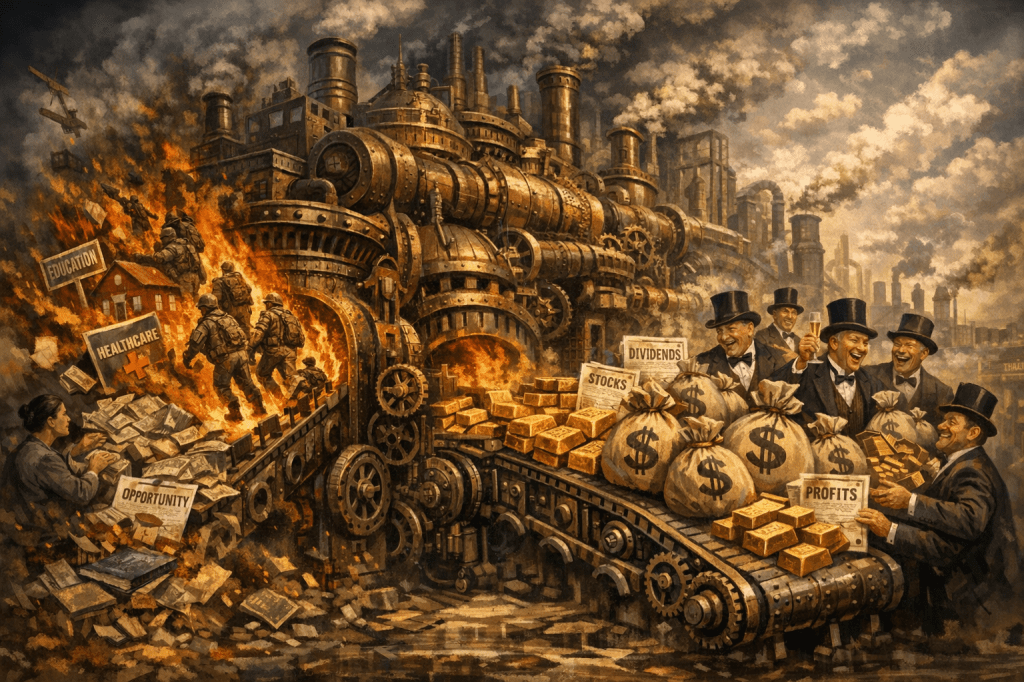
Drawing from economist Milton Friedman’s essay, The Role of Government in Education, neoliberal reformers in both parties decided to submit lazy and incompetent public schools to the ruthless discipline of the free market. In Florida, this manifested in “school choice” movements. If parents were free to “shop” for the school they wanted, the low-quality schools would disappear and the high-quality schools would prosper.
Of course, if parents were to choose the best schools, they needed a tool by which to judge. Students after third grade were submitted to relentless standardized testing. These multiple-choice tests became an efficient measure of a teacher’s “value added” to student learning. At least part of the teacher’s evaluation, and thus their pay, was determined by test scores. These scores were also used to ascribe a letter grade to each school making it easier for parents to choose the “A” school over the “C” school. The state, then aggregated this information into a district wide grade. School and district grades then determined funding and the level of state oversight.
The burden of this tiered system rested on the teacher. Creativity, innovation, passion, and engagement continued to receive professional lip-service, but were of secondary importance to test scores. Teachers were expected to be “data driven,” focused on reaching objective benchmarks. Meeting student needs was on a back burner to raising test scores. I have been involved in committees in which students were not mentioned at all. I remember one staff meeting early in this period dedicated to brainstorming strategies for attracting higher level readers to the school—to bring up test scores.
Teachers were encouraged to participate with the carrot of pay raises and bonuses to those with the best scores. Then, in 2011, Governor Rick Scott applied the stick when he signed the Student Success Act, eliminating teacher tenure. Teachers were reduced to annual contract employees. A principal could, for any reason, refuse to renew a teacher’s contract at the end of the school year. Teachers were cast into a perpetual state of paranoia. This was presented as a necessary palliative to purge so-called bad teachers, but there was no check against abuse. Teachers, regardless of their value-added, worked at the whim of the school principal. Curriculum and classroom engagement were shaped around making the principal happy.
Yet, even under these stultifying conditions it was possible to sneak some teaching in around the mind-numbing “objective” benchmarks. If benchmarks were reached and scores went up, administrators paid little attention to course content. Many teachers strived to maneuver themselves into more nuanced or untested courses to exercise more academic freedom. Rapidly expanding AP, AICE, and IB programs were golden gigs for teachers. A talented teacher could still teach.
The War on WOKE Stage
Then came the second stage, the War on WOKE. This was Governor DeSantis’s claim to fame. Public schools and teachers were no longer defined as lazy and incompetent. Instead, they were cynical agents in a great left-wing conspiracy to indoctrinate children into a…well…fill-in-the-blank (Marxist, gay, feminist, vegan, multiculturalist, DEI, Critical Race Theory, etc.) agenda. It is essentially a choose your own paranoid dystopian fantasy adventure rhetoric.
The pupal form of this stage squirmed to the surface when right-wing provocateur Rush Limbaugh described government, academia, science, and the media as the Four Corners of Deceit. It turns out, these corners frame the public-school classroom. Government schools and their leftist academic teachers and atheist science were not to be trusted. They twisted the minds of the youth to reject America, reject God, reject their families, and reject their natural roles as men and women.
The pandemic, however, sparked a turning point for this perspective. At first, public school teachers were lauded as heroes for finding innovative ways to continue teaching in the face of school closures and quarantines. Parents had an experiential lesson in just how hard it was to teach their own kids, let alone classrooms with twenty to thirty other-peoples’ children. It was in response to this reality that producer Shonda Rhimes Tweeted, “Been homeschooling a 6-year-old and 8-year-old for one hour and 11 minutes. Teachers deserve to make a billion dollars a year. Or week.”
The exultation of teachers was inconvenient to the right-wing movement. When angry parents organized against continued school closures, often expressing legitimate concerns, movement conservatives piggybacked on this frustration with their own brand of paranoia. The George Floyd protests serving as a backdrop, activist Chris Rufo drummed up a nonsense scandal around Critical Race Theory. From there it was easy to stack on stories about children reading pornography, watching erotic drag shows, being groomed into sexual deviance, and even undergoing gender transition surgery. No actual evidence of these wrongdoings was necessary. Paranoia is a vat monster that grows by feeding on itself.
Buoyed by paranoia, Governor DeSantis and the Florida GOP passed legislation strictly regulating what teachers could discuss in class. The infamous Stop WOKE Act was the flagship legislation. Florida law forbids teaching about structural racism, specifically bans The 1619 Project, and limits discussion of gender and the use of preferred pronouns. Books in schools are subjected to state vetting before students are allowed access to them. All titles found in a school are to be posted for public scrutiny and personal challenge. Furthermore, the legislation, as written, is so vague that districts are compelled to protect themselves by imposing even more onerous policies than the laws specify.
An unwritten consequence of these laws was to enlist parents as a de facto police force, with their children as confidential informants, subjecting teachers to constant surveillance. Any comment made by the teacher, no matter how innocuous, could be interpreted as a violation of “Parental Rights” and reported to the district and the state. My career was upturned by one parent sending an angry text message to my district’s deputy superintendent. Without talking to me, the district put me under investigation. My principal confiscated my books. I had to load my books into my vehicle under escort by the assistant principal and remove them from the campus.
To be clear, I was under investigation because the parent alleged that I was letting kids read books and using their preferred pronouns. Under any school system in the world, such actions would elicit exactly zero attention. In Florida, encouraging students to read, and respecting their identities can lead to a district and state level investigation, upturn a career, and even result in legal action. This threat hangs over every teacher in Florida like the Sword of Damocles. To clarify further, I was reported for the things I said when I was doing nothing more than going over the class syllabus and expectations. There is no margin for error in a Florida classroom.
In Florida, teachers are forced to practice what I call defensive teaching. Many of my peers have emptied their bookshelves and stripped their walls of posters, either out of fear or in protest. They eliminate controversial materials, replacing them with anodyne and uninspiring sources. Many teachers have abandoned engaging debate and discussion formats for far less inspiring and ineffective lecture-based instruction. They avoid talking about current events and self-censor any comment that might incur the ire of that one parent. Ultimately, many of them quit. According to Florida Tax Watch there were between four and five thousand teacher vacancies at the start of this school year.
Florida has been ground-zero for repressive school reforms for over a generation. The state is exceptional in its ability to enforce rigidity and squelch academic freedom through an entrenched and well practice process of disempowering teachers, discrediting teacher unions, and submitting public schools to ubiquitous surveillance. All of this is perpetuated by a tiny, vocal minority of activists. Florida is the model for reactionary educational oversight that any interested state government might emulate. It is imperative to understand that as Florida goes, so much of the nation will follow.
Stone is not Forever is certainly a book that will never be approved by the state censors in The Free State. Yet, there is a lot to learn from Dominico Rossa’s struggles upon immigrating to the United States at the turn of the 20th century. Order your copy wherever you get your books.


 The Mad Sociologist Blog
Leave a comment