


How Democrats Staunched the Bleeding, but Didn’t Close the Wound
Health Care Before the Affordable Care Act
In 2008, I became a health care activist. I didn’t want to be a health care activist. I was already an active environmental activist and an anti-war activist. At the same time, I was a father of two holding down three jobs to make ends meet for my family. At that point, one of the biggest factors making it difficult to fulfill the latter obligation was health care.
Early in the 2008-2009 school year we received word that our health care premiums were increasing…by double digits…again! It goes without saying that, as a teacher in Florida, my paycheck wasn’t rising by double digits, or even any digits. In 2008, school districts were laying off teachers due to budget constraints. The district let us know, in subtle though unmistakable terms, that we were lucky to even have jobs. So, we were just going to have to swallow those premium increases.
Around October or November of that year I got my teacher cold. If you’re a teacher, you’re familiar with this phenomenon. By the end of the first quarter all the viruses and bacteria traveling gushing from your students will finally overwhelm your otherwise superhuman immune system and take you down.1 It happens about the same time every year. Once you get through that, it’s smooth sailing for the rest of the year.
Typical for me, that cold settled into my lungs and became a debilitating cough. I’ve had pneumonia in the past, so I take lung infections seriously. I went to the clinic and was diagnosed with severe bronchitis. The doctor put me on an inhaler treatment and prescribed a massive dose of antibiotics.
While sucking in the breathing treatment I got a visit from the billing specialist. It turns out that exactly three hundred and sixty-four days earlier I was diagnosed with…bronchitis. Because it was the same diagnosis within a one-year period, my insurance company considered it a pre-existing condition. They would not pay. My treatment would have to be out of pocket.
I was dumbfounded. “Pre-existing condition? Is the insurance company saying that this is the same bronchitis I had a year ago? That’s crazy!”
The billing specialist explained that that was the policy. Since my previous diagnosis was within one year of the current diagnosis her hands were tied.
I continued, “are you saying that if I had just waited an extra day, and came in tomorrow, I would be covered?”
Her smile was unconvincing. “I’m afraid that’s the policy.”2
Also, in 2008 there was this freshman Senator from Illinois named Barack Obama who was running for president. Central to his campaign was healthcare reform. His proposal was a “public option” plan available to anyone who was unable to afford insurance or was unsatisfied with the insurance they had. It was billed as a way for Americans to buy into the same quality health plan that congress members enjoyed. I looked into it and was sold on the idea.
My personal story above was frustrating but not devastating. After all, at the time I was a healthy thirty-eight-year-old man. The same could not be said for millions of Americans in the Pre-ACA United States. Tragic stories abounded. In 2008, 43.8 million Americans were without health insurance with over 50 million going without insurance at some point in that year. Almost forty-five thousand working age Americans died every year because of lack of insurance.
Even those who had insurance were vulnerable as the laws allowed these multi-billion-dollar institutions to deny coverage for any number of reasons. The most notorious strategy was through the “pre-existing condition” clauses and annual caps on coverage. Insurance companies could squeeze out the old and sick…and female…by charging these groups more for insurance.
Every American understood, whether they had coverage or not, that they were one illness or injury away from financial ruin. I personally witnessed the implosion of a family, financial at first, but emotional upon divorce and dissolution in the end. They had a child born with an immune deficiency. Since he was born with this illness, the insurance company would cover nothing related to the immunological disorder. The family was destroyed by medical debt just to keep their child alive long enough for a bone-marrow transplant–also not covered.
The Fight
When Senator Obama took the oath of office on January 20th, 2009 expectations were high. He declared that health care reform would be his top priority. With overwhelming majorities in both chambers of congress, and the prospects of a filibuster-proof majority in the Senate, it looked like the Public Option was just around the corner. The people might just win one this time.
What we didn’t know was that there were sinister forces afoot. At that moment, in the Caucus Room Inn in Washington DC Republican leaders had gathered to decide upon their strategy after being routed in November. After such a catastrophic loss one would think that the party would assess its dedication to tax-cuts for the wealthy and imperial ambitions for the world. Instead, they decided upon the most cynical political strategy in American History. They decided that they would bottleneck every single attempt on the part of the new administration to govern effectively. Instead of coming up with a strategy for future success, the GOP decided to dedicate itself to making the incoming administration and opposition party fail even if that meant untold suffering for millions of Americans.3
The Caucus Room Conspiracy mentioned in the previous paragraph would become a huge problem as Obama really wanted a bi-partisan bill. Nobody at the time knew that that was an impossibility, though it didn’t take long to realize that the Republican Party was not playing by the same rules as everyone else. Obama had conservative Democrat Max Baucus chair a bi-partisan committee on health care in a vain attempt to write a bill that would be supported by at least a few from the GOP. The time dedicated to a bi-partisan bill would prove to be the death of the Public Option.
At the end of June, after what seemed like endless recounts, progressives got another win. Progressive Democrat Al Franken was declared the winner of the Minnesota Senate race. The Democrats now had a filibuster-proof majority in Congress.
All they had to do was stick together and they could pass any legislation they wanted without opposition.
All they had to do was stick together.
That’s all they had to do.
………………………FUCK!
That summer, when congress members returned to their districts, anti-healthcare lobbyists organized one of the most atrocious assaults against rational political debate in history up to that time. Having their own media spin system with FoxNoise at its height, conservative “Tea Party” activists enraged their base with blatantly false claims about what was becoming known as Obamacare. The legislation was said to contain “Death Panels” that would determine if grandma was worthy of having that pacemaker battery replaced or if it was just time for her to go for the sake of cost-effectiveness. They claimed that the Affordable Care Act would require everyone to be injected with micro-chips. It was equated to a “government takeover of healthcare!” Most notably, anti-Obamacare forces were screaming “Keep your government hands off my Medicare!”
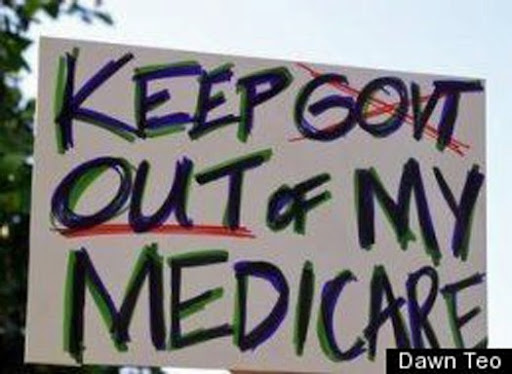
Democratic congresspeople found themselves facing mouth frothing mobs at their town halls.4
While Democrats were chasing the elusive Bi-Partisan Unicorn, and facing a brutal propaganda onslaught at home, Senator Ted Kennedy succumbed to his long struggle with cancer and died. That filibuster-proof majority? Poof! Gone.
By November, the House under Nancy Pelosi passed their version of Healthcare Reform that included a Public Option. It garnered exactly one Republican vote. Meanwhile the Senate version of the bill was being stonewalled. It’s fate rested in the craggly hands of Joe Fucking Lieberman. Lieberman, his wheels well-greased by the insurance lobby, threatened to vote with Republicans if the Senate bill included the Public Option. Democrats caved just in time for Christmas. The Senate version was passed and the Public Option was dead.
After conservative Scott Brown took Ted Kennedy’s seat in January 2010, there was no hope for the popular Public Option. The House abandoned its own legislation and voted to pass the Senate bill without amendment to avoid having to send the legislation back to that chamber.
President Obama signed the Patient Protection and Affordable Care Act into law on March 23 2010.
An Inadequate Bandage
The Affordable Care Act, otherwise known as Obamacare, was not a perfect bill. It was not what health care activists had signed on for. In fact, many activists turned against the legislation and even the Democrats as a whole. The loss of the public option was devastating to progressive liberal moral.
At that point we understood the Republican game even if the President was slow to recognize. At the height of the debate, Republican Leader John Boehner announced that the GOP would not vote for the Affordable Care Act unless it included four concessions: Of course, the Public Option would have to be removed…check. There had to be clear prohibitions against funding abortion…check. The act had to include provisions for small businesses…check. Finally, there would have to be some kind of cost containment…check.5 All four concessions were made. Not a single Republican voted for it.
That being said, though the legislation did not go far enough to staunch the bleeding in America’s health care system, it did provide some coverage.6 First and foremost, the Affordable Care Act ended the hated Pre-Existing Conditions clause. Because of the ACA, insurance companies actually have to cover your medical expenses without caps.
Obamacare expanded coverage through a subsidy supported Health Insurance Marketplace and Medicaid Expansion.7 Insurers were required to provide a minimum level of coverage at a community rating. This was important. Insurance companies could no longer push people from coverage by charging those with pre-existing conditions, or those guilty of being a woman, higher premiums. Children were allowed to remain on their parents’ coverage until age twenty-six. Also, insurance companies were required by law to use eighty percent of their revenues on…wait for it…health care!
These and other reforms were very popular. Over 20 million people gained coverage, dropping the uninsured rate from over 15% to under 10%. This included millions of young people. Preventive care was covered. The ACA reduced the Federal Deficit in its first decade and did, in fact, slow the rate of premium increases.8
That being said, it wasn’t all good news. The most hated component of Obamacare was the Individual Mandate. This policy required people to get coverage or pay a fine for being uncovered. Supporters claimed that the Individual Mandate was required because insurers were required to provide coverage. The fear was that if insurers were required to provide coverage, what’s stopping someone from just waiting until they were sick to get coverage? Critics cried that requiring people to buy health insurance was government overreach.9 The bottom line is that nobody likes to be “mandated” to do things. So the Individual Mandate was the biggest bone of contention.
The Individual Mandate was challenged in the Supreme Court but sustained when the Court defined it as a tax, well within the government’s power to enforce. In his First Reich, the Orange Don killed the Individual Mandate by simply reducing it to $0. He then declared that Obamacare was “dead.” The hope was that without the Individual Mandate people would drop their Marketplace plans like hotcakes, leaving only a pool of sick people that insurers would not be able to cover. This was the much anticipated “death spiral.”
The mandate supporters were wrong.10 The “death spiral” never materialized. When the Individual Mandate was destroyed, people still wanted health care. It turned out that people did need to be coerced into purchasing coverage by a punitive mandate. If affordable plans were available, and they were, people bought them.
Another blemish occurred when President Obama promised that if people liked their existing health insurance that they would be able to keep it. That turned out to not be true. This wasn’t specifically a problem with the Affordable Care Act, but rather the private industry’s strategic and cynical response.
Here’s the problem. When the ACA required a minimum level of coverage it was assumed that insurance companies would simply update their policies that did not comply to the requirement. That’s not what they did. Instead, they canceled those policies, and millions of Americans received letters informing them that their coverage was being canceled because of Obamacare. Understandable outrage ensued.
The Wrap
Overall, Obamacare is a vast improvement over the American Health Care System that existed before it. It was not, however, adequate for addressing the underlying issues in American Health Care. Yes, we had fewer uninsured, but we never achieved zero uninsured. Yes, prices were controlled, but they were never reduced. The United States still has the most expensive and yet most mediocre health care system in the world.
Republicans, true to form, are being disingenuous when they declare that “Democrats broke health care.” Those of us old enough to remember, and choose to do so, can attest that American health care before the Affordable Care Act was awful and expensive. That’s why there was such a huge mandate for reform in 2009. Obamacare did not solve the problems of American health care…not by a long shot. But it was an improvement over what we had.
That’s why, every effort by the Republicans to repeal the ACA has met with fierce public resistance and has failed every time. After all the fearmongering and absurd propaganda people realize that there are no death panels. No microchips. They have come to rely on the Medicaid expansion and the Healthcare Marketplace.
Still, the fear and uncertainty of premium increases linger.
This was an especially poignant concern during the pandemic. For this reason, the Democrats pushed to increase federal subsidies to the Healthcare Marketplace, that part of the ACA that is most distinctly Obamacare. These increased subsidies were so popular that they were extended by the Inflation Reduction Act. However, to get this extension Democrats had to bypass the GOP by passing it through Reconciliation. This required progressive Democrats to mollify the modern Liebermans by setting subsidies to expire this year.11
The hope was that the subsidies would be so popular, and the loss of such subsidies so destructive, that nobody would allow them to expire. This assumption underestimates the disdain that conservatives and so-called moderates have for the well-being of working Americans. Conservative shills are now using the impending premiums cliff as a whip to foment another Anti-Obamacare movement. Perhaps they can finally accomplish their goal of stripping life-saving healthcare from millions of Americans.
Don’t buy the hype. It is true that Obamacare and the health care subsidies of the Inflation Reduction Act could be interpreted as a payout to the insurance industry. I’ve made that same argument myself. Subsidizing private insurance does not solve America’s health care problems, but it is better than watching millions of Americans lose their healthcare.
The solution to America’s health care woes is not to go back to the bad old days before Obamacare, when those who needed care the most were priced out of the market or denied care altogether. Nor is it to reroute the money going to the insurance industry by just cutting a check (or a voucher) to Americans to purchase their own coverage. After all, the check is still going to the exploitative insurance companies.
Rather, the solution is to take the next step in health care reform. Ultimately, activists like myself would like to see Medicare for All. After all, if you want to deny the corrupt insurance industry their exorbitant premiums, a single-payer system is the way to do it. It is unlikely that we will jump into a Medicare for All single-payer system. We can, however, resurrect the public option and offer a real choice to Americans.
Footnotes
- You’ll fight through it, of course, because the extra work resulting from requesting a sub and taking a few days off to rest is just not worth it. ↩︎
- In my case, I had just paid down a chunk of my credit card debt. I charged my treatment and found myself back at square one after years of trying to get my debt under control. ↩︎
- When uncovered this was called the Caucus Room Conspiracy. In my opinion, it is one of the most important under-reported moment in U.S. political history. This one dinner changed the course of American history and government forever and may have been the first crack in the edifice of American Democracy. To see more click Here, Here, Here, and Here. In my opinion, this was the moment the GOP stopped being a governing party. ↩︎
- That’s not to say that there weren’t legitimate criticisms of Obamacare. Only, we really weren’t able to talk about them. Instead, advocates like myself found ourselves arguing against absurdities like Death Panels. ↩︎
- For Republicans, the only cost that doesn’t have to be contained is tax cuts for the wealthy. ↩︎
- I will write a more comprehensive description of the Affordable Care Act on The Underground Classroom soon. Such a description is beyond the scope of this essay. ↩︎
- The Supreme Court later ruled that the Federal Government could not force states to expand Medicaid. many states, such as the Free State of Florida, have to this day refused to do so, leaving about 400,000 Floridians without coverage for absolutely no reason other than…you know…Obama! ↩︎
- There was a spike in premiums in and around 2014 to critics portended as the death of Obamacare. This spike turned out to be an outlier. ↩︎
- It’s unclear why this was government overreach. After all, states require people get Homeowners Insurance, and Car Insurance. Why not Health Insurance. The federalist argument was that this was within the power of the states, but not the federal government. ↩︎
- I was one of the people defending the Individual Mandate. ↩︎
- Here’s a more expansive explanation of the current crisis. This was a social media explainer on my Facebook: So, I’m noticing a lot of people who don’t quite understand why their premiums are shooting up. I saw one person whose premiums went from $79 a month to over $1000! She’s going to drop her insurance. Here’s the deal. In 2021, Democrats increased subsidies for those getting their insurance through the Affordable Care Act exchanges. This was part of the American Rescue Plan. The subsidies were really popular and really helpful to folks struggling during the pandemic. Democrats then extended the subsidies in the Inflation Reduction Act. Republicans would not vote for the Inflation Reduction Act. To get it passed, Democrats had to pass it through reconciliation. To approve spending through reconciliation it most follow what’s called the Byrd Rule. In other words, it cannot increase the federal deficit beyond a ten-year window. Since conservative Democrats Joe Manchin and Kyrsten Sinema refused to vote for a small tax increase that would cover the subsidies permanently, the subsidies were required to sunset this year. The hope was that the subsidies would be so popular and losing the subsidies so detrimental that no politician in their right mind would allow that to happen, and the subsidies would be extended through new legislation. Maybe even made permanent. Yeah. That didn’t work out. Republicans made it a point to extend and even expand tax cuts for the wealthy. But health care for working Americans? Come on! If you are seeing your premiums go up, you can thank Republicans and conservative (I refuse to say “moderate”) Democrats. What? You’re not getting your insurance through the ACA? Well, your premiums are going up as well. First, the ACA helps control premiums by offering competition with private insurance. Also, the more people who are uninsured, the more expensive healthcare is for everyone as uninsured people still get emergency care at hospitals, then they go bankrupt (healthcare debt is the leading cause of bankruptcy in the U.S.). That cost is passed on to you via higher premiums. Enjoy.
↩︎



 The Mad Sociologist Blog
Leave a comment