

It has been a while since I have posted an MSB Classic. I was having a conversation with a friend of mine about the Orange Don and his onslaught of Executive Orders when I remembered that I had written on this very issue years ago. Here is that post. It opens with a reminder of the infamous Caucus Room Conspiracy in 2009. This was an event that future historians will identify as the beginning of the end of the United States Republic. It recounts how President Obama, facing relentless GOP obstruction, understandably turned to Executive Orders to push his agenda. Though I agreed with a lot of what he was doing, I was concerned that governing through Executive Order could evolve into government by Executive Decree.
I fear that this is exactly what we are seeing today. The Orange Don and his dictates, overtly or tacitly legitimized by the Republican Party, may be dismembering the Constitutional Order piece by piece. This essay was written during the Orange Don’s first campaign, back when he was scary, but we all knew that there was no way he could actually win the election.
We were so much older then…
August 21, 2016: Political Obstructionism and the Rise of Executive Power
HOW THE CAUCUS ROOM CONSPIRACY CREATED A CRISIS IN DEMOCRACY
On January 20, 2009, Republican Party leaders, having been soundly humiliated in the 2008 election, met at the Caucus Room in Washington DC. They sat around, no doubt slicing into $50 steaks, and brainstormed how they might rebuild the dusty pile of rubble that was all that remained of the conservative movement.
It must have seemed a daunting task. Up to that time, thirty years of conservative dominance in politics was so thorough that movement leaders were confident enough to talk openly of empire, plutocracy and permanent majorities. By the end of the W Administration, however, the bloody foundations had collapsed out from under their feet.
The mighty U.S. Army, vaunted as the most powerful fighting force in the history of mankind…and not without good reason…was stretched thin between two major wars and a global military campaign against a tactic instead of an opponent. Volunteer soldiers were deployed without respite in these endless wars. Many of their families were living off of food stamps. That at least one of these wars was the result of presidential lies was irrefutable.
As the death rate climbed, the human costs of war shook the nation’s faith. The deregulated market proved why children cannot be trusted with unrestricted access to the candy store. The so-called geniuses of Wall Street used increasingly questionable financial instruments. They turned debt, America’s number one commodity, into trillions in paper profits. Eventually, they found themselves holding nothing but paper. They scurried and cried until the government bought up all that worthless paper, sending the bill to the taxpayer. John Boehner literally cried on the floor of the House to make it happen.
When it was time to help the taxpayer, however…sorry, there’s a deficit don’t you know? If American families have to tighten their belts, well then so should the government…um…ahem…after it bails out the banks. Don’t forget to pay those mortgages, by the way, because it’s your responsibility to pay your debts, not the government’s…um…ahem…you know. It was now clear that the American political economy was nothing more than a military supported Ponzi Scheme.
By 2008, conservatism and corporatocracy was so unpopular that the most racist of advanced nations elected a black man president rather than allow another Republican, even a Republican as well regarded as John McCain, into the Oval Office.
Things must have looked pretty grim for the Republican leadership. It must have been hard to even swallow their single malt scotch.
Now they could have responded to this catastrophe in a number of ways. The best way for everyone would have been if they had just packed their offices, moved to the mountains, and were never seen nor heard from again. But that was asking too much. At the very least, they could have re-evaluated their positions, taken an honest, hard look at the data, and developed a new platform. This platform might have acknowledged their faults while offering new policies for addressing real issues of inequality that are a threat to the very traditions and principles that conservatives claim that they hold dear.
They could have done that…
…but they didn’t.
Instead, they engineered the most disgusting regimen of political obstruction in the history of the United States. On that date, before the new president could even offer a policy proposal, before a bill had even been submitted to Congress, Republican leaders vowed that they would do everything they could to stall and obstruct every single piece of legislation supported by the Democrats without regard to the content. In precise, goose-stepping formation, the Republican Party stayed true to this one principle at the expense of all others. Otherwise bi-partisan legislation, drafted by Republican leaders like John McCain? Forget it. John McCain came out against his own legislation.
It was then that the Republican Party surrendered any claims to governing authority. True, political cynicism and scheming in the Re was nothing new. Regardless, historically there was at least some space reserved for actual governance. No longer. On January 20, 2009 the Republican Party dedicated itself to its own fortunes without regard for the nation. All legislation would be stalled. No compromise would be broached. Even the faith and credit of the United States was a target for dangerous political brinkmanship when the new Tea Party refused to authorize an increase in the debt limit. Only intensive intervention by the party’s corporate patrons prevented the rising Tea Party from pushing the nation over the fiscal cliff.
President Obama tried to reach across the aisle, but found no takers. His signature health care legislation was all but destroyed when he directed the Senate to create a bi-partisan committee to negotiate an agreement that both parties could
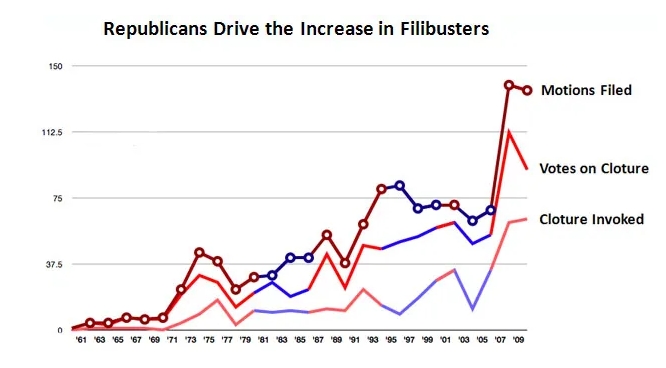
support. Republicans were given almost every compromise they asked for, even getting the popular public option removed from the legislation. When it was done, Obamacare was, in almost every way, the Republican health care proposal from the early 90’s. Still, Republicans refused to vote for it. The stimulus package, so necessary for jump-starting the stalled economy, was stuffed with tax cuts to entice a couple of Republicans to sign on. No luck! Republicans were the party of no.
Obama was a slow learner. He tried all of the diplomacy in his community organizer toolbox, but he was up against the most intractable community he had ever known. A community of desperate and disempowered conservatives. Eventually, he took matters into his own hands. He brought his staff together and determined exactly what he could do without having to go through Congress. Obama, his ability to get the kinds of legislation he was looking for, turned to the bureaucracy and the regulatory pen. He has now presided over the greatest expansion of government regulation and executive authority since the New Deal. According to the New York Times:
Blocked for most of his presidency by Congress, Mr. Obama has sought to act however he could. In the process he created the kind of government neither he nor the Republicans wanted — one that depended on bureaucratic bulldozing rather than legislative transparency. But once Mr. Obama got the taste for it, he pursued his executive power without apology, and in ways that will shape the presidency for decades to come.
This is a bad thing.
At the time, I remember expressing concern that Republican obstructionism was forcing the President to rely on his own executive authority to pursue his agenda. Though I agreed with many of the regulations the president put into effect, such as moves to improve the quality of our air and water, this kind of executive action set a dangerous precedent. Future presidents will almost certainly build on this regime of executive authority and may even be more effective in doing so as the rational components and bureaucratic structures are built to accommodate such leadership. As time goes on, presidents will, through executive authority, gain greater and greater powers unchecked by Congress.
In many ways, the precedent was set by George W. Bush and his Administration, operating under a dogmatic belief in the Theory of the Unitary Executive. Candidate Obama, in 2008, was a critic of Bush’s use of executive authority and misguided belief that he could alter laws through presidential signing statements. Obama was right, and he echoed similar critics, both liberal and conservative, in his concerns about the expansion of presidential power.
American politics can be described as a contest between the executive and the legislature for dominance in government. Competing for power is what institutions do, so this should come as no surprise. The outcome of this struggle should be of the utmost importance to American citizens as our government was set up to ensure that no one branch held unchecked power. This was a laudable effort on the part of our founders in the face of the fact that doing so runs contrary to the very nature of institutions. Institutions empower themselves.
The Great Depression, World War II and the Cold War provided the context for a dangerous expansion of executive authority at the expense of Congress. This expansion of executive authority, regardless of how one might feel of the intent, is a direct threat to representative democracy. The Bush Administration furthered this project using the war on terror and 9/11 as a pretext.
Now, the next chapter in the saga of growing executive power begins with the Caucus Room conspiracy. Ironically, the very tactic used by Republicans to render President Obama impotent and, at least rhetorically, to promote small government conservatism (which has always been a myth), has done exactly the opposite. The executive is now increasingly independent of the legislature and the regulatory regime has increased by more than fifty percent over the last president.
Furthermore, the Republican Party’s scorched earth tactic has been largely successful. Yes, they failed in making Obama a one term president, but the party went from obscurity to total control of almost half of state governments, a majority of state legislators, thirty-four governorships and control of both the House and Senate. If the party continues this trend, and manages to put it’s guy in the White House (which is a thankfully remote possibility, but still a possibility), then it only makes sense that the Democrats should use the same strategy. Governing through consensus building and compromise, the uneasy norm since the founding of our Constitutional government, must then give way to political obstructionism and expanding executive authority.
Under such a scenario, representative government is impossible. It’s one thing for a one branch to check another branch, or for one party to balance out the other. When one institution, however, is totally dedicated to obstruction and guaranteeing that the other party actually fails, we no longer have a republic in quite the way we once new. We no longer have representation. Any hopes of democracy under such a system cannot be fulfilled. Tyranny is the only reasonable outcome.
This is not a partisan concern. This is not about liberal and conservative. This is about defending a core principle of our society.

 The Mad Sociologist Blog
Leave a comment