


Marx’s Description of the Capitalist Mode of Production

Gettin’ Down with the Capitalist Mode of Production!
Note:
This is the third post drawn from a series of college lectures I gave on Karl Marx for my Introduction to Sociology classes. They do not need to be read in order, but it helps. The first two posts can be accessed below.
First Post: What do Taylor Swift and Karl Marx Have in Common
Second Post: Capitalist Blues
Everyone on the Round!
The core of Marx’s theories is the recognition of an intrinsic problem in all social arrangements. And I do mean all. It does not matter if it’s a society of lions, or penguins, or wolves, or humans. Every society must deal with the same intrinsic problem.
This problem arises from the fact that the primary function of all societies is the procurement of material resources necessary for the survival of all members of that society. Unfortunately, in every society there are those members who are incapable of helping to secure resources, yet they still need these resources to survive. For instance, babies need food, clothing and shelter just like everybody else. However, we don’t expect babies to go out and secure those resources. Adults take responsibility for doing that.

That means that those individuals who can secure resources must produce a surplus to accommodate those who can’t. Now, this is not an overwhelming problem. Most people don’t complain about buying diapers and formula for our babies. In fact, the only limits able bodied adults have with securing resources for our children are the material limitations of our economic position. We also feel the same way about our elderly, people with disabilities and illnesses. Few people have a problem with doing a little extra so that those who can’t, for whatever reason, can survive.
Because human beings are, for the most part, decent. Of course, we prioritize the needs of our families. We see this as the right and natural way of doing things. Society is divided up into families and each family is responsible for securing the resources for itself and its non-productive members. To us, it seems that this was always the case. Marx, and especially Engels, point out that this is a relatively recent phenomenon. In the period that Marx refers to as primitive communism, the entire tribe ensured the survival of all members regardless of family arrangements.
In modern societies, this communal approach to sharing resources is contested. On one hand, we spend a lot of money and energy on taking care of others. Public schools are a great example of this communal mentality. Education is a resource that all children need, and we all benefit from, so we are willing to pay into a system that educates all children even if we ourselves don’t have children, while others have a dozen children. On the other hand, not everyone agrees with this arrangement. Why should I, who only had two children, pay the same taxes into public schools as someone with ten children?
Furthermore, primitive communist societies didn’t hesitate to provide food and shelter for those who could not do so for themselves. In modern societies, however, why should I pay for someone else to get medical care or housing? Why should I care about a homeless family in Wisconsin whom I have never met?
This is a source of debate and conflict in our modern societies. Part of this is the result of the success of civilization in growing the population. In primitive tribes, I knew everyone in the tribe and was emotionally connected in some way. I was also dependent to a certain extent on everyone, and everyone was dependent on me.
In modern societies we are more atomized. Relative to the population of the United States, over 320 million people, I know and interact with only a tiny fraction. For such huge populations we have markets and governments that organize the distribution of resources. This is what used to be referred to as the Political Economy. That we no longer really use this term outside of academia is a real loss. We talk about Government, or the State, and we talk about Economics or the Market as if they were separate things. But they are not. They are interrelated institutions. One is not possible without the other. Marx knew this and was concerned about what he saw.
Everybody Do the Modes of Production!

So, why the different mindsets? Why does my thinking change from one of communal responsibility in primitive societies to one of taking care of myself and mine in modern societies?
Marx points out that how I think about and understand the world around me is shaped by what he referred to as the Mode of Production in which I live. According to Marx, “the mode of production of material life determines the social, political and intellectual life process in general. It is not the consciousness of men that determines their being, but on the contrary, their social being that determines their consciousness.”1 You can see why sociologist think this guy is important.
Wait! Go back. I get Means of Production, and Factors of Production. Now I havta learn Modes of Production? What the hell!
Look, it’s not hard. You have your factors of production, or what could be called forces of production because all production relies on them. That is material resources, referred to as “Land” in your High School Economics class, and the work that goes into turning those material resources into commodities. That’s the “Labor.”
Now, in Primitive Communism, everyone pretty much did the same labor with the same resources. In other words, they related to the forces of production in much the same way. That’s no longer the case. The advent of civilization born from surpluses that were created by horticulture and agriculture, freed some people from food production so they could do other work. Most continued to do food production, but others did craft work. Some were soldiers who worked for kings. There were those in the civilization who really didn’t have to do any productive labor whatsoever. Then there were those who spent all of their lives doing productive work until they died. And there were people in between.
In other words, with the rise of civilization, different people related to the work of securing material resources differently than others. Societies developed Classes, and members of different classes had very different experiences in the material world. Marx referred to these differences as Relations of Production.
In the beginning of this post, I pointed out that in every society there are those who are excused from producing or securing the material resources necessary for survival. Well…when you think about it…not having to labor and having the material necessities of life provided for you is a pretty big advantage. Who doesn’t love that? If you have any doubts about this, take a cruise and see if you don’t enjoy it.
Since the beginning of human civilization there have been those who were able to use their privileged relations to production, often birth privilege, to exploit others. There are those who control or own the means of production and can use their ownership to force others to do the productive labor, and hand over the resulting surplus. In ancient times these were kings and high officials who controlled armies. They used these armies to secure land and slaves, thus controlling the material resources and the labor and benefiting from the resulting production.
Here we have the inherent conflict of society, between those who control or own the stuff necessary for survival, and those who have nothing but the labor they can perform in exchange for some of the stuff necessary for survival. Two different classes of people with an inherent conflict in their relations to production is the Dialectic that Marx focused on in his writings.
How this dialectic was structured and sustained is what Marx referred to as the Mode of Production. You can look at the mode of production as a combination of the forces of production plus the relations of production. However, this description does not quite go far enough.
Shake that Superstructure, Baby! Shake it! Shake it!

It’s easy to understand why we do not expect babies, the elderly, or disabled people to be productive members of society. Equally understandable to people with any sense of empathy is why productive members of society are willing to produce a little more to sustain those unable to produce. We can evaluate this in terms of internalized symbolic meaning of what it means to be deserving of extra attention. A more cynical, economic or transactional approach suggests that we are willing to care for the unproductive because someday we may be in the same position and would like others to provide for us.
That being said, how do we justify a political economy in which a man like Elon Musk, or Jeff Bezos can hold billions of dollars while the vast majority of their employees make so much less? Many make barely enough to get by and are often subject to relentless exploitation. Perhaps an argument can be made that the wealthy work very hard, but do they work a million times harder than anyone else?

The Marxist argument is that the capitalist class works only to the extent that it advances their capital interests. They are productive only to the extent that they move capital from point A to point B to effect a profit. This profit, however, would not exist at all without the thousands, even hundreds of thousands of workers who actually make firms like Amazon or Tesla work. Arguably, if an alien came down and kidnapped Jeff Bezos, we might not even know about it for a long time. Amazon would function just fine. But if that alien transported all of Amazon’s workers to the mothership…that would be a problem. How would we get our cheap, plastic junk? Jeff Bezos isn’t going to deliver it to us himself.
Jeff Bezos and Elon Musk are perfectly capable of doing work, delivering packages or working an assembly line. Why do we let them get away with sitting back and accumulating gob-smacking amounts of money with relatively little effort? In the face of advancing technology and education, American workers are more productive than ever, yet wages and salaries have largely stagnated while the holders of capital are thriving at levels not seen in over a hundred years. Yet we barely debate these facts at a society level. We seem okay with it.

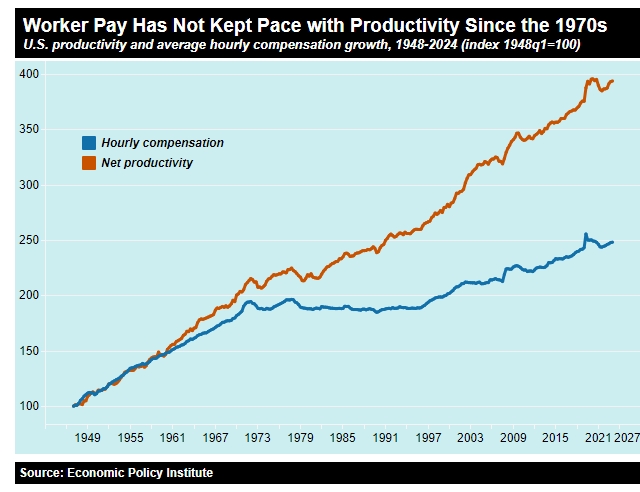

Marx has an explanation.
We accept the political economy as it is because we perceive it as the right and natural way of running a political economy. Musk and Bezos are where they are because of their hard work and innovation. They deserve the privilege of sitting back and collecting their dividends even if they are not contributing even a single calorie of labor to actually producing anything of value. They own, and their ownership is their contribution. Furthermore, their ownership, and the decisions that they make are “creating jobs” for millions of people who should feel grateful that they have the opportunity to make money by working for such great companies.
Workers, on the other hand, should do the best they can for their employers, give one hundred percent. That’s called having a strong “work ethic.” If they work hard and invest wisely, they too can be Jeff Bezos. They should educate themselves in useful fields to make themselves “marketable” for their future employers. If they are struggling, it’s because they are just not working hard enough. They are lacking “marketable skills.” It’s their own fault.
Well…of course. Everyone knows that. It’s common sense.
Is it? Why do we see it this way? Why not a world where the workers own Amazon and decide collectively what to do with the profits? Why is there a “work ethic” but we never talk about an “ownership ethic?” Why should you dedicate your time and energy to learning skills that benefit your employer rather than those skills that bring you personal satisfaction? Marx points out that there are other ways of seeing the world, but living within a particular mode of production makes it difficult for us to imagine the alternatives.
Political theorist Mark Fischer expressed this view when he said, “it is easier to imagine the end of the world than the end of capitalism.”2 Why? I mean, I can imagine some pretty cool stuff. Why do we feel that there is no alternative to capitalism?
Well, it’s human nature. Human beings are naturally greedy and acquisitive, and that’s why we have a capitalist economy?
Is it, though? If human beings really were naturally greedy and acquisitive, why not just take Jeff Bezos’ stuff? Why do we have a moral value like the “work ethic” that tells us to give one hundred percent to the work we do regardless of what we are getting paid? That doesn’t jive with your commonsense notion.
Marx see’s it a bit differently. According to Marx, there have been four major modes of production since the rise of civilization: Asiatic, Slave, Feudal, and Bourgeois or Capitalist. Every mode of production was an expression of a dialectic by which a small group of people controlled the resources, and the vast majority had to exchange their labor to get access to enough of the resources to survive. In the Asiatic, the kings controlled armies and used those armies to extract tribute from the communities in their sphere. Slave societies were run by masters who owned slaves that were forced to work. Feudal lords owned land and extracted rents and loyalty from serfs and others who lived on that land. Capitalists hold the capital that is used to invest in firms that organize economic activity.3
In every mode of production, the productive workers far outnumbered those who controlled the wealth. Indeed, even the armies that protected the wealthy and conquered in their interest are members of the productive class. There is no reason why ninety-nine percent of the population has to submit to the mere one percent. Yet many of these modes of production lasted for hundreds, even thousands of years. How did this happen, and why is it a constant condition throughout history?
It’s like the Electric Slide.4 When the Electric Slide comes on everyone hears the music and they get on the dance floor, and they all do the same moves. If you are not doing the same moves as everyone else, you’re not doing the Electric Slide.
When it comes to the modes of production, everyone has to be dancing to the same tune. That one guy on the dance floor who is doing the Mashed Potato is ruining everything. Call the bouncer!
On the dance floor we have the music, the DJ and the people lining up to dance crowding out any other groove.
In our modes of production, we have what’s called the Superstructure. This is often represented in textbooks as an actual structure. Well, if it ain’t broke…
All About that Economic Base!

At the base of the superstructure is the Mode of Production, or the economy. This base is what supports the whole of society. Of course, it consists of the forces of production, the firms and companies and all the resources they bring to the field. It also organizes the relations of production, or where people stand relative to the capital necessary for survival and social thriving.
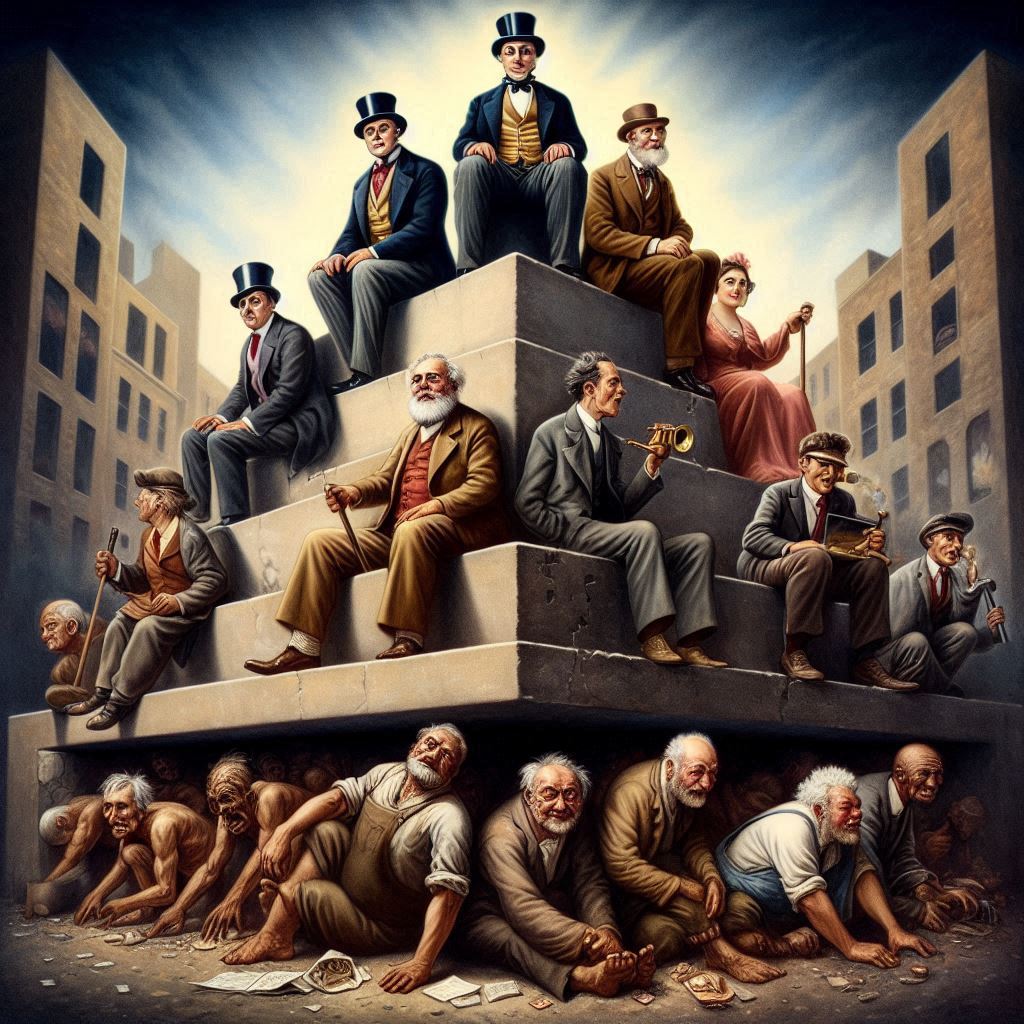
At the top of the economic pyramid is the Bourgeoisie, or what we more commonly refer to as the Capitalist Class. These are the folks who hold so much capital that they can live off of the rents that comes from ownership, more commonly referred to as “profits” or even more specifically, “dividends.”
Below the capitalists is the Petit Bourgeoisie. This mostly consists of small business owners. They hold capital, but not enough that they can get by without expending their own labor. Often, they are working right next to their employees. Think of a guy who owns a sandwich shop. It’s not unusual to see him at the counter making sandwiches with one of his employees standing next to him.
Also inferred to be in the group, though not really elaborated by Marx with any depth, are your professional middle class, or New Middle Class. These are folks who are technically laborers but possess a more valuable skill set. They are still exploited, but less so. They often hold capital, but not enough that they can live from their dividends.
Below the Petit Bourgeoisie is the working class. The working class can be divided into two different groups. First and foremost for Marx was the Proletariat or the urban working class. These were the folks who worked the factories, the docks, etc. They were distinct from the rural working class, or peasants, because they were more densely populated and were not bound by landed traditions. Marx believed that the biggest potential for resistance against the Capitalist Mode of Production came from the proletariat. This will be the topic of a later post.
Finally, at the bottom of the class structure, is the Lumpenproletariat
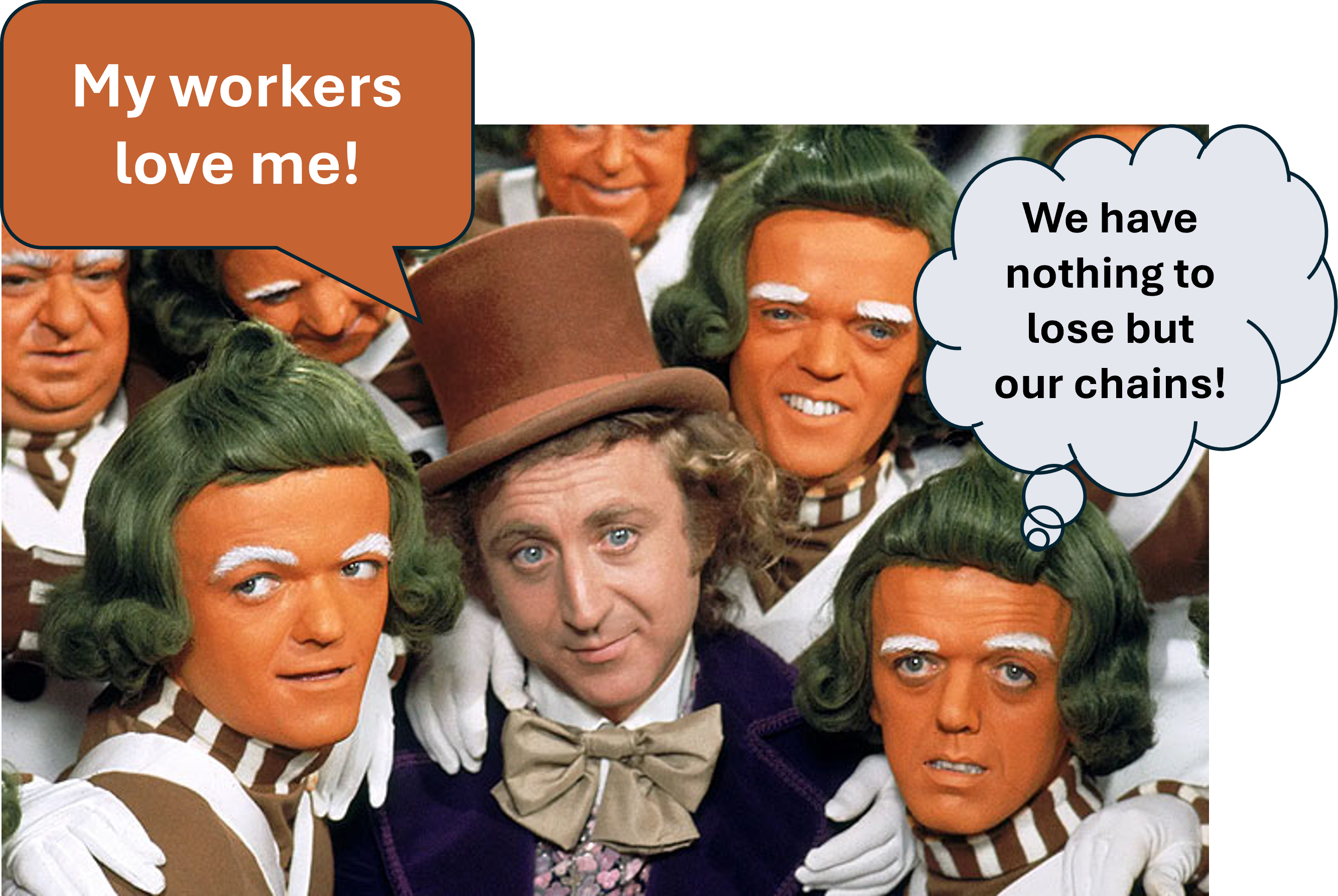
Oh, like the little guys in the chocolate factory!
No. Stay with me here. We’re talking about the Lumpenproletariat, not the Oompa Loompas. In fact, Charlie Bucket and his family in Roald Dahl’s book6 are better examples of a Lumpenproletariat than the exploited proletarian Oompa Loompas. The Lumpenproletariat (such a fun word to say…such an unfun word to be) is the most destitute, marginalized people in the Capitalist Mode of Production. They are unemployed, without stable means of employment. They must often resort to extra-economic vocations like crime, or prostitution, to gain the means of survival. They fulfill a very important role in capitalism because they help keep wages low by competing with the proletariat for jobs. They also serve as a reserve army of proletarians should the working-class revolt. Most importantly, they are an example of what can happen to a proletarian should they not do what the capitalist tells them to do.

Everything else rests on the economic base. All the other non-economic activities that we do becomes part of the Superstructure. Going to the park, the library, spending time with friends and family, working out at the gym, even going to church are part of this Superstructure. We may think of them as in no way related to the Mode of Production. However, Marx points out that these things, the mundane interactions of everyday life, play an integral role in capitalism or any mode of production. According to Marx, the Economic Base provides the resources for all of the activities that rest on it. Capitalists make major donations to churches, fund libraries and colleges. Gyms and restaurants where you hang out are all for-profit businesses. In other words, the economic base provides the economic support for everyday life.
In return, by participating in everyday life, the non-economic structures within the superstructure provide ideological support for the economic base. In other words, it teaches us how to understand and accept our relations to production. Hanging out with your friends usually means spending money or watching TV…which pays for advertising space. Schools are there to help students develop into valuable workers. Churches affirm the righteousness of the system and preach honesty and fidelity, values that your bosses appreciate.
The Ideology Shuffle

Ideology is the ideas that shape how we see the world.
Well, how I see the world is how I see the world. I have my own ideas about that. What does this have to do with my boss?
We often think that way, that our ideas are entirely our own. Marx, and his friend Engels, flat out say we’re wrong. They open their book, The German Ideology, by saying, “…men have always formed wrong ideas about themselves, about what they are and what they ought to be. They have arranged their relations according to their ideas of God, of normal man, etc. The products of their brains have got out of their hands.”7
If my ideas are not in my hands, whose hands are they in?
Marx and Engels famously argue, “The ideas of the ruling class are in every epoch the ruling ideas.” (Marx and Engels 1846) In other words, how you see the world is largely shaped by those who own it.
Let’s take a look at something we can all agree on. Marvel Movies. I loved the Marvel Movies, didn’t you?
Well…yeah! Who didn’t? Ironman, The Hulk, all those cool flying battleships…
Okay. Hold on right there. We all love it when the good guys overcome the bad guys, good triumphing over evil. That’s always a winning combination, but what else was being communicated through those movies? Think about some stuff that we never even thought to question.
What? Those movies are perfect just the way they are.
Really? Are they? Think about the main character, Tony Stark, and all the wealth he had. Think about S.H.I.E.L.D and all the resources it had at its disposal. The technologies that went into Captain America to build the perfect soldier, or the amazing suits that Tony flew around in to fight the aliens.
Yeah! That’s what I mean! Coool!
Cool, yes, but think about all the money and resources that such an endeavor would have soaked up. All of that tech that went to fighting supervillains and alien invaders. We never question how that tech and all of that money could have been used to provide valuable resources to everyone in the world. Tony’s power source could have saved us from climate change. Cap’s super-soldier formula could be used to fight disease and physical atrophy. With those resources we could solve homelessness, poverty, create a technological revolution all over the world. But these resources were owned by Tony’s Stark Industries and by S.H.I.E.L.D to do with as they saw fit, not as most of the people in the world would have wanted.
Yeah! And it was a good thing, too. Thanos woulda won if they hadn’t!
Um…there is no Thanos. There is no Ironman. It’s not real. But the background story being told reifies, or makes real, the assumptions of capitalism. The owners of capital are the heroes who will protect us from the things that threaten us.
But most of the things that we are being taught to see as a threat, aliens, evil scientists, “those people,” are not real. In fact, by creating fictional threats, and making the capitalists the heroes, Marvel Movies are legitimizing the assumptions about capitalism. Let the holders of capital do what they want, and everything will work out for the best. The real threats, according to Marx, are not the aliens and supervillains. They are the Tony Starks and the Nick Furys. People who hold or direct tremendous capital that they use how they want, with no accountability and without regard to the rest of the world.
Whoa! That got deep! I still like those movies, though.
So do I, but Marx gives us another way to look at them. When we watch a movie, or TV show, or even take a walk in a park, what are some themes that are just taken for granted? We don’t think about them because they are just assumed to be the right and natural way of things. Those are ideologies, and they often do not serve our interests. They more often than not serve the interests of the capitalist class.
We Are Family!
Let’s get back to talking about the family. How does our family shape our ideologies and whose interests do these ideologies really serve? Marx’s friend Freddy wrote a long treatise on the family. It was called The Origin of Family, Private Property, and the State.8 A critical look at the family can reveal just how insidious ideological and material support for the economic base is.
In essence, the family as we know it does a lot of work for the capitalist class. Most of it unpaid and even at the expense of the workers. It’s through the family that workers are literally reproduced. Families raise children to work hard, be respectful, obey their bosses. They teach a work ethic. How many of you were paid an allowance by your parents for doing chores around the house? What is that preparing you for? Adults in families, especially the women, do a great deal of care work to sustain the health of the proletarian workforce. This is unpaid labor. We send our kids to school where they learn to be good, obedient workers. This is done with the hope that when they enter the workforce, they have an advantage, they can compete with others. This is a huge benefit to the capitalist class because they get the best quality workers ready to compete for fewer and fewer quality jobs.
In exchange for all of this support, businesses pay the adults in the family a wage. This wage is what sustains the family economically. However, as mentioned in the last post in this series, the wages one receives are worth less than the value of the work that’s done. This is a huge subsidy for business owners. In essence, the working class pay the costs for providing, a healthy, educated, self-reproducing workforce, that is then paid less than the value of the labor they have been indoctrinated into providing.
That’s insidious!
Now, let’s say I’m a parent who hates capitalism. I may be the most radical anarchist on the block, but I don’t live in an anarchist mode of production. I live in a capitalist mode of production. I still have to teach my kids how to get along in the real existing material reality in which we live. I have to teach a work ethic. I have to teach obedience to authority, even if I think these values are bunk. If I don’t, my child will not be able to compete and has no prospects of thriving in capitalism.
We’re trapped.
In fact, Engels points out that the Capitalist Mode of Production is the force that has shaped families into what we know of today. In other modes of production, families looked different. Families in modern society, however, are shaped by concepts of private property. In Engels time, this even inferred that women, as wives, were the legal property of their husbands. This happened because modern capitalism shifted the relations of production such that men had more control of the marketplace than women and were therefore able to take a dominant role in the family. In non-capitalist societies, families are more often matriarchal, with a lot more liberty for women.
This theory can be validated when we look at our contemporary society. After intensive social movements, more and more women have access to higher education and are able to position themselves better in the marketplace. As this happens, women gain more autonomy in the family and family structures have changed significantly than what they were in Engels’ time.
The State Shake Down

Finally, we come to the role of the state in the Capitalist Mode of Production. Students going into any social studies class often enter with the assumption that the state is in charge of the economy. We see this in contemporary politics when we blame or credit the President with the state of the economy.
Marx points out that this is not the case. Not to beat a dead horse here, but the Economic Base drives the society, not the state. The state serves the interest of the Economic Base. Most immediately, the state uses its power to enforce rules that sustain the economic base, even with the threat or exercise of violence. In a Capitalist Mode of Production, this means that the power of the state is used to protect property rights. Some capitalist philosophers have gone so far as to suggest that protecting property rights is the only job of the state.
We can see this in action when homeless people “squat” in a house that has been empty for a long time. If discovered, they are driven from the house because they don’t own it. Those who do own it may not be using it, but it is theirs and they have a right to keep that house empty even if there are thousands of homeless people needing a place to live. According to the most recent census, there are over 15 million empty homes in the United States, more than enough to solve our homeless crisis. But the state will protect the right of the owners to keep their homes empty.
If that doesn’t make sense to you, you may have inculcated a bit of Marxist ideals in this series of posts. You’re welcome.
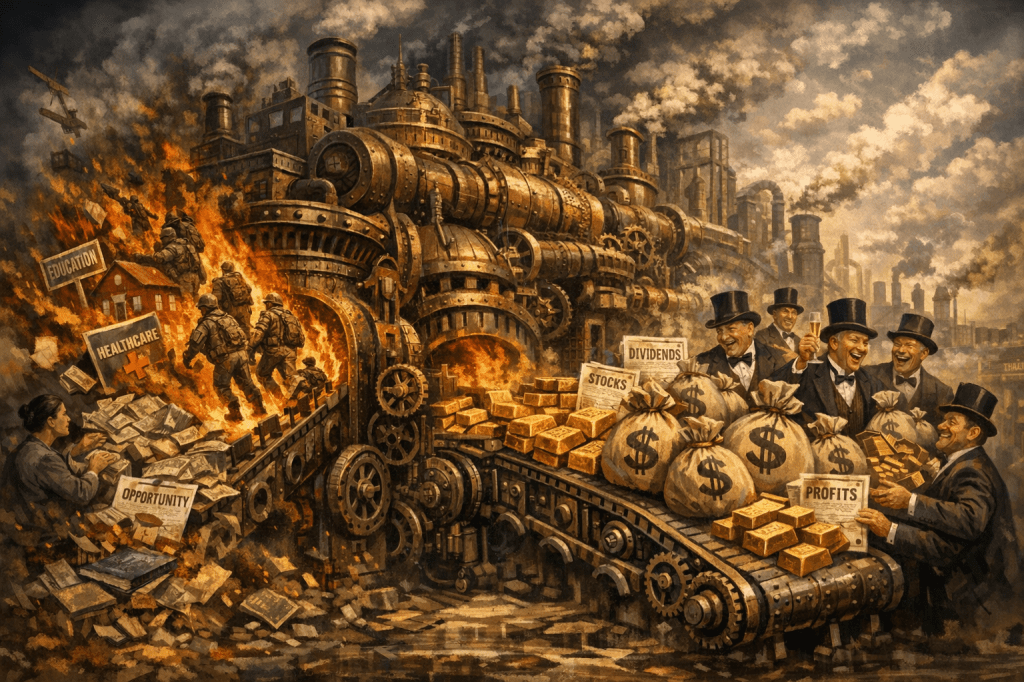
Of course, in exchange for this support, the economic base funds the state.9 In the United States, that means spending millions on political campaigns and lobbying. But that’s not all. Capitalist firms also help staff the state, especially in the top echelons. If you look at most presidential cabinets and high-level cabinet officials, you’ll find that many of them come from what we call the “private sector.” That means they come from big corporations like Goldman Sachs. This constitutes what some political observers refer to as a “revolving door.” Having a high-level government job is good for the resume and a steppingstone to a cushy corner office for some big Fortune 500 firm.
This sharing of expertise is elaborated in C. Wright Mills’ invaluable book, The Power Elite.10 Mills highlights the many network connections between big business, often the recipients of massive and lucrative government contracts, the executive branch which is supposed to regulate big business, and the top military in the Pentagon, a huge recipient of corporate produced resources. It is clear that the state is not going to upset the capitalists when their vested interests and economic futures rest in the private sector.
This was highlighted in Michael Lewis’s book The Big Short.11 Lewis put a spotlight on the profound conflicts of interest of those expected to regulate major bond investors. Many of the regulators were farming their resumes to the very companies they were supposed to oversee. Ratings agencies were selling triple A’s in order to attract the business of companies that were clearly not making triple A investments. And it all came crashing down…and the state jumped in and bailed out the very businesses that caused the Great Recession. Meanwhile, millions of Americans lost their homes with little help from the government.
None of this would have been a surprise to Karl Marx or to Marxist theorists. Of course the state came to the rescue of the capitalist class. That’s what the state is for in a Capitalist Mode of Production.
Everybody on the Dancefloor!

There it is, the Capitalist Boogie! And everybody is doing it! It’s the latest fad of the last two hundred years or so! And when everyone on the round is dancing to the same groovy tracks, it’s hard to do the dance you really want to do.
This is what Marx is trying to get at. Yes, capitalism is a great dance. It may even be the greatest dance of all time. But not everyone has the same soul, the same rhythm. If you can’t dance to the Capitalist Boogie, then you are not welcome to the party.
Wow! You can extend a metaphor!
I can. That’s my superpower!
The bottom line is that capitalism may be a very lucrative Mode of Production, but only a few people really benefit. The vast majority of people are exploited by the system. Despite the human exploitation, the environmental waste, the blatant corruption, the entire society is structured around this Mode of Production, making it very difficult to even conceptualize a better way.
This leads to some very serious negative consequences for everyone involved in this Mode of Production. According to Marx, the Capitalist Mode of Production, and all that goes with it, is destructive to human beings at the core level.

Next Post: Species Being, Man!
Notes
All images not designated as “figures” were generated using AI image algorithms, mostly Copilot and Nightcafe.
- Marx, Karl. 1859. A Contribution to the Critique of Political Economy. Berlin: Franz Duncker. ↩︎
- Fisher, Mark. 2009. Capitalist Realism: Is There No Alternative?. Winchester, UK: Zero Books. ↩︎
- To be sure, it is more complex. These are simplified models. For instance, those who controlled armies were also important in slave and feudal modes of production and used these armies to extract tribute. Slavery still existed and was crucial to the development of capitalism as we know it. When we look at these modes of production, we are really creating a model of dominant forms of economic relation. Marx understood this, but was shaping theories to help understand what was driving the dialectic of his time. ↩︎
- I know. I know. I’m old. Bite me! ↩︎
- See, Willy Wonka’s Exploitative Chocolate Factory | Marxist Student Federation and Charlie and the Chocolate Factory: A Capitalist Dystopia | The Artifice ↩︎
- Dahl, Roald. 1964. Charlie and the Chocolate Factory. New York: Alfred A. Knopf. ↩︎
- Marx, Karl, and Friedrich Engels. 1846. The German Ideology. London: Lawrence & Wishart. ↩︎
- Engels, Friedrich. 1884. The Origin of the Family, Private Property, and the State. Zurich: Hottingen. ↩︎
- Notice how I’m using the word “State” rather than “Government”. Government is simply how power is organized in a society. The State is the institution that actually does the work of governing. ↩︎
- Mills, C. Wright. 1956. The Power Elite. New York: Oxford University Press. ↩︎
- Lewis, Michael. 2010. The Big Short: Inside the Doomsday Machine. New York: W.W. Norton & Company. ↩︎




 The Mad Sociologist Blog
Leave a comment