


Here’s how it Invents One!
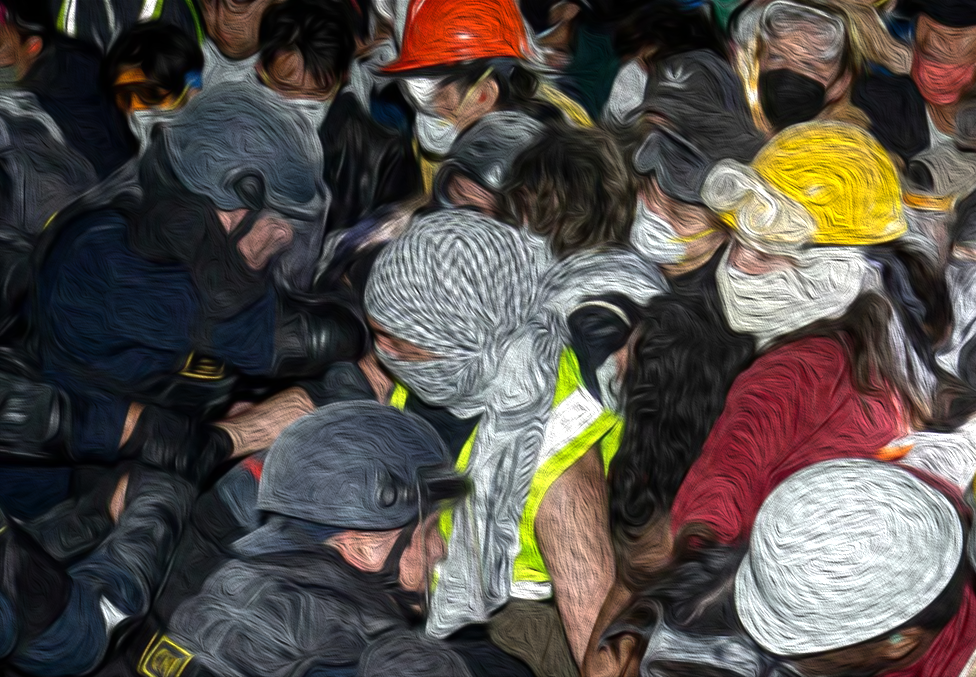
Framing Legitimate Protest to Justify Illegitimate use of State Violence
We take for granted the narrative that we live in a democratic society founded on the principles of free speech and the values of standing up for the oppressed. In such society it should be the expectation that our institutions of higher learning will be the proving grounds for these principles. Yet time and again it is demonstrated that elites disdain the core fabric of a free society and will not tolerate any trespass against their authority.
Consequently, we have a tension of contradictions. On one hand, we have the narrative, however shallow, that ours is a bastion of freedom. On the other hand, we have a muscular policing authority waiting, batons in hand, to crush any attempt to exercise that freedom in any way that might be inconvenient to elite goals.
These two forces rest in opposition, mitigated by the expectation that the state will exercise restraint over its agents of violence–the police and military–and the aggrieved citizens will conform to rules of “appropriate dissent.” These rules are centered around the belief that protest should be peaceful, and respectful of property.
Of course, this should not be seen as an agreement between equals. The state always has the final say as to when and under what circumstances it employs violence. The only restraints binding the state are the gossamer tendrils of legitimacy that tie the citizens to state authority. The state must be able to justify its use of violence, especially if it acts under a thin veil of democratic status.
Toward that end, the state must be able to make two claims. First, the protests are illegitimate. Those gathering in collective speech and action are either on the wrong side of history, or they are yammering about nothing. Second, the protest is violating its tacit agreement to be peaceful and respectful of property.
We see these dynamics play out with the violent suppression of protestors demanding just action against Israel’s genocidal tactics in Gaza
Discrediting Dissent
The first feature involves discrediting dissenting discourse.
In this matter, the state’s position is clear. Israel was the innocent victim of brutal terrorism on October 7th and therefore has the authority1 to respond in kind. Israeli actions in Gaza are justified in the interests of self-defense. Indeed, it’s hard to argue with this claim. People living under Israel’s jurisdiction were attacked, kidnapped, held hostage, and killed by Hamas, the governing authority of Gaza. Hamas’s actions constitute an act of terrorism. Israel is justified in a response.
From this metric, we can establish an easy discursive formula. Any criticism of Israel is an embrace of terrorism. This is reified in norms of discussion on the topic when any critical claim regarding Israel must be prefaced by the acknowledgement that Hamas’s actions were unconscionable…but [insert milquetoast critique of Israel] …again, this does not justify what Hamas did… The very rules of the discursive game are rigged in favor of Israel.
There are a couple complexities involved in this premise that we are not allowed to explore with any depth, the notion of what constitutes terrorism, and the limits to what constitute self-defense.
Terrorism
The first variable has to do with how “terrorism” is being defined. In essence, terrorism is what “those people” do. What “we people” do is called military response or some such designation. For instance, we can all agree that Hamas’s actions on October 7th constituted terrorism. To those in the protest encampments, however, terrorism is a more inclusive construct.
For instance, Israeli attacks against Jenin, in the West Bank must constitute terrorism in light of the same criteria. According to The Wire, a publication of the Jewish Voice for Peace, reported, “The details of this attack qualify it as a war crime under international law. Amidst the bombing campaign, the Israeli military raided Jenin Public Hospital, firing teargas and live ammunition. The military also targeted emergency services and fired teargas several times inside Khalil Suleiman hospital, rendering the emergency room unusable.” At the time of this quote, twelve Palestinians had been killed, including five children.
The Wire also describes five days of Pogroms against Palestinian villages instigated by Jewish settlers in the West Bank. “These attacks are not only condoned by Israeli officials and carried out with the protection of the Israeli military — they are part and parcel of how the Israeli government expands its control over the Occupied West Bank, stealing Palestinian land and ethnically cleansing the Palestinians who live there.”
These reports are corroborated by the United Nations, “Prior to 7 October, a record-high 200 Palestinians had already been killed in the West Bank this year.” Doctors without Borders also points out that, “Even before Hamas’ attack on October 7, Israeli forces had already killed 205 Palestinians in the West Bank this year, while settlers were responsible for nine more killings. Of these deaths, 52 occurred in Jenin alone…” In Gaza, “Between 14 June 2007 and 14 June 2022, Israeli military attacks have killed 5,418 Palestinians, 23% of whom are children and 9% women, and injured thousands of others,” according to a fact sheet put out by Al Mezan Center for Human Rights.
Sources also report that five Israeli units active in the West Bank were involved in significant human rights violations. According to Reuters, “Human rights groups say they have reported incidents involving Israeli units including extrajudicial killings, torture and physical abuse to the State Department, most of them committed against Palestinians in the Israeli-occupied West Bank.” Extrajudicial killings? Torture? Not to worry, four out of five of the groups conducted “remediation” for their crimes, so it’s perfectly legal to send them more weapons despite clear U.S. laws to the contrary. The fifth, the Netzah Yehuda Battalion has yet to remediate. But they will likely get weapons as well, because four out of five ain’t bad!
Even if we lay aside the specific incidents of violence against Palestinians in Gaza and the West Bank, of which there are far too many to report here, there is the question about the very nature of Israel’s occupation of Palestinian territory. In the West Bank, this occupation serves to dispossess Palestinians at the bequest of Jewish Settlers, a clear violation of International Law.
Gaza, before October 7th, was often referred to as the world’s largest open-air prison. Serving as a refugee camp after the 1948 expulsion of Palestinians from their home, Gaza has been under strict Israeli lockdown since Hamas’ rise to power over fifteen years ago. The consequences have been devastating. According to the United Nations, “The result has been the near collapse of Gaza’s regional economy and its isolation from the Palestinian economy and the rest of the world,”
There’s also the matter of the hostages being held by Hamas. This is, of course, an awful violation of human rights. No human being should have their freedom constrained without due process. This is understood. Of course, Israel does not hold hostages. Instead, Palestinians being held in Israel are “detainees.”
Self-Defense
Do these trespasses on the part of Israel constitute authority for violent Palestinian response? If not, we have to explain the criteria by which we justify Israel’s violence while condemning that of Palestinian organizations.2 If an argument is to be made that Palestinians have an equal right to defend their sovereignty3 as do Israelis, to what extent should such a response be limited? Should we not expect that Israel’s response also adhere to such limits?
The primary function of any state, a function acknowledged almost universally, is the defense of its citizens. Here is the gist of the Pro-Palestinian movement in the United States. Israel does have the recognized authority to respond to threats against Israeli citizens. This includes the use of violence within the limits of International Law and the bounds of human morality. However, Israel’s response has long since exceeded its internationally accepted limits.
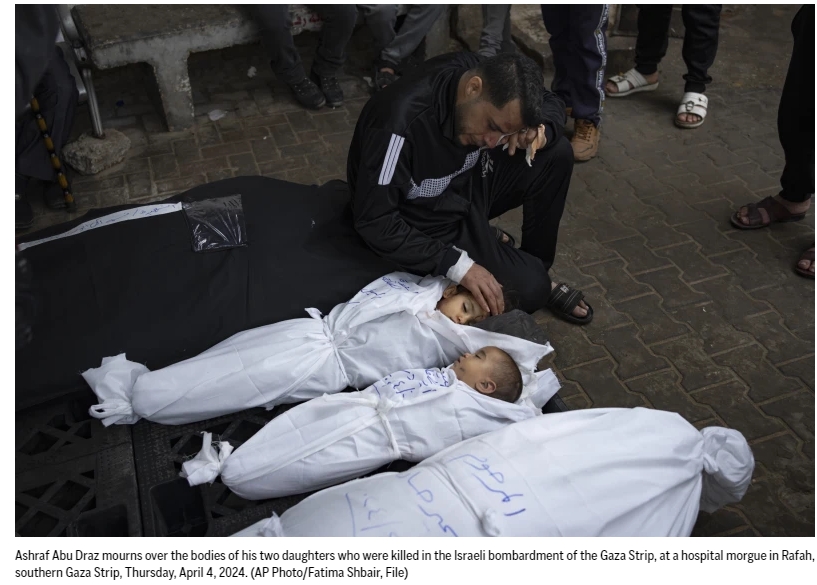
I will not use this post to rehash the wealth of information out there on the extent of devastation faced by Gazans at this point. There is no question that Israel’s military response can no longer be defined as defensive if it ever could be. It is clearly retribution, otherwise known as collective punishment–a clear violation of international law.
This is the most difficult discourse to contain. Anyone with internet access can see for themselves the brutal inhumanity of Israel’s punitive response. The exemplar of this inhumanity was what has become known as the Flour Massacre in which over a hundred Palestinian civilians were killed and almost three hundred wounded when they attempted to retrieve food from aid trucks. According to witness Ali Awad Ashqir speaking to The Guardian, “The moment they arrived [the relief trucks], the occupation army fired artillery shells and guns,”
Israel, of course, denied the charges and her supporters are inclined to believe that, at worst this incident was a horrible accident, a misunderstanding of some kind. But then we see footage of Palestinian civilians being shot and killed trying to retrieve air-dropped supplies. It’s impossible to ignore the realities that Israel is engaging in punitive terrorism against defenseless civilians.
Campus protests are responding to these clear violations. These actions are repugnant to all observers regardless of where they stand on the Israel-Palestine issue. Organizations like Coalition for Mutual Liberation are composed of many different interests, including Jews who are appalled at Israel’s conduct.
This information cannot be contained, but it can be distorted. According to a poll conducted by the on-line news channel, Breaking Points, those who get their news from cable are more supportive of Israel than those who get their news from on-line sources like YouTube. In other words, what we have is a discursive divide between older and younger Americans. This is, of course, the very kind of divide that is activated when young people on college campuses take over public spaces in protest of heinous war crimes.
Genocide?
Activists and advocates do run into a discursive problem when it comes to references to Israel perpetrating genocide against Gazan Palestinians. It is painful and discomforting to suggest that a culture tempered in the fires of centuries of ethnic cleansing and pogroms, that the very victims of the Holocaust could be accused of genocide. The existence of Israel itself is a testament to the centuries of shameful, inhuman, prejudice, purges, brutality and death faced by Jews throughout history. Israel stands as the ultimate answer to and respite from a long history of subjugation. That such a nation could violate the very core of its cultural soul is gut-wrenching on a primal level.
Yet, the level of destruction inflicted upon Gaza can engender no other conclusion. There is no historical law to suggest that the victims of genocide cannot themselves become victimizers. There’s no question that the level of destruction in Gaza is nothing short of gruesome and categorically one sided despite the fact that Hamas continues to fire missiles into Israel in desperate vane. The disproportionate power between Hamas in Gaza and the Israeli war machine reinforces the disproportionate responsibility that Israel has to ensure its response conforms to international law.
Back in January, South Africa accused Israel of committing genocide against Palestinians in Gaza. Since then, Francesca Albanese, a Special Rapporteur for the UN presented a report from the Human Rights Council on the situation in Gaza. The report draws the following conclusion:
The overwhelming nature and scale of Israel’s assault on Gaza and the
destructive conditions of life it has inflicted reveal an intent to physically destroy Palestinians as a group. This report finds that there are reasonable grounds to believe that the threshold indicating the commission of the following acts of genocide against Palestinians in Gaza has been met: killing members of the group; causing serious bodily or mental harm to groups’ members; and deliberately inflicting on the group conditions of life calculated to bring about its physical destruction in whole or in part. Genocidal acts were approved and given effect following statements of genocidal intent issued by senior military and government officials.Human Rights Council Report
As much as it pains us to admit it, despite its history and cultural narrative, Israel is perfectly capable of committing acts of genocide. That it is doing so is becoming incontrovertible as it defies the world in perpetuating inhumane violence and punishing sanctions on an all but helpless adversary. According to Amos Goldberg, a Holocaust and genocide researcher at Hebrew University, “Yes, it is genocide. It is so difficult and painful to admit it, but despite all that, and despite all our efforts to think otherwise, after six months of brutal war we can no longer avoid this conclusion.”
Ultimately, whether or not an act of violence constitutes genocide is a matter of debate. There is no empirical measure. Obviously, the metric used has more to do with one’s personal values and their empathy for the targeted group than it does any scholarly operationalization defining it. That being said, if by their values one interprets a policy as genocidal, they must act.
In the face of genocide, then, it is incumbent upon us all to stand against. This is not just a matter of opinion. Since the opening of the concentration camps in German controlled territory in World War II the collective mantra was baptized in tears…never again! Never again for Jews. Never again for anyone. It is not only a right to stand against genocide regardless of its perpetrators. According to all civilized values since the revelation of the Final Solution, it is our collective responsibility.
The Tacit Agreement
That the weight of police violence could be used to crush those exercising our collective responsibility to oppose genocide defies any sense of justice. It is impossible to discredit the diverse groups occupying campus quads, public spaces, and even buildings in light of the evidence. Only the most devout Zionist can justify the horrors we are all witnessing…as is their right. But the world can see…and no amount discursive gamesmanship can turn out the light on Israel’s atrocities.
The only other means for justifying the use of state violence against those who dissent against death is to suggest that they have violated the agreement to peacefulness and respect for property. This is the go-to tactic for the state. As has been explained on this blog, protests are complex things and attract a wide array of people with a wide array of interests for being there. If looking for violations of the tacit agreement in any large enough protest, it’s likely at least one will be found. Someone broke something or pushed someone. You can almost count on it.
This is especially true when we take into consideration the actions of those not associated with the organized protest. Those who organize a protest will often drill into the participants mindsets to remain peaceful at all times. The most well-organized protests will include trainings and practice runs in preparation for state or civilian violence. Those who break the contract are often participants not associated with the organized protests. It’s impossible to police everyone.
This is especially true in the face of counter-protesters who have no vested interest in satisfying the contract. This may be the case with violence that broke out at the UCLA protest where it appears that counter-protesters through fireworks and teargas at the protestors. This isn’t conspiratorial…necessarily…once violence breaks out in a crowd, it is impossible for the police to know who is at fault and who is the victim. They’ll arrest everyone they get their hands on. It is, however, opportunistic. It’s a great opportunity for the state to exercise its violent prerogative against dissent.
It’s a great opportunity, but it’s not prerequisite. In New York, after one-hundred protesters were arrested at Columbia University, NYPD Chief of Patrol John Chell reported, “To put this in perspective, the students that were arrested were peaceful, offered no resistance whatsoever, and were saying what they wanted to say in a peaceful manner.” “We arrested them anyway,” was the unspoken caveat.
That’s the problem when protests are largely peaceful. At least where there’s footage of buildings burning or cars overturned, as was the case with some of the George Floyd protests, the police have pretext to move in on the other ninety-three percent of protests that were peaceful. In the current case, there is a dearth of violence and criminal action. Yet there is great pressure on the college administrators and the state to shut down dissent. As Natasha Lennard observed at The Intercept, “The negligible acts of property damage were not, of course, what was being policed…Instead, it was the protesters’ message that was being handcuffed — the condemnation of Israel and the calls for a free Palestine — and young peoples’ commitment to it.”
Where there’s not enough violence or damage to property to justify a violent state response, some other criteria must be met. There are, of course, the standard “outside agitators” claim. Trespassing. Protesting without permits. Those are always reliable fallbacks.
When it comes to Israel and the excesses of extreme Zionism, however, the go-to is antisemitism. The claim is that Jewish students (those not participating in the protests) are being victimized by antisemitic comments made by protesters. The trauma suffered constitutes, in essence, a de facto violence against Jewish students necessitating state violence against the protestors.
Anti-Arabism or Anti-Palestinism doesn’t have the same punch. That’s just the point. In this discursive game there isn’t even a good word to describe the experience of Palestinian students resulting from October 7th. According to the Times of Israel, Anti-Muslem and Anti-Palestinian discrimination in the U.S. increased 180% since October 7th. Yet outside of the protestors, there is no voice for the trauma Palestinians experience.
To be sure, there is plenty of evidence to support claims that both groups face an increase in dehumanizing rhetoric and discrimination. Conflict heightens the worst elements of our motivations, especially when they are perceived justified against an out-group. In neither scenario is prejudicial rhetoric excusable. Protest groups, activists, and advocates should be proactive and responsive to all prejudicial actions that may be inspired by the movement. But the policing should be in the hands of protest leaders and members…not the actual police.
Free societies do not use the state to police speech. Many of the advocates wringing their hands over the trauma speech is inflicting on poor Jewish students (not to diminish this…rhetoric can be hurtful) also decry so-called “safe spaces” for LGBTQ+ students, and racist rhetoric when it comes from right-wing protests. Exposure to hurtful rhetoric is a characteristic of free speech. The salve for this is more free speech, to allow all parties to express themselves in public spaces. All protests should be mindful of the need to engage with the opposition in meaningful and fruitful discussion.
The antisemitism claim carries further weight. Among some Jewish advocacy groups and their allies, the claim is that any criticism of Israel equates to criticism of Jews and is therefore antisemitic. To suggest that Israel has gone too far in its butchery in Gaza, according to this frame, is a hate crime against Jews. Recently, the House of Representatives passed legislation intent on defining antisemitism more broadly. According to the Washington Post, “Several Republicans said opposing Zionism — the political movement to create, and now to preserve, a state for Jews in their biblical homeland — would qualify as antisemitism under the law. Some suggested that even holding a prolonged protest would constitute antisemitism.”
It is impossible to legislate the particulars of speech. That’s why we have a First Amendment. Language that is directly threatening is easy to identify, but other scripts are more ambiguous. Case in point, is the phrase, “from the river to the sea, Palestine will be free,” antisemitic? Certainly, it can be. There are examples of those who say this with the thought that “Palestine” will be free of Jews. In that iteration, it is clearly antisemitic. On the other hand, it could mean that Palestine will be free for everybody. It could mean free from hate. It’s a great rhyme for a protest chant…that’s its value. It is descriptively vague, however.
Regardless, it cannot be the role of the state, or of college boards, or certainly not the police, to be the arbiter of what this phrase means. Hearing this phrase may make Jewish students uncomfortable. That’s a reason for opening discussion…not a justification for police violence against dissent.
Another claim is that the protestors represent some extremist fringe that does not represent American values. This requires a distortion of the dissenting message. The Occupy Protests were slandered as far left socialist agitation as well as the wailing of “dirty hippies” who didn’t want to take a bath and get a job. The actual protestors were saying that they wanted an economy that worked for everyone, not just the super-rich who had just been bailed out after the Great Recession. Were there socialists in the crowd? Sure. But there were also Ron Paul activists, and libertarians…I know this because I chatted with them! Black Lives Matter was smeared as anti-white, black radicalism. In fact, they were just folks who are demanding that the police stop shooting non-violent and unarmed black people…which should not be controversial.
So, the Pro-Palestinian protestors are being painted as extreme Cultural Marxists, antisemitic and anti-American. Of course, all they are asking is that their colleges, the institutions they are spending tens of thousands of dollars to attend, not use that money to invest in a nation that is slaughtering people. They are asking that the United States, the nation that acts in their interests, to stop sending weapons that will be used against civilians, often women and children, who are trying to get food or medicine, or used to bomb hospitals and electrical infrastructure.
According to Data for Progress, much of what the protestors are asking for is hardly fringe. Even a majority of Republicans support a cease fire.
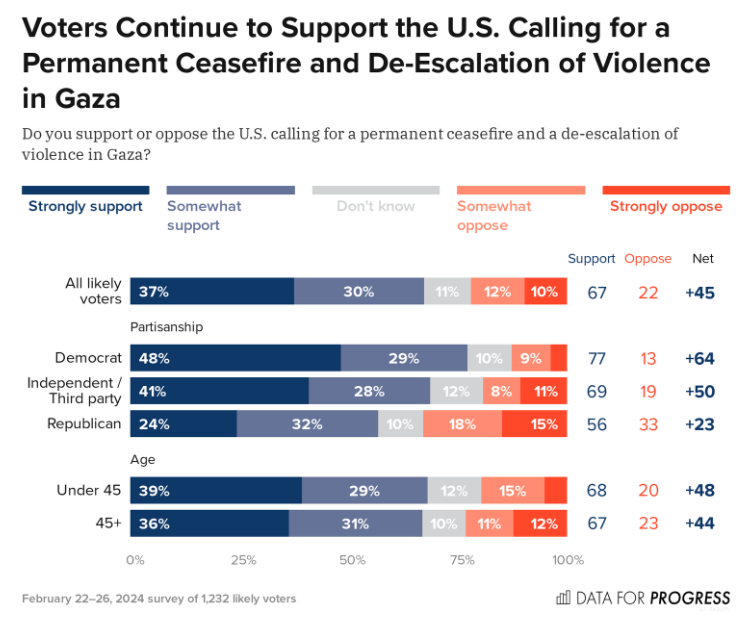
It’s hard to find data on support for divestment, but it is understood that calling on a nation to not kill civilians is hardly extremist rhetoric. Indeed, the opposite is the case. Are there some socialists in those protests. Of course, socialists have a long history of opposing imperialist and colonialist wars. Our young protestors, however, are not arguing from the extremist fringe. Being anti-genocide should not be a subject of debate.
There is, however, a great deal of pressure on college and university elites to shut down dissent. The state is also under pressure. The thing about protestors is they have the tendency to reveal the slimy underbelly of American foreign policy. That’s not good for business. So, these college brats have to be shut down. It is incumbent upon the state, answerable to the economic elite, to find the justification.
- We often see this discourse presented in terms of “rights” in that Israel has a right to defend itself. Lately I’ve been trying to focus on disentangling this notion of rights from the realities of power. The people of Israel have a right to be secure. Israel has the power and the authority to act in that interest. Israel as a nation does not have rights. It is an institution order. Only people and other living things have “rights.” ↩︎
- To be sure, it is the position of this Blog to condemn all acts of violence. ↩︎
- Of course, the whole idea of a Palestinian sovereignty hangs on the status of a Palestinian state for which there is no formally recognized body. Israeli Prime Minister Netanyahu has been clear that such a body will never be constituted while he is in office. Without an institutional authority to respond to foreign trespasses against its people, there is no legitimate recourse of Palestinians to address grievance. A condition that Israeli settlers have been taking advantage of for decades. ↩︎


 The Mad Sociologist Blog
Leave a comment