

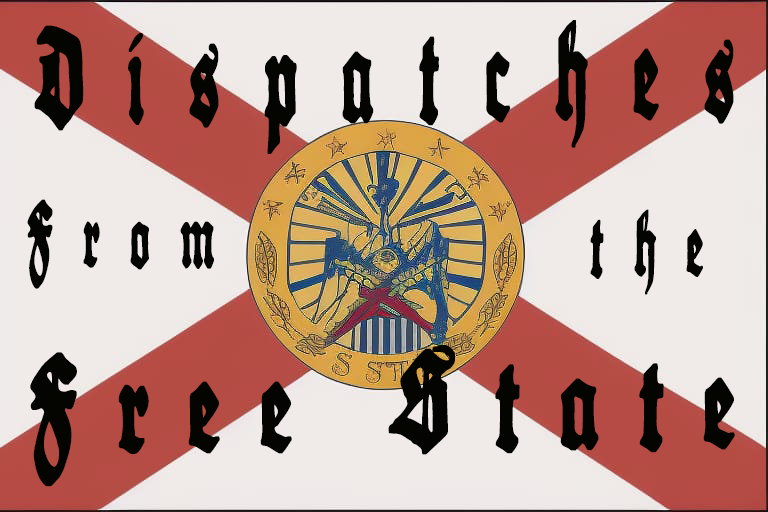
THE LINK BETWEEN EDUCATION AND AUTHORITARIANISM
Democratic vs. Autocratic Philosophies of Education
Public education is the bedrock of any healthy democracy. Further, the functional principle of any sound system of public education is academic freedom. In a diverse, multicultural democracy public schools, resting on the shoulders of teachers, have an awesome responsibility. Teachers must take young people at various stages of their lives with differential ability, from countless backgrounds, and vouch every single one of them the same opportunity to maximize their human potential. At the same time, for the sake of our democratic system, these students must become critical agents prepared to think deeply about a wide array of topics and to evaluate the quality of the information that they receive from those in power. In the process, if done well, students also learn to relate to each other in terms of equal citizenship, shared responsibility, and as human beings deserving of basic dignity.
The primacy of human potential. The responsibilities of citizenship. Respect for human dignity. The beauty of diversity. These are bedrock standards for democratic education. As philosopher John Dewey said, “Democracy has to be born anew every generation, and education is its midwife.” It’s through universal and broad public education that democratic society is reproduced and perpetuated. No other institution can fulfill this promise.
If public education grounded in academic freedom is the bedrock of democracy, then those who are antagonistic to these values must also focus their attention on schools. Autocracy, as opposed to democracy, must embrace oppositional values regarding education. Autocratic education is exclusionary, geared toward the needs of an elite group, premised on authority and obedience. An autocratic education system is not focused on maximizing human potential. Rather, it is designed to maximize human utility to the needs of the autocrat.
An autocratic education must by necessity be at least two-tiered. There is the education that must exist for the children of the economic elite and those who directly serve them. Then there is the education for everyone else. The first tier is focused on critical and creative thinking and freedom. The second tier emphasizes rote content learning and obedience. Both tiers must be bounded by intentional class indoctrination.
In this context, the current assault against public schools and public school teachers in the “Free State of DeSantis” and other right-wing states should come as no surprise. Public schools, since the beginning, have served as the microcosm as well as the staging ground for all the great political debates: immigration, science vs. religion, slavery, war and peace, desegregation, patriotism. Always and especially is the ubiquitous debate that underlies all others–that between democracy and authoritarianism. Public education girded by academic freedom is anathema to authoritarian ambitions like those held by DeSantis the Mediocre. Tyrants cannot achieve their ends when public schools are functioning according to democratic principles.
Therefore, contemporary fascists like Ron DeSantis and Betsy DeVos must make the destruction of progressive education a top priority. An aspiring authoritarian party has two main strategies. First, it can overthrow the democratic government and seize the technologies of the state. This is no small task in a society with a long history of democratic pretensions even if one could argue that this society falls short of democratic ideals. However, states once seized are difficult to hold, especially if democratic ideals are incorporated into other important institutions.
The second strategy is more of a long game. Authoritarians can intercede in, undermine, and seek to control foundational democratic institutions. What are these foundational institutions? At this point, institutions necessary to the sound functioning and perpetuation of democracy are unions, mobilized democratic interest groups including radical social movements, a free, diverse, and professionalized media, higher education premised in Enlightenment values of science and inquiry, and universal progressive public education.
Public schools are the root of all. Public schools educate future economic actors, both workers and entrepreneurs. Public schools inculcate political actors, activists, politicians, and bureaucrats. Public schools enlighten and inspire future scientists, historians, philosophers, and artists, train the soldiers, socialize the police, incentivize the lawyers, doctors, accountants and, yes, future teachers and professors.
When all these social actors are steeped in democratic principles of humanity, reason, and tolerance, authoritarians are deprived of the oxygen they get from conflict, ignorance, fear, and isolation. To undermine democratic public education is to undermine all institutions premised on free thought. To seize the ship, one must control the boiler. The long game must start below decks.
The Long Game: The Neoliberal Phase
The long game started in the eighties under President Reagan with his desire to eliminate the nascent Department of Education. The result was the publication of A Nation at Risk, an empirically flimsy description of America’s failing education system. From this publication, conservative education reformers took the wheel.
Those going to teacher school in the late 80s and early 90s learned all the latest and most up-to-date science and research in education. They learned how students grow and develop in the course of a well-implemented progressive and experiential curriculum. They also learned how economic inequality, overcrowded classrooms, and underfunded school systems stunt student potential. Professional educators coming out of the eighties and into the nineties became advocates and spokespeople for progressive reform such as increased resources for schools in poor communities and smaller class sizes. Teachers fought to incorporate technology into classrooms as well as implementing experiential and inquiry-based curricula, cooperative learning, and alternative, higher-order, comprehensive assessment. Meanwhile, conservatives and moderates fought this progressive model at every step under the guise of “getting back to basics” and “emphasizing rigor.”
Progressives mostly lost. The political momentum was behind those “reformers” who placed the blame for “underperforming schools” on lazy teachers protected by corrupt unions, lack of accountability, and a curriculum watered down to accommodate…well…you know…”those people.” The proposed “market-based” reforms, spearheaded in Texas and Florida by the brothers Bush, were exactly the opposite of what was needed to bring American education into the twenty-first century. The curriculum was recentered around traditional coursework and some vague notion of “rigor”. Teachers’ unions were attacked and disempowered. Tenure and other teacher protections were destroyed. Accountability was rationalized in terms of mind-numbing multiple-choice, standardized tests.
The underlying educational philosophy shifted from progressive and democratic pedagogy emphasizing community and active citizenship to a “market” based approach emphasizing competition, choice, and efficiency. Schooling was transformed from a public good to a consumer product. Education was to be subject to the same production processes as any other market output. Improving education was relegated to the laws of supply and demand. Those schools with the best output would outcompete those schools with the worst. Parents, as informed consumers, could make simple decisions about which school to choose for their children based on easy-to-understand “objective” measures. Schools were given their own report cards, summarizing everything that happened within their walls with a simple A, B, C, D, F rating. To generate these efficient measures, student achievement was decoupled from meaningful accomplishment and broken down into measurable standards of “value-added”.
Professional educators tried to explain that human potential is subjective and impossible to evaluate based on quantitative measures of value. But then, professional educators were not asked for their input. Any objection was shrugged off as nothing more than whining on the part of those lazy teachers who do not want to be held accountable for their ineptitude.
The justifying principle of these first conservative incursions into public education was that schools were falling short in preparing students for participation in the free market. Emphasis was to be placed on practical learning and marketable skills to prepare young people for the complex jobs of the twenty-first century.
This was the premise. It was a lie from the start. Since the late eighties and early nineties, economists and educators predicted that the post-industrial economy would require workers who were creative, innovative, and flexible. They would have to be prepared for a rapidly changing and evolving marketplace driven by expanding information technology. Success in such an economic environment would require the ability to analyze, evaluate and synthesize information. Furthermore, the workplace of the twenty-first century would be more interactive and interpersonal than the industrial conveyor belt.
We knew this from the start. That the curriculum was designed to be standardized and content based, exactly the opposite of what was needed for the market of the future was not an error. It was what the conservative movement was planning from the beginning. We know this because these market-based systems were not imposed on the high-end private schools. If conservative activists really believed that market-based solutions were the best possible pedagogical approaches, wouldn’t the wealthiest schools have been the first to incorporate them? No. Standardization, objective measures, and value-added measures were targeted only at the children of working people.
The goals were manifold. First was reframing the public school mission from the development of critical and active citizens to one of producing a docile and dependent workforce. As philosopher Mortimer J. Adler pointed out in The Paideia Proposal, “…vocational training, training for particular jobs, is not the education of free men and women.” Of course not. Free men and women have never been important to the right. The goal was always to create exploitable bodies.
Secondly, the goal was to create a two-tiered educational system consistent with autocracy. The top tier constituted those young people intended to hold the higher echelons of the knowledge-based economy. They would develop the higher-order thinking skills necessary to be leaders in this evolving market. They would practice these critical thinking skills without all the impedimenta of empathy or tolerance intrinsic to enlightened public education and necessary for a democratic society. They would learn that they were the special class, entitled to privilege and deserving of their status because their parents could afford to buy it.
The bottom tier was to learn that they were not active participants in a marketplace of ideas. They were in school not to maximize their human potential, because their human potential was not necessarily marketable. They were to passively accept the stories they were told. They were to learn practical skills as determined by the needs of the economic elite. Most importantly, they were to do what they were told. Any deviation from this script was met with coercion from in-school practices of suspension and seclusion, to medically drugging the student into docile oblivion, to locking him away should all else fail. The infamous School to Prison Pipeline was not a bug of this system. It was a feature.
Meaning, innovation, creativity, was to be stripped from the pedagogy. Schooling became a demonstration of obedience and self-discipline. A high school diploma meant that one filled in the correct bubbles on some “objective” measure and was, therefore, worthy of a place in the market–to make themselves marketable to the economic elite. If they were marketable enough, they might even gain some financial stability. After all, freedom has nothing to do with politics. Freedom is gained in the market and is reserved only for the deserving.
The third goal can only be inferred but seemed obvious from the beginning. Market-based reforms were intended to dismantle education as a public good. Why else would public schools be tasked with doing the opposite of what everyone knew to be quality education, assess the outcomes based on unreasonable standards, and then make life harder and harder for those doing the work of educating students? There is no other reasonable inference but that public schools were set up to fail.
That public education did not, as yet, collapse has more to do with the quality of American professional educators than with neoliberal policy. Public schools continued to teach in spite of the reforms. Teachers adapted to the stultifying standards and even managed to sneak some real teaching into the curriculum despite the academic plans. Communities insisted on smaller class sizes, arts education, and accelerated courses. Admin and faculty worked together to find creative ways to satisfy backward state requirements while at the same time providing quality learning experiences for their students. The big problem with the neoliberal phase of educational autocracy is that teachers did not fail as planned.
There are, of course, limits to the malleability of even the most flexible material. The two-tiered education system has evolved, and despite some progress continues to reflect the racial disparities of our nation. Teaching, once a solid middle-class profession, has become a trap in which dedicated professionals find themselves overworked, underpaid, and disrespected. Becoming a teacher is an ascetic undertaking, consigning the individual to a low standard of living, working multiple jobs, with no guarantees for a secure future. Teaching is a calling for which the called upon are expected to make any sacrifice. At least this is true in dead-end states like Florida.
Furthermore, despite the best intentions and efforts of even the most talented teachers, many students leave school adept at filling in bubbles on scantrons. They have learned the all-important test-taking skills that would equate to primary and secondary school success. Upon graduation they are released into the real world where life does not offer neat little multiple-choice options and test-taking skills are completely irrelevant. In the last thirty years or so of market-based reforms right at the rise of the information age, we now have a generation a significant portion of which is unable to tell the difference between real and fake news. They are ripe fruit for authoritarians to suck.
The process described above might lead one to think that there was some underlying, well-planned, conspiracy to undermine public schools. This is too simplistic. The trends described above were the natural consequences of the rise of a conservative movement inspired by neoliberalism. President Reagan’s axiom about government being the problem rather than the solution was embraced as dogma by American conservatives. This conservative movement did not just embrace the nuclear family, the military, and the church as traditional American institutions. It also wrapped the flag around the American entrepreneur. There were no problems that could not be solved by the market. If public education was failing, as revealed by A Nation at Risk, then the solution was privatization rather than more government bureaucracy.
It should also come as no surprise that a capitalist class would applaud such measures. They would then use their position in the halls of power, on the boards of media conglomerates, their seats on college and university advisory panels to promote market-based reforms. Most importantly, they dedicated their lobbyists to pushing laws that disempowered public education and incentivized privatized ownership. Within ten years Dewey was out and Milton Friedman was in.
Framing on this was such that both parties embraced the neoliberal approach. Financially strapped States and municipalities, often under the pretext that market reforms could offer better educational outcomes at a lower burden to taxpayers, also bought into this reform discourse. Some of this may have been motivated by cynical self-interest. Much of the impetus, however, was a sincere belief that markets were the universal solution. The role of government was to do nothing more than clear the way for markets to do what markets do.

To be fair, considerable progress was made in elementary education. By the time students graduate from high school, however, any progress made in the earlier years evaporated. Students walking out the door on the last day of their senior year in 2023 were no better off in any measurable way than I was when I walked out the door in 1988, or my mother was when she walked out the door in 1969.
Of course, the trendline was never of interest to movement conservatives in the neoliberal phase. This early phase of authoritarianism held three assumptions about public education. First, public schools were failing because they were state-run, and government is the problem. One can only expect failure from any public institution. Second, schools were failing because teachers were incompetent and lazy, but protected by their all-powerful unions. Administrators, in the meantime, were nothing more than political hacks with nobody holding them accountable. Finally, public schools were failing because they were progressive. Schools spent too much time and energy coddling “those people” and trying to build self-esteem and confidence. What “those people” really needed was the basic “three R’s” and practical work skills. Time spent trying to turn “those people” into Renaissance Men and Women was wasted. Schools should prepare students for market position.
These assumptions are authoritarian in the context of standard capitalist class exploitation. They are premised on an understanding that elite children will receive high-order instruction, while those destined to work the counters, the floors, and the cubicles need only the basics. Simple market efficiency. That we often do not understand market discourse in terms of authoritarianism is a testament to how effectively internalized and reified neoliberal discourse has become.
Exeunt Neoliberalism: The Neofascist Phase
Markets, however, tend to collapse. When they do, the door is opened to other possibilities that can be exploited by authoritarians. The Great Recession of 2008 was just such an opportunity. At first, it seemed that the Reaganite, New Right authoritarianism of the late twentieth century was so discredited by two military quagmires and the total collapse of the global economy that it was impossible to think that it could recover–and it never really did. On the other hand, economic calamity, in conjunction with the election of one of “those people” as President of the United States, excited and mobilized what historian Richard Hofstadter referred to as the “paranoid style” of American politics.
At this point, the authoritarian discourse shifted from neoliberal market dominance and small government, libertarian mythology to a darker conspiratorial rhetoric. Government was still the problem, but not because of byzantine bureaucracy, corruption, and incompetence. In this next authoritarian phase, the government is the problem because it is the staging ground for a “deep state” to manipulate and to enslave America. It was the vehicle by which “the left” would impose its “agenda”. The only defense against enslavement was for well-armed real Americans (read white), girded by Christ, to resist the socialists, the atheists, the feminists, and the internationalists.
The time was ripe for a more pure, focused authoritarian discourse when Rush Limbaugh revealed the Four Corners of Deceit: Government, Academia, Science, and Media. These institutions could not be trusted. They were lying about everything. They lied about climate change, about homosexuals, about racial minorities, about the separation of church and state. Real Americans, those Americans in the know, tuned in to FoxNoise and right-wing radio, understood that benevolent sounding schemes like universal health care, or free college, were nothing more than deep-state chains binding us to Soviet-style slavery. Remember the black helicopters? The FEMA death camps?
In this light, the right-wing strategy shifted. If the government is nothing more than a bulging, incompetent leviathan, then it makes sense to want to shrink it to the point where one could “drown it in the bathtub.” If, however, government is just the central nervous system of a massive, global, leviathan intent on enslaving humanity, then a different approach must be taken. In this latter case, it makes sense to take over the reins of government by any means necessary and to use the very weapons of the state, namely its policing authority, to crush the leftist cabal, to put “those people” back in their rightful place, and to empower real Americans to preserve their freedoms.
At first, it was easy to dismiss this paranoid discourse as the ravings of the lunatic fringe amplified by a media ecosystem that incentivized niche rather than mass appeal. Certainly, the mouth-frothers could not be taken seriously. Reason would prevail.
Then they started to win elections, not the least of which was the 2016 Presidential Election. This gut-wrenching event had one singular effect if nothing else. It revealed to the authoritarians that democratic pretensions are not necessary for winning popular appeal…at least not anymore. Since the Nixon administration it was understood that authoritarian discourse had to be conducted in whispers using dog-whistle terms targeted to the right. When authoritarians extolled the virtue of a state’s right to use law and order policies to encourage urban youth to respect the law and cuts to big government spending so welfare recipients can learn the value of work, it was understood what they were talking about and whom they were referencing. The swastikas and banners printed in Gothic Bold were implied, but not explicit. They were, therefore, deniable. After 2016, it was no longer necessary to hide the swastikas and SS paraphernalia. It was no longer necessary to speak in whispers. Bigotry, xenophobia, and hate could be shouted from the rooftops. Open authoritarians could win elections.
Now, as we enter this second phase of authoritarianism the discourse around public schools reflects its influence. State-run schools and teachers on the public payroll are no longer considered incompetent, lazy, and unaccountable. Rather, they are part of the deep-state conspiracy. Their task is to indoctrinate good, American youth into the vile camp of the tolerant, the multiculturalists, and the socialists. The depth of this conspiracy ranges from the clear “cultural Marxism” of university graduate and undergraduate programs but can also be found in books about gay penguins read to kindergarteners. Limbaugh’s Four Corners of Deceit converge in public schools. Schools and teachers with the wrong values, anti-American, anti-Christian, anti-family, had to be rooted out.
The Florida Experiment
Conspiracies must be dealt with more directly than incompetence or laziness. Phase one neoliberal authoritarians could impose so-called “accountability” measures like standardized tests and arcane VAM scores to filter out the incompetent. Disempowering unions, ending tenure, and instituting annual contracts laid the groundwork for the second phase of authoritarian interventions in public schools. This second phase intervention as exemplified by Florida Governor and aspiring presidential hopeful, Ron DeSantis, can only be described as fascist.
In an essay for Scientific American, Eden McLean, an expert on education in Fascist Italy points out, “[a]t the heart of fascist political strategy was the expansion of state control over public and private life under the facades of popular support and common good.” This control included the consolidation of party control over education. State ministers of education were replaced with loyal fascists, without regard to their credentials as educators. Curricula and textbooks were purged of “offensive” material. “As Mussolini solidified his power in the 1920s, he increasingly placed restrictions on school curricula (and public discourse) until the regime announced the development of national textbooks produced by a handful of party faithful.”
The parallels in the Free State of Florida are impossible to avoid, even if one is reluctant to apply the fascist label. Ron DeSantis and the Florida Republican Party have de facto one-party or unilateral control over policy. They act according to a twisted rhetorical frame of advancing parental rights, though which parents have rights deserving of defense is selective. His board of education is staffed with party loyalists. County-level boards that do not toe the DeSantis line are subject to state wrath. Increasingly intensive censorship regimens are put in place while the state purges textbooks of anything that could be construed as “woke” or discomforting to real American children. Teachers are restricted, upon threat against their careers and lawsuits, from expressing any views contrary to the party line.
Furthermore, it is impossible to avoid parallels between fascist, especially Nazi, efforts to indoctrinate students with a particular understanding of racial and patriarchal superiority and American right-wing assaults against Critical Race Theory, Equity Education, and Gender and Queer Studies. In the state of Florida, for instance, it is illegal to teach about structural racism, or any concepts regarding race that might make someone (read a white student) uncomfortable or experience a sense of shame associated with a long history of racism. Gender must be taught as a clear, biological binary. As with fascist systems, any instruction that might be critical of the national mythology, including the myths of what it means to be a real American man or a real American woman, are forbidden. History education is a target of especially acute control by which it is illegal, by state statute, for history teachers to present any curriculum that might suggest that U.S. History is anything but “the creation of a new nation based largely on the universal principles stated in the Declaration of Independence…”. As in fascist states, Florida school curriculum decouples instruction from intellectualism.
They Come for the Teachers
Authoritarians of any stripe, left-wing or right-wing, must exercise strict control over education. The depth of that control, in many ways, defines the health of the regime. The kind of education advocated by Dewey, one of inquiry and exploration, invariably leads to a greater sense of autonomy as well as an inclusive understanding of community, the bedrocks of democracy.
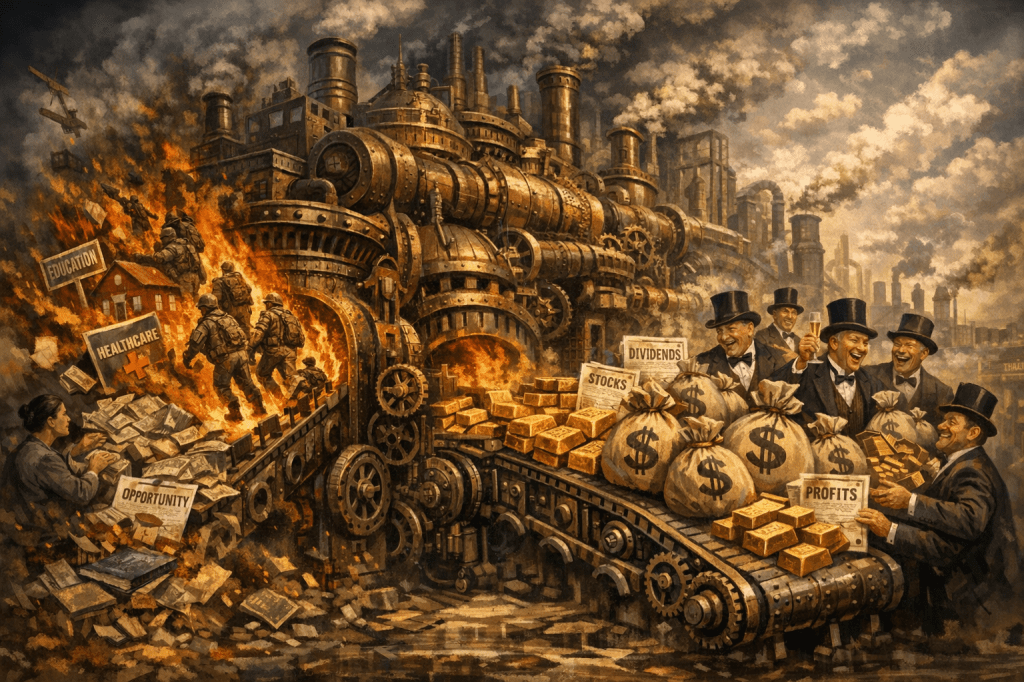
A neoliberal oligarchy, for instance, must advance a curriculum emphasizing practical skills, efficiency, and accountability in a two-tiered system designed for the owners and the workers. This neoliberal variation of authoritarianism has been the modal form in the United States for almost two generations. Consequently, we have a population of workers who believe that if they just work hard enough, if they do what they are told, they can be successful. They actively vote against their interests for fear that doing otherwise might cost them jobs and opportunities. They are willing to eat, drink and breathe poison for the sake of someday, with just the right amount of hard work, becoming one of the owners and getting theirs. Meanwhile, the actual owners have profited like never before from this hard-working population.
Now the neoliberals are against the wall as two important movements emerged from the Great Recession. Both blocs recognize that the game is rigged, that they have been robbed by the owners all along. The first bloc understands that the thieves are motivated and legitimized by unbounded capitalism. Their vision of the future is one of greater equity, openness, and creativity. The second bloc blames their plight on “those people”. Its vision is one of exclusive dominance. To the embattled neoliberals, the first bloc constitutes the greatest threat to capitalism and the status quo. They may not like the second bloc, but they are willing to accommodate the authoritarians in exchange for preserving their precious property rights.
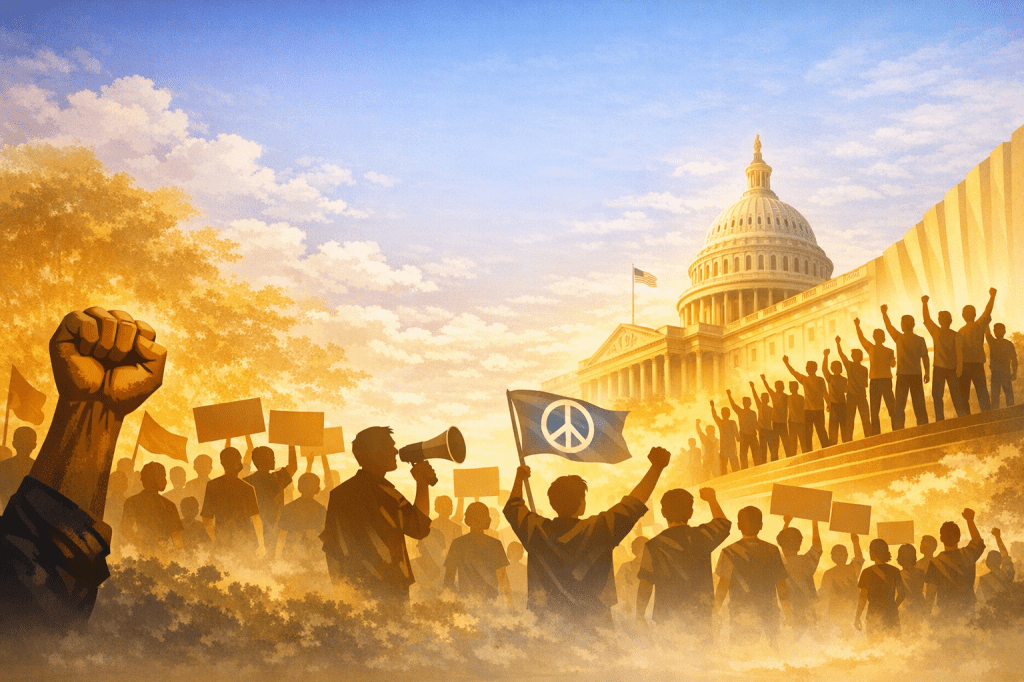
This is the American political-economic landscape. On one hand, there is a double bloc of regressives intent on asserting control and autocracy. The first intends to re-establish market orthodoxy. The second aims to secure the future of the pure race at the expense of those people. The third bloc, the progressives, seek a diverse, multicultural, egalitarian world where everyone regardless of personal identity can achieve their full human potential. As always, this contest will continue to be played out in public schools.
Teachers are caught in the crossfire. All three blocs must aim, in some way, to incorporate the teachers. Small “d” democrats must convince teachers that the current status quo is inadequate. They must restore the principles of the Paideia Proposal emphasizing human potential and democratic citizenship. The authoritarians, whether they are neoliberal or neo-fascist, must secure control over teachers and classrooms, and thus control the human capital that schools produce. The average teacher, largely apolitical, who wants only to teach and inspire her students, must navigate this hostile terrain. She must also gird herself against declining standards of living, loss of benefits, incessant disrespect and failing status.
Sources
United States. National Commission on Excellence in Education. (1983). A nation at risk : the imperative for educational reform : a report to the Nation and the Secretary of Education, United States Department of Education. Washington, D.C. :National Commission on Excellence in Education : [Superintendent of Documents, U.S. Government Printing Office distributor],
Adler, M. J. 1 (1982). The Paideia Proposal: an educational manifesto. 1st Macmillan paperbacks ed. New York, Macmillan Publishing Company
Arendt, H. (2006). Eichmann in Jerusalem. P Reform’enguin Classics.
Bacon, Jr., J. (May 8, 2023). ‘Education is Dying. Now we can actuality reform education. Washington Post. https://www.washingtonpost.com/opinions/2023/05/08/how-to-reform-education
Cineas, F. (April 20, 2023). Ron DeSantis war on ‘woke’ in Florida schools, explained. Vox.com. https://www.vox.com/policy-and-politics/23593369/ron-desantis-florida-schools-higher-education-woke
Dewey, J. (2011). Democracy and education: An introduction to the philosophy of education. Simon & Brown.
Hess, R. (April 24, 2023). ‘A Nation at Risk’ Turns 40: Its Roots, Its Legacy. Education Week. https://www.edweek.org/policy-politics/opinion-a-nation-at-risk-turns-40-its-roots-its-legacy/2023/04
Hofstadter, R. (from November 1964). The Paranoid Style in American Politics. Harper’s Magazine. https://harpers.org/archive/1964/11/the-paranoid-style-in-american-politics/
Horn, D. (1976). The Hitler Youth and Educational Decline in the Third Reich. History of Education Quarterly, 16 (4), 425–447. https://doi.org/10.2307/367724”
Kamenetz, A. (April 29, 2018). What ‘A Nation at Risk’ Got Wrong, And Right, About U.S. Schools. NPR. https://www.npr.org/sections/ed/2018/04/29/604986823/what-a-nation-at-risk-got-wrong-and-right-about-u-s-schools
McLean, Eden. (April 7, 2023). Fascism’s History Offers Lessons About Today’s Attacks on Education. Scientific American. https://www.scientificamerican.com/article/fascisms-history-offers-lessons-about-todays-attacks-on-education/
Merisotis, J. (March 2, 2021). The best defense against authoritarianism? More educated citizens. Big Think. https://bigthink.com/the-present/anti-authoritarian-education/
Tharoor, I. (November 8, 2022). U.S. Democracy slides toward ‘competitive authoritarianism’. Washington Post. https://www.washingtonpost.com/world/2022/11/08/american-democracy-backsliding-competitive-authoritarianism/


 The Mad Sociologist Blog
Leave a comment